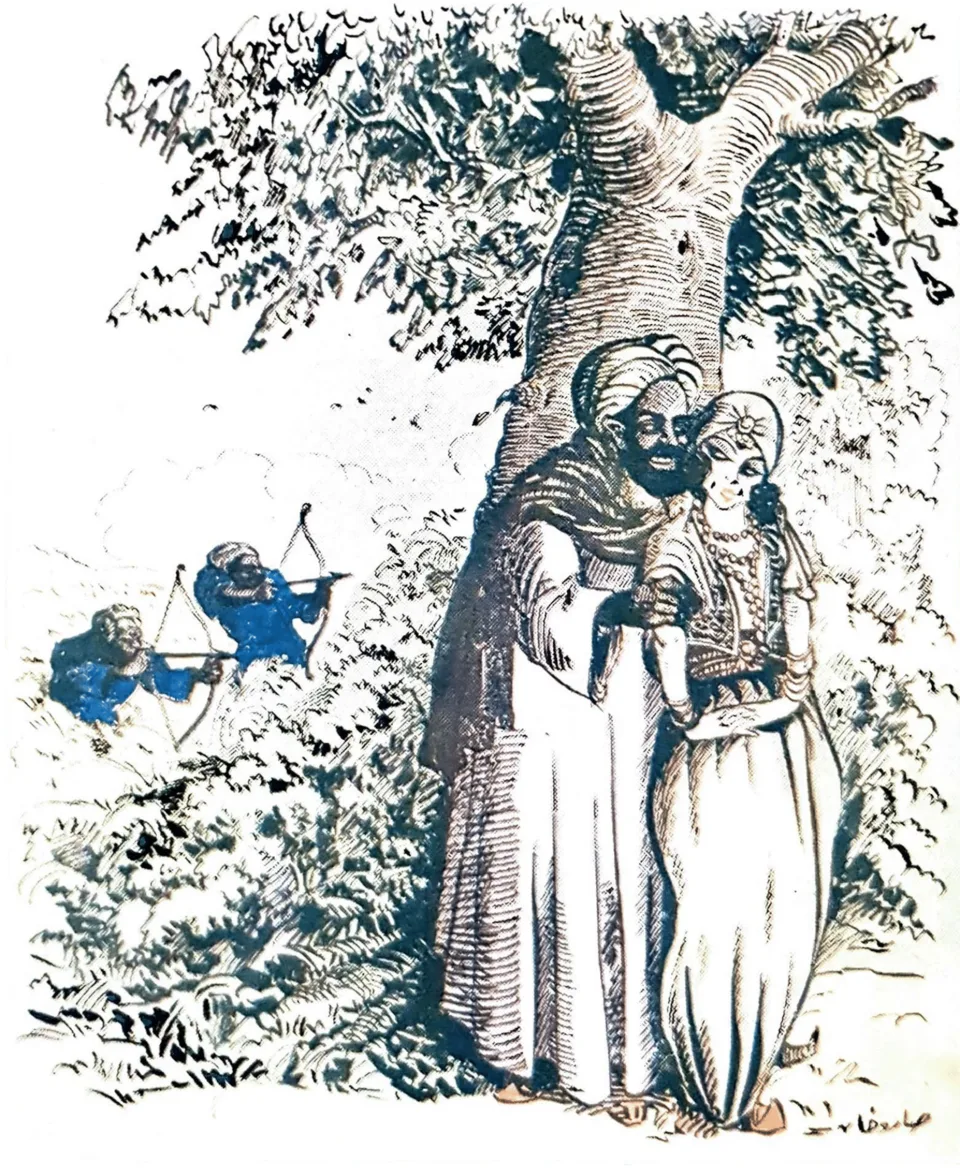
'Antara ibn Shaddad
Arabian poet-warrior; composer of one of the seven canonical Mu'allaqāt; foundational figure of the manumitted-slave-warrior biographical archetype that subsequently became central to Arabic-Islamic literary tradition. Born c. 525 CE in the Najd region; son of Shaddād ibn Mu'awiyah (a chief of the Banu 'Abs tribe) and Zabība (an Ethiopian slave-woman captured in raid). Per Arabian custom, the child of a slave-mother inherited the slave-status of the mother — 'Antara was therefore born into slavery, despite his free-Arabian-noble paternity. Manumitted by his father Shaddād during a raid in which his exceptional warrior-prowess was demonstrated; subsequently recognized as a Banu 'Abs warrior. In love with his cousin 'Abla bint Mālik, whose father Mālik repeatedly refused to grant her hand in marriage on grounds of 'Antara's slave-mother origin — the love-of-'Abla narrative is the central romantic-topos of the subsequent Sirat 'Antara cycle (the medieval Arabic biographical-romance compilation, Mamluk-era recension). Composed the canonical 'Antara Mu'allaqa, becoming one of the seven canonical Mu'allaqāt poets. Distinguished himself in the canonical Dahis and Ghabra war (a forty-year inter-tribal war between the Banu 'Abs and Banu Dhubyan c. 568-608 CE). The 'Antara figure became one of the most-extensively-elaborated Arabian biographical-historical narratives, with the manumitted-slave-warrior + poet + frustrated-lover + war-hero arc serving as foundational template for the broader Arabic-romance-and-hero literary tradition; the Sirat 'Antara is one of the longest medieval Arabic prose narratives and was one of the most-popularly-circulated works in the Mamluk and Ottoman periods.
Parentage
- parent: Shaddad ibn Mu'awiya
- parent: Zabiba
Domains
- heroic warfare
- poetry
- chivalry and courtly love
Powers
- Peerless prowess in single combat and the charge
- Mastery of heroic and amatory verse
Epithets
- عنترة الفوارس 'Antara of the HorsemenSirat 'Antar (secondary)
- أبو الفوارس Father of the KnightsSirat 'Antar (secondary)
Relations
- lover: 'Abla bint MalikHis cousin and beloved, addressee of his Muallaqa ode.
Sources
- existence: Mu'allaqāt corpus — 'Antara Mu'allaqa (primary); Sirat 'Antara ibn Shaddad (the medieval Arabic biographical-romance compilation; Mamluk-era recension) (primary); al-Isfahani, Kitab al-Aghani (primary)