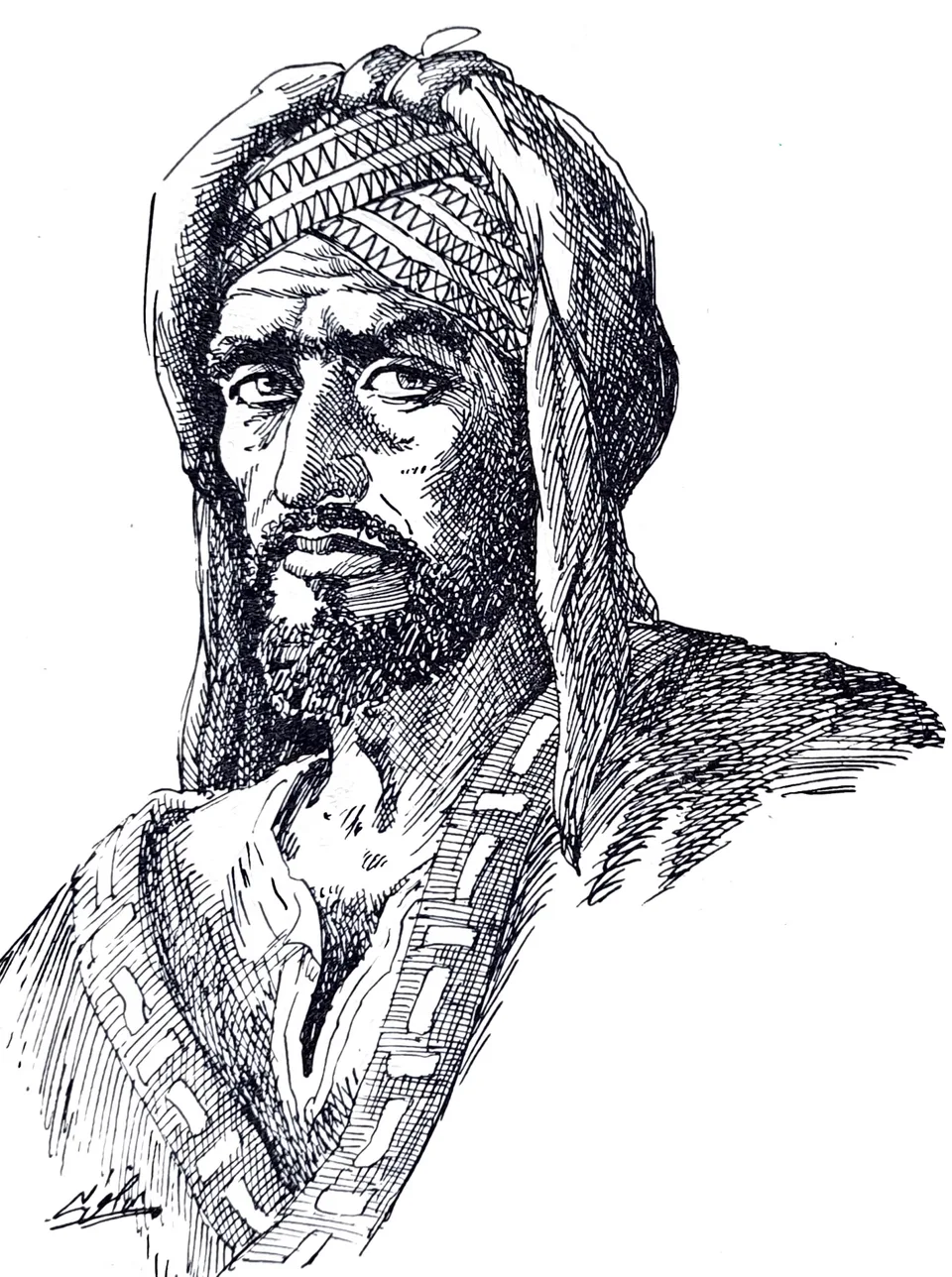
Imru' al-Qais
Foundational Arabian poet; composer of the canonical Imru' al-Qais Mu'allaqa (the longest and most-celebrated of the seven Mu'allaqāt); last Kindite prince. Born c. 501 CE in the Najd region; son of Ḥujr ibn al-Ḥārith, the last king of the Kindite kingdom (a 5th-6th c. CE Central Arabian polity briefly unifying several Arabian tribes under Lakhmid-Sasanian Persian patronage). Banished by his father from the Kindite court for his dissolute lifestyle of poetry, wine, and pursuit of women — the foundational youthful-disgrace-of-the-poet topos. Composed the foundational Mu'allaqa beginning with "Qifa nabki min dhikra ḥabībin wa-manzili" ("Stop, both of you, let us weep at the memory of a beloved and a former dwelling-place") — the foundational nasīb (amorous-elegiac prelude) that established the Mu'allaqāt-genre opening convention. When his father Ḥujr was killed by the Banu Asad tribe revolting against Kindite rule, Imru' al-Qais embarked on the canonical-Arabian vengeance-quest, eventually traveling to Constantinople to seek the support of the Byzantine emperor Justinian I against the Lakhmid-Persian-supported Banu Asad. Was received favorably and granted military support, but on the return journey was given (per legend) a poisoned shirt by Justinian as punishment for an alleged liaison with a Byzantine princess; died c. 540 CE at Ankara of the alleged-poisoned-shirt or natural causes (the poisoned-shirt being a later legendary embellishment). The Imru' al-Qais figure is one of the most-extensively-developed Arabian historical-legendary biographies, with the Kindite-prince + dissolute-poet + vengeance-quester + Byzantine-embassy + poisoned-shirt narrative arc serving as the foundational template for subsequent Arabic-Islamic biographical-historical writing.
Parentage
- parent: Hujr ibn al-Harith
Domains
- poetry
- kingship
Powers
- Master the qasida and the imagery of the desert ode
Epithets
- الملك الضليل the Errant/Vagabond King (he who never regained his throne)Kitab al-Aghani; Encyclopaedia of Islam, s.v. Imru' al-Kays (secondary)
- ذو القروح the Man of Ulcers (the sores said to have killed him)Kitab al-Aghani; Encyclopaedia of Islam, s.v. Imru' al-Kays (secondary)
Sources
- existence: Mu'allaqāt corpus — Imru' al-Qais Mu'allaqa, the canonically-longest and most-celebrated of the seven (or ten) Mu'allaqāt (primary); al-Tabari, Tarikh al-Rusul wa-al-Muluk (primary); Ibn Qutaybah, al-Shi'r wa-al-Shu'ara' (Book of Poetry and Poets, 9th c.) (primary); al-Isfahani, Kitab al-Aghani (Book of Songs, 10th c.) (primary)