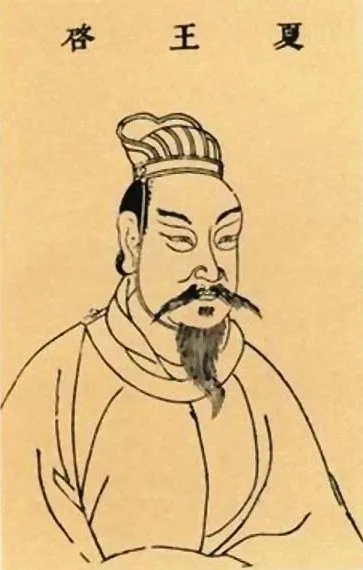
Qi of Xia
Second king of the Xia dynasty; son of Yu the Great; the first hereditary-dynastic successor in the Chinese canonical-historical framework. The Yu-to-Qi transmission broke the Yao-Shun-Yu meritocratic-abdication chain by transmitting the throne from father to son rather than to a meritorious minister, establishing the hereditary-dynastic principle that subsequent Chinese imperial-state structure followed. Per Shiji, the accession was contested by Bo Yi (Yu's designated successor, a meritorious minister); Qi defeated Bo Yi in the resulting succession-conflict and consolidated hereditary-dynastic authority. Subsequently defeated the Hu (有扈) clan that contested his rule at the Battle of Gan; the resulting Gan Shi ("Speech at Gan") preserved in the Shujing constitutes one of the earliest extant Chinese political-rhetorical texts. The Erlitou archaeological site (mid-2nd millennium BCE) is interpreted by some scholars as the early Xia capital and provides material-archaeological grounding for the Shiji-attested Xia dynasty, though the precise correspondence between Erlitou and the textual Xia remains debated. Conventionally dated to the early 21st c. BCE.
Parentage
- paternal: Yu the Great
Powers
- Ascend to heaven riding two dragons
Sources
- existence: Sima Qian, Shiji Ch. 2 Xia Benji (primary); Shujing — Gan Shi "Speech at Gan" (primary); Bamboo Annals (Zhushu Jinian) (primary); Mencius / Mengzi 5A.6 (primary)