Fimmilena
Continental Germanic · deity · Continental Germanic religion under Rome (1st c. BCE – 3rd c. CE) · Recorded classification
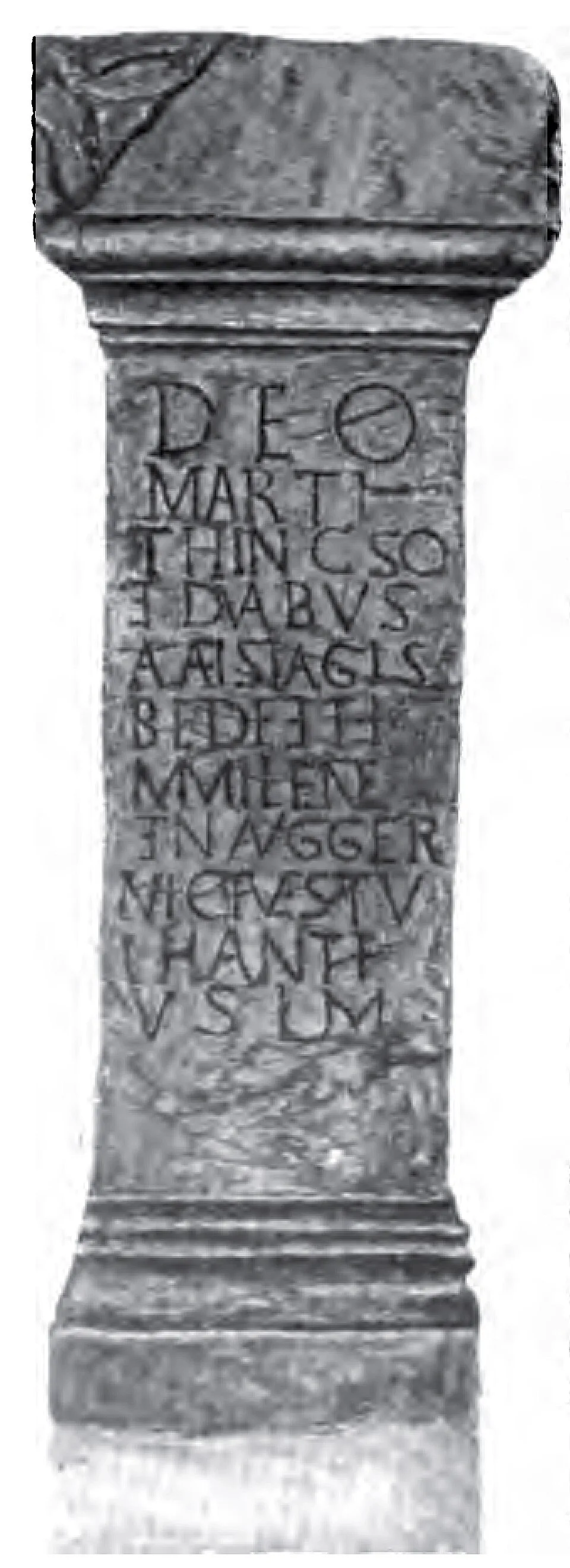
Fimmilena is one of the Alaisiagae, named on the Housesteads altar RIB 1593 alongside Beda, Mars Thincsus and the imperial numen. Her name is most often connected with the Old Frisian legal institution fimelthing, a kind of court session, which has encouraged the interpretation of the Alaisiagae as goddesses presiding over law and the assembly as well as over victory in battle, fitting their pairing with Mars Thincsus, 'Mars of the Thing'. Like the other names in the group she is preserved only in Latin epigraphy on Hadrian's Wall, carried there by Germanic troops drawn from the Twenthe district of the lower Rhine.
Domains
- victory and war
- law and the assembly
Powers
- to grant victory to those who go to war
Epithets
- AlaisiagaR. G. Collingwood and R. P. Wright, The Roman Inscriptions of Britain, vol. I: Inscriptions on Stone (Oxford: Clarendon Press, 1965), no. 1593. (primary)
Relations
- companion: BedaFimmilena and Beda are named together as the two Alaisiagae on the same Housesteads altar (RIB 1593), forming a fixed divine pair.R. G. Collingwood and R. P. Wright, The Roman Inscriptions of Britain, vol. I: Inscriptions on Stone (Oxford: Clarendon Press, 1965), no. 1593. (primary)
Sources
- Fimmilena is one of the two Alaisiagae, a Continental Germanic victory-goddess paired with Beda and honoured with Mars Thincsus at Housesteads, her name often linked to a Frisian legal assembly.: R. G. Collingwood and R. P. Wright, The Roman Inscriptions of Britain, vol. I: Inscriptions on Stone (Oxford: Clarendon Press, 1965), no. 1593. (primary); Rudolf Simek, Dictionary of Northern Mythology, trans. Angela Hall (Cambridge: D. S. Brewer, 1993), s.v. 'Alaisiagae', p. 7. (secondary); Philip A. Shaw, Pagan Goddesses in the Early Germanic World: Eostre, Hreda and the Cult of Matrons (London: Bristol Classical Press, 2011), pp. 70–96. (secondary)