Nehalennia
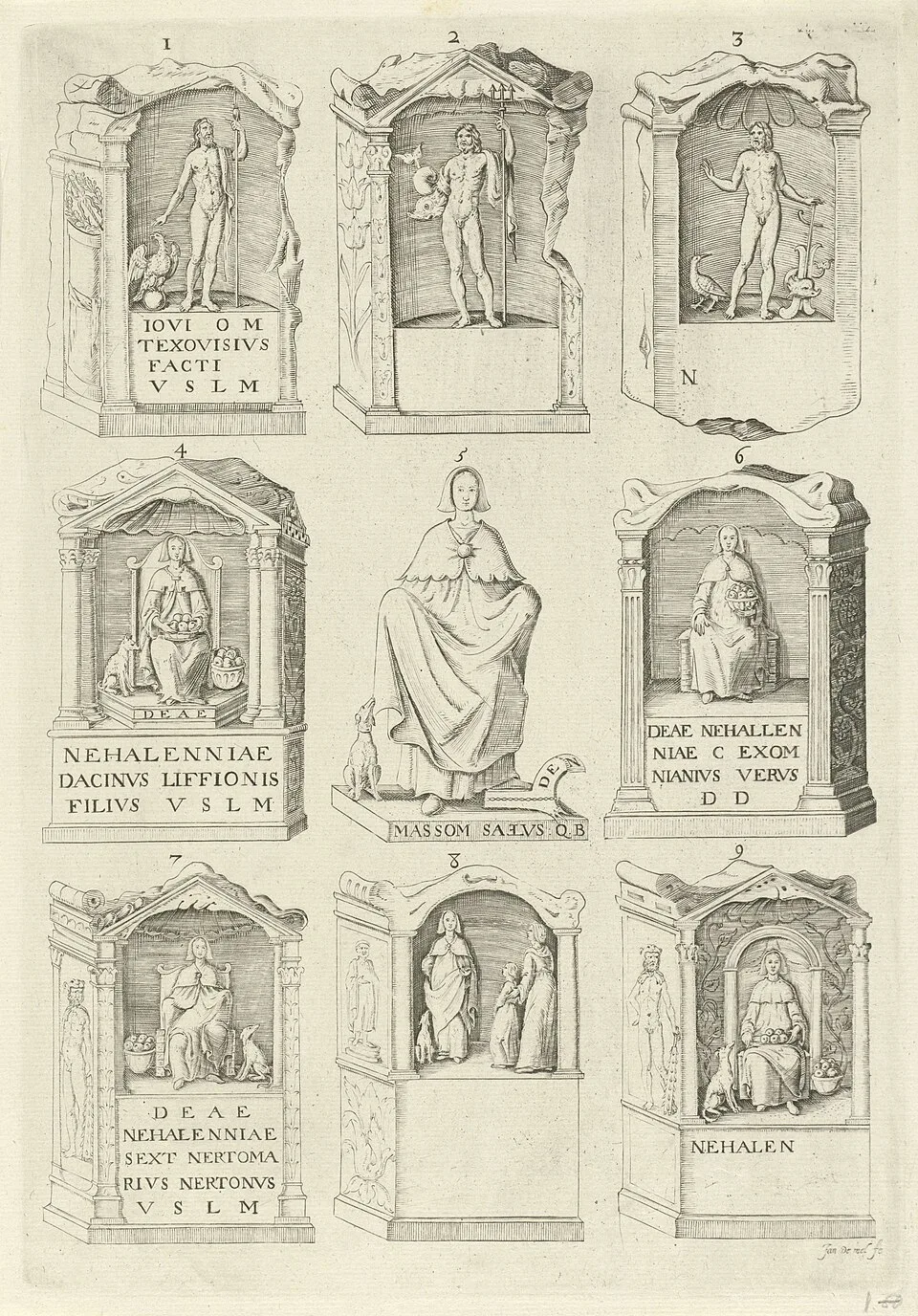
Nehalennia is the best-archaeologically-attested deity of the Roman-period Rhine-mouth Germanic world, known not from literature but from roughly 160 inscribed votive altars and statues recovered chiefly at two sanctuaries on the Scheldt estuary in Zeeland: Domburg on Walcheren (dunes opened by a storm in 1645) and Colijnsplaat near the river mouth (recovered from the Oosterschelde from 1970 onward). The altars date to the 2nd and early 3rd centuries CE and were dedicated overwhelmingly by merchants and shippers giving thanks for safe sea-crossings and preserved cargoes, many trading toward Britain. Her standard iconography shows her enthroned with a large dog at her side, a ship or ship's prow, and a basket of apples or loaves. The cult lay on the Germanic–Celtic language frontier, and the etymology of her name and her precise ethnic affiliation remain debated, but the dedicants and naming-formulae place her squarely within the Romano-Germanic religious world of the Rhine delta.
Domains
- seafaring and safe passage
- trade and commerce
- abundance and protection
Powers
- to bring ships and their cargoes safely across the North Sea
Epithets
- dea NehalenniaP. Stuart and J. E. Bogaers, Nehalennia: Römische Steindenkmäler aus der Oosterschelde bei Colijnsplaat, 2 vols. (Leiden: Rijksmuseum van Oudheden, 2001). (secondary)
Sources
- Nehalennia is a coastal goddess of the lower Scheldt, patroness of North-Sea seafarers and traders, known from about 160 votive altars of the 2nd–3rd centuries CE that depict her with a dog, a ship and a basket of fruit.: P. Stuart and J. E. Bogaers, Nehalennia: Römische Steindenkmäler aus der Oosterschelde bei Colijnsplaat, 2 vols. (Leiden: Rijksmuseum van Oudheden, 2001). (secondary); Rudolf Simek, Dictionary of Northern Mythology, trans. Angela Hall (Cambridge: D. S. Brewer, 1993), s.v. 'Nehalennia', pp. 228–229. (secondary); J. E. Bogaers and M. Gysseling, 'Over de naam van de godin Nehalennia', Naamkunde 3 (1971), pp. 227–238. (secondary)