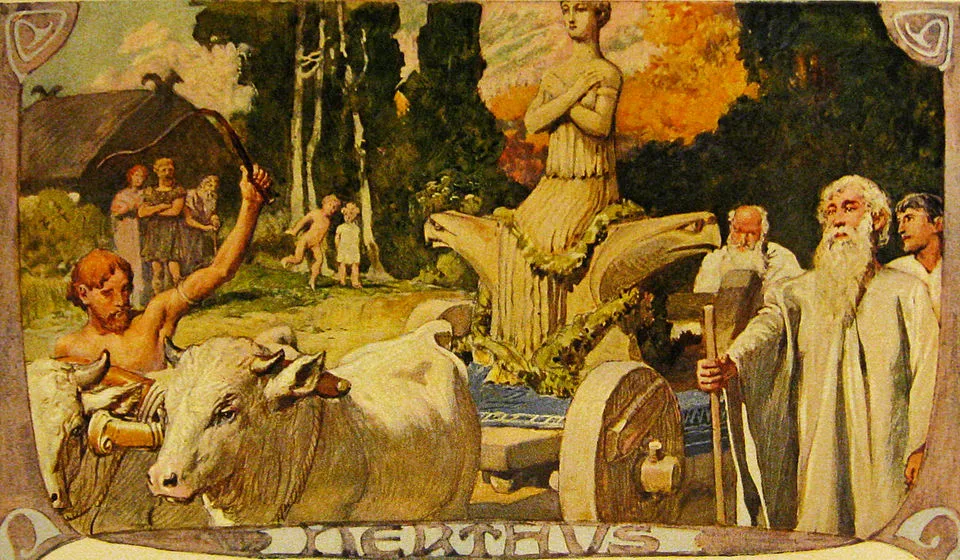
Nerthus
Nerthus is the best-described deity of early Continental Germanic religion, known from chapter 40 of Tacitus's Germania (c. 98 CE). A group of seven tribes worshipped her in common in a grove on an island of the Ocean, generally located in the Jutland–Schleswig region. Her cult image stood in a covered wagon that no one but her priest could touch; when the priest sensed her presence, cattle drew the wagon among the peoples, and wherever it went there was festival and a sacred truce in which iron was put away and no war waged. Afterward the wagon, its cloth and the goddess were washed in a secret lake, and the slaves who performed the washing were drowned. Her name (*Nerþuz) is the formal etymological ancestor of the Old Norse god Njǫrðr, a gender shift that has generated extensive scholarly discussion about the relationship between the Continental goddess and the later Scandinavian deity.
Domains
- earth and fertility
- sacred peace and festival
Powers
- to bring a sacred peace in which all iron is locked away and no war is waged
- to make the land fruitful and intervene in the affairs of mortals
Epithets
- Terra MaterTacitus, Germania 40, ed. and trans. M. Hutton & E. H. Warmington, Loeb Classical Library 35 (Cambridge, MA: Harvard University Press, 1970). (primary)
Sources
- Nerthus is a Germanic earth-mother goddess described by Tacitus, worshipped by a confederation of northern tribes through a covered-wagon procession and ritual washing in a sacred lake.: Tacitus, Germania 40, ed. and trans. M. Hutton & E. H. Warmington, Loeb Classical Library 35 (Cambridge, MA: Harvard University Press, 1970). (primary); Rudolf Simek, Dictionary of Northern Mythology, trans. Angela Hall (Cambridge: D. S. Brewer, 1993), s.v. 'Nerthus', pp. 230–231. (secondary); Jan de Vries, Altgermanische Religionsgeschichte, 2nd ed., 2 vols. (Berlin: Walter de Gruyter, 1956–1957), vol. 2, §§ 308–312. (secondary)