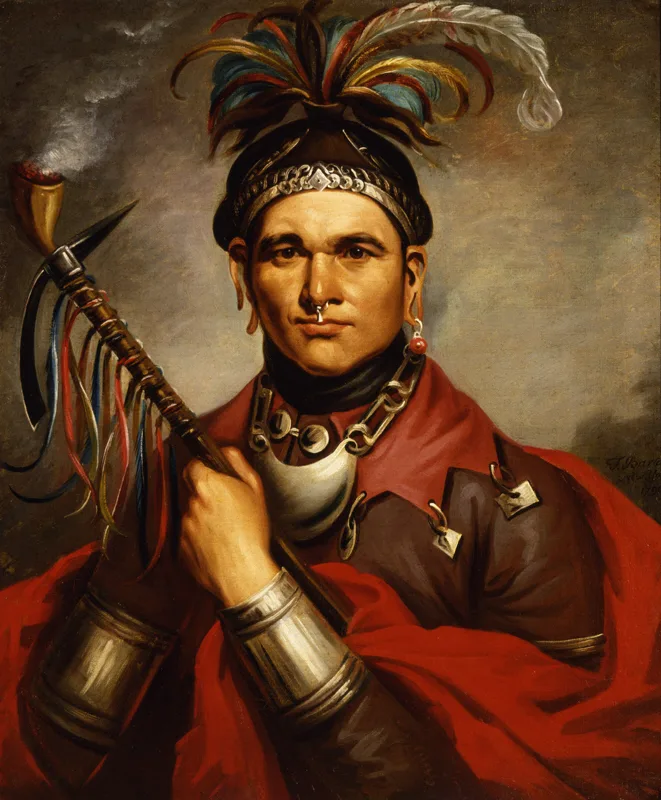
Cornplanter
Seneca war chief of the American Revolutionary War period; subsequent post-war diplomatic-political leader; half-brother of Sganyodaiyo (Handsome Lake), the prophet of the foundational Iroquois religious revival movement. Born c. 1750 CE at Conewaugus on the Genesee River (modern western New York); son of Aliquipiso (Seneca mother of the Wolf Clan) and John Abeel (a Dutch trader from Albany). The Dutch-Seneca dual-heritage was reflected in his English name (John O'Bail / John Abeel, the anglicized form of his father's name). Per Seneca matrilineal kinship, his Wolf Clan affiliation through his mother determined his political-cultural identity. Served as Seneca war chief during the American Revolutionary War, initially supporting British loyalist forces; after the British defeat transitioned to diplomatic-political leadership, signing the Treaty of Fort Stanwix (1784), Fort Harmar (1789), and the Pickering Treaty / Treaty of Canandaigua (1794). Met with Presidents George Washington (1790) and Thomas Jefferson. Secured the Cornplanter Tract — a 600-acre Pennsylvania land-grant given to him and his heirs in perpetuity in 1796 in recognition of his diplomatic services. His half-brother Sganyodaiyo (Handsome Lake) experienced visionary-religious revelations beginning in 1799 that produced the foundational Handsome Lake revival movement (Gaihwi:io / "the Good Word") — the Iroquois religious-cultural revitalization movement that continues as the primary religious framework for traditional-Iroquois communities to the present day (the "Longhouse religion"). Died February 18, 1836 at the Cornplanter Tract; buried at the Cornplanter Cemetery on the tract. The tract and cemetery were submerged in 1965 by the Allegheny Reservoir (Kinzua Dam project) — a foundational late-20th-c. Iroquois grievance-and-cultural-heritage event, with the cemetery relocated to higher ground but the broader tract permanently flooded.
Parentage
- parent: Aliquipiso
Epithets
- Gaiänt'wakê Cornplanter / 'By What One Plants' (Seneca name)Wikipedia, 'Cornplanter' (secondary)
Relations
- half sibling: Handsome Lake
Sources
- existence: A. F. C. Wallace, The Death and Rebirth of the Seneca (1969) (primary); Cornplanter's dictated memoirs to the Pennsylvania state government, 1822 (primary); U.S.-Iroquois treaty records 1784-1797 (primary); F. Bartoli oil portrait, 1796, New-York Historical Society (archaeological)