Iethinihstén:ha
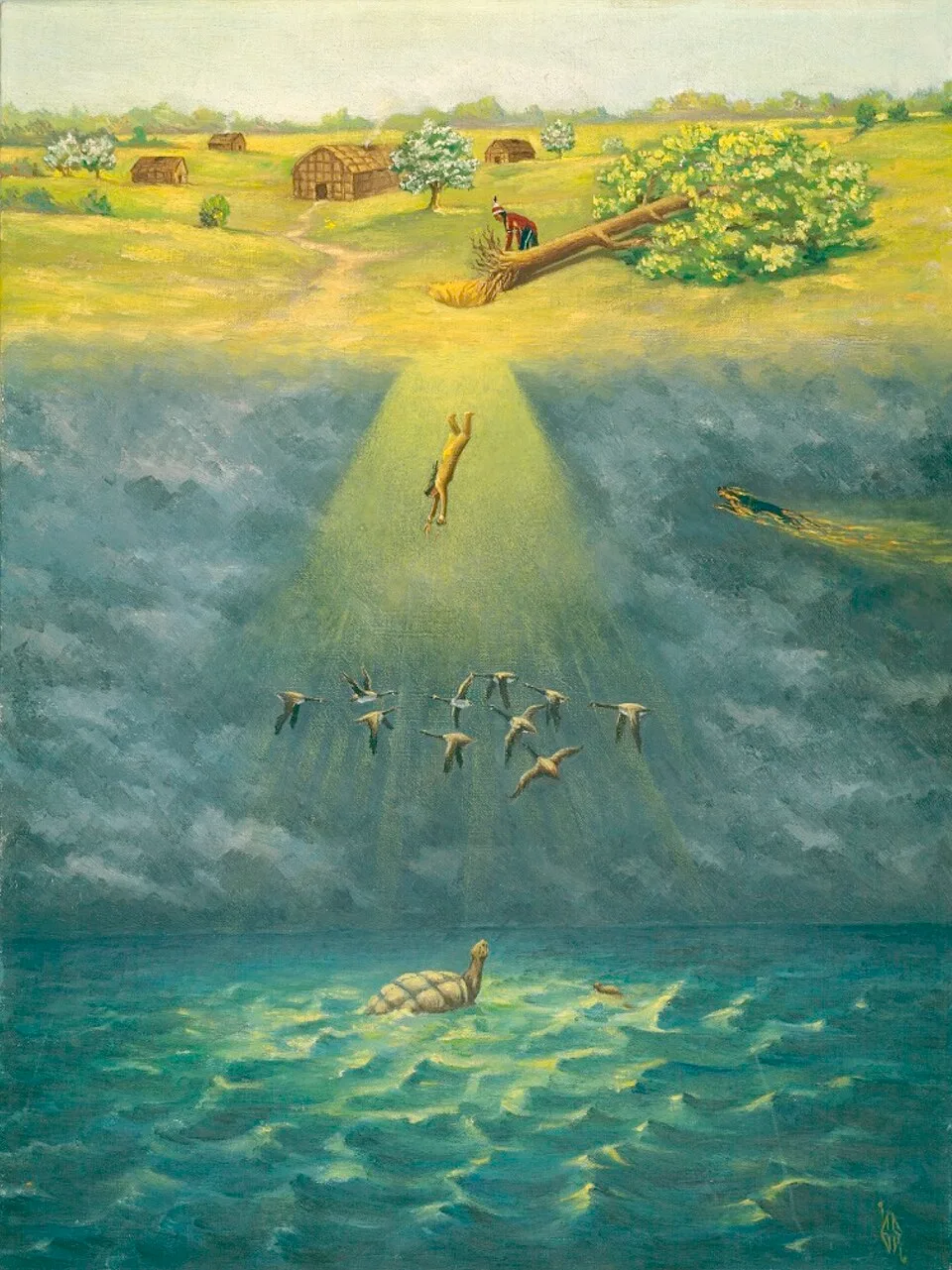
Foundational creator-figure of the Haudenosaunee (Iroquois) cosmogony; the primordial mother who fell from the Sky Country through a hole in the firmament — in some recensions deliberately pushed by her husband for stepping over taboo-restrictions, in others falling through accident in the digging-around the Great Tree. In her descent, was caught by water-birds (swans or geese in most recensions) who supported her on their wings and laid her on the back of the Great Turtle, who then accumulated mud brought up from the ocean-floor by the muskrat (after multiple animals attempted and failed) to form the foundational earth-on-Turtle's-back. The Iroquois cosmological designation "Turtle Island" for North America preserves this foundational cosmogonic event in continuous community-cultural usage. On the newly-formed earth, gave birth to a daughter (variously named Tekawerahkwa, "Lynx") who subsequently became the mother of the foundational twin-brothers Tawiskaron (Flint) and Sapling — the second-generation creator-figures of the Iroquois cosmogony. The Three Sisters (corn, bean, squash) agricultural-cultural complex is traced to Sky Woman in some recensions and remains the foundational Haudenosaunee agricultural tradition. The Thanksgiving Address (Ohén:ton Karihwatékwen) — the foundational Haudenosaunee ceremonial speech opening and closing all formal gatherings — explicitly thanks Sky Woman alongside the other foundational Iroquois cosmological-figures.
Children
Powers
- Found the earth on Turtle's back
- Sow the first seeds on earth
Epithets
- the Woman who fell from the Sky The primal mother who fell from the Sky World; earth grew on the Great Turtle’s back to receive herJ. N. B. Hewitt, Iroquoian Cosmology (secondary)
- Atsi'tsiaka:ion Mature (Fallen) FlowersJ. N. B. Hewitt, Iroquoian Cosmology, First Part (BAE 21st Annual Report, 1903) (secondary)
- Awenhai Mature FlowerHewitt, Iroquoian Cosmology (1903) (secondary)
- Ataensic Ancient Body / Ancient WomanHewitt, Iroquoian Cosmology (1903) (secondary)
Sources
- existence: J. N. B. Hewitt, Iroquoian Cosmology Part I (BAE 21st Annual Report, 1903) and Part II (BAE 43rd Annual Report, 1928) (primary); E. A. Smith, Myths of the Iroquois (BAE 2nd Annual Report, 1883) (primary); Arthur C. Parker, The Constitution of the Five Nations (1916) (primary); Onondaga Nation Council of Chiefs publications; Haudenosaunee Confederacy Council communications (primary); Barbara Mann, Iroquoian Women: The Gantowisas (2000) (secondary)