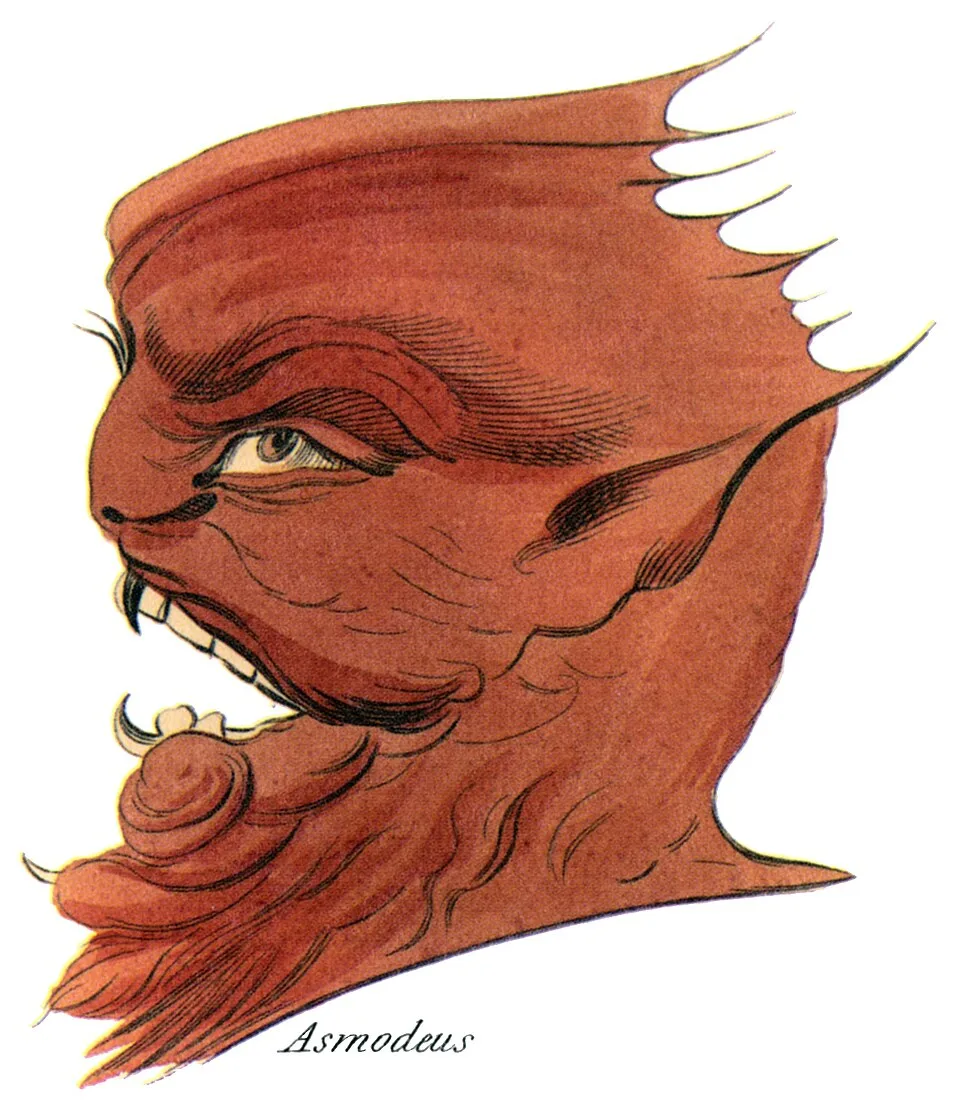
Ashmedai
Jewish mythology (rabbinic–kabbalistic) · numen · Jewish mythology (rabbinic–kabbalistic) traditional religion; continuing · Recorded classification
Ashmedai, known in Greek and Latin sources as Asmodeus, is the king of the demons in Jewish myth, his name traced to the Avestan aēšma-daēva, the demon of wrath. In the Book of Tobit he slays the seven bridegrooms of Sarah before being driven off; in the Babylonian Talmud he is a more ambiguous figure, wise and study-loving, who ascends daily to the heavenly academy. The best-known legend has Solomon's captain Benaiah subdue him with a chain graven with the divine Name and wine, to compel from him the shamir that shapes the Temple stones without iron; freed of his fetters, Ashmedai flings the king to the ends of the earth and reigns in his stead until Solomon regains his throne. Aggadic tradition names the demoness Naamah as his mother.
Parentage
- parent: NaamahNaamah the demoness is named as his mother.Louis Ginzberg, Legends of the Jews, vol. 4 (1913), p. 166 (secondary)
Domains
- demons
Powers
- reigns as king of the demons
- commands the stone-cutting shamir
Epithets
- מַלְכָּא דְשֵׁדֵי — king of the demonsBabylonian Talmud, Pesachim 110a (primary)
Relations
- parent: NaamahNaamah the demoness is named as his mother.Louis Ginzberg, Legends of the Jews, vol. 4 (1913), p. 166 (secondary)
Sources
- Ashmedai is the king of the demons in the Talmud, captured by Benaiah at Solomon's command to yield the shamir for the Temple, who later usurps Solomon's throne; his name and character derive from the Avestan wrath-demon.: Babylonian Talmud, Gittin 68a-69a (primary); Tobit 3:8 (primary); Howard Schwartz, Tree of Souls (Oxford University Press, 2004), pp. 236-239 (secondary)