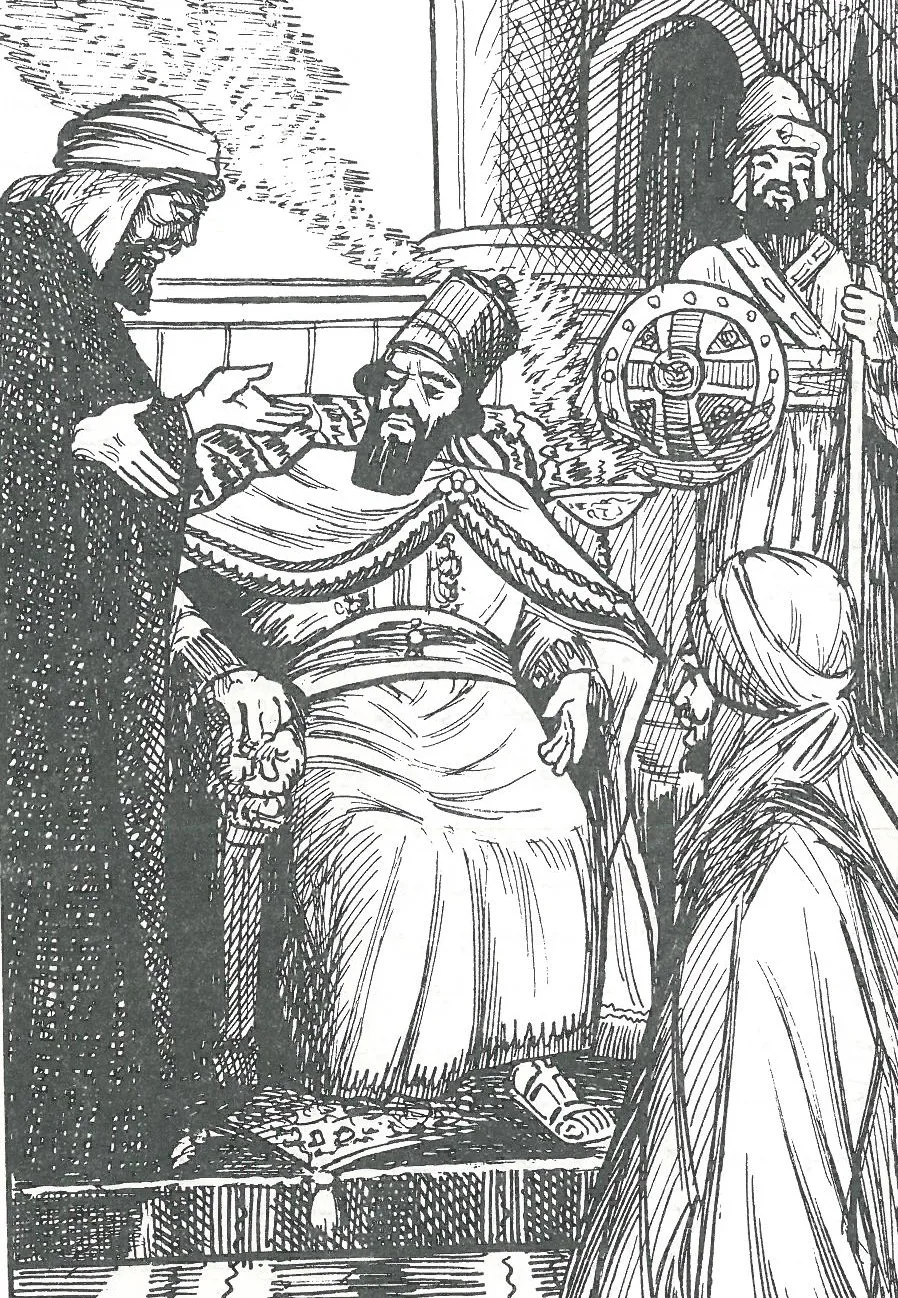
Sef
Sef is the eponymous ancestor of the Sefuwa (Sayfawa), the dynasty that ruled Kanem and then Bornu for roughly eight centuries and whose kings bore the sacral title mai. He opens the Diwan, the dynastic chronicle preserved in written form as the Diwan and recited orally as the girgam. After the court's conversion to Islam, court genealogists equated Sef with Sayf ibn Dhi Yazan, a semi-legendary sixth-century Himyarite prince of southern Arabia and hero of later Arabic romance, thereby grafting the royal line onto a prestigious Near Eastern pedigree. Modern historians, notably Dierk Lange, treat this Yemeni descent as an ideological construction rather than history, while recognising Sef as the genuine apical figure of the dynasty's self-image. Through him the office of divine or semi-divine kingship was held to descend to every mai.
Children
Domains
- sacred kingship
- ancestry
Powers
- embody sacral kingship
- found the Sefuwa dynasty
Epithets
- Sayf ibn Dhi Yazan — Sword, son of Dhu YazanDierk Lange, 'The Kingdoms and Peoples of Chad', in UNESCO General History of Africa, vol. IV (1984) (secondary)
Relations
- child: IbrahimIbrahim stands as Sef's son and successor in the Diwan king-list.Le Diwan des sultans du Kanem-Bornu, ed. Lange (1977), succession of Sef, Ibrahim, Duku (primary)
Sources
- Sef heads the Diwan (Girgam) king-list of Kanem-Bornu as founding ancestor of the ruling house.: Le Diwan des sultans du Kanem-Bornu, ed. Dierk Lange (Wiesbaden, 1977) (primary); H. R. Palmer, Sudanese Memoirs (Lagos, 1928), vol. I (secondary)
- The identification of Sef with the Yemenite Himyarite prince Sayf ibn Dhi Yazan is a post-Islamic legitimizing genealogy that scholars regard as fabricated.: Dierk Lange, 'The Kingdoms and Peoples of Chad', in UNESCO General History of Africa, vol. IV (1984) (secondary)