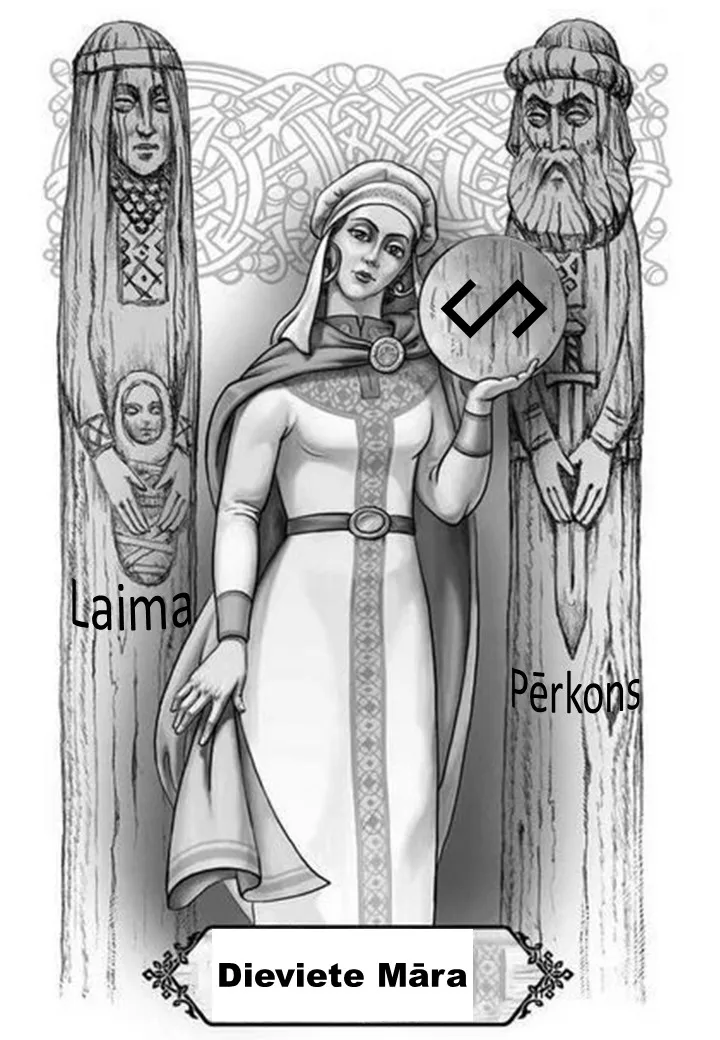
Māra
Māra is the most complex of the Latvian goddesses, the great feminine power set over the earthly and bodily half of existence. In Biezais's influential reconstruction the folk-song cosmos is divided between Dievs, who governs the sky and the soul, and Māra, who rules the material world, the flesh, and the fertile earth. She is above all the protectress of cattle and of the milk-giving cow, and she attends women in labour, receiving the newborn into physical life. Her name and much of her cult were overlaid by that of the Virgin Mary after Christianisation, and her chief feast day, Māras diena, coincides with the Assumption; scholars nonetheless recognise beneath the Marian surface an older native mother-deity of soil, herd and human fertility.
Domains
- material earthly world
- cattle livestock
- childbirth women
Powers
- governs the earthly and bodily world
- protects cattle and grants milk
- attends women in labour
Epithets
- Mīļā Māra — dear MāraBarons & Wissendorff, Latvju dainas. (primary)
- govju Māra — Māra of the cattleŠmits, Latviešu mītoloģija, 1926. (secondary)
Relations
- ally: DievsMāra rules the material world under the higher sky-god.Biezais, Die Hauptgöttinnen der alten Letten, 1955, on the Dievs-Māra-Laima triad. (secondary)
- ally: LaimaBoth attend childbirth and shape the newborn's lot.Biezais, Die Hauptgöttinnen der alten Letten, 1955. (secondary)
Sources
- Māra is the great mother-goddess of the Latvian dainas, mistress of the material world, cattle and childbirth, whose figure fused with the Christian Virgin Mary.: Biezais, Haralds. Die Hauptgöttinnen der alten Letten. Uppsala, 1955, pp. 269-330. (secondary); Gimbutas, Marija. The Balts. London, 1963. (secondary)