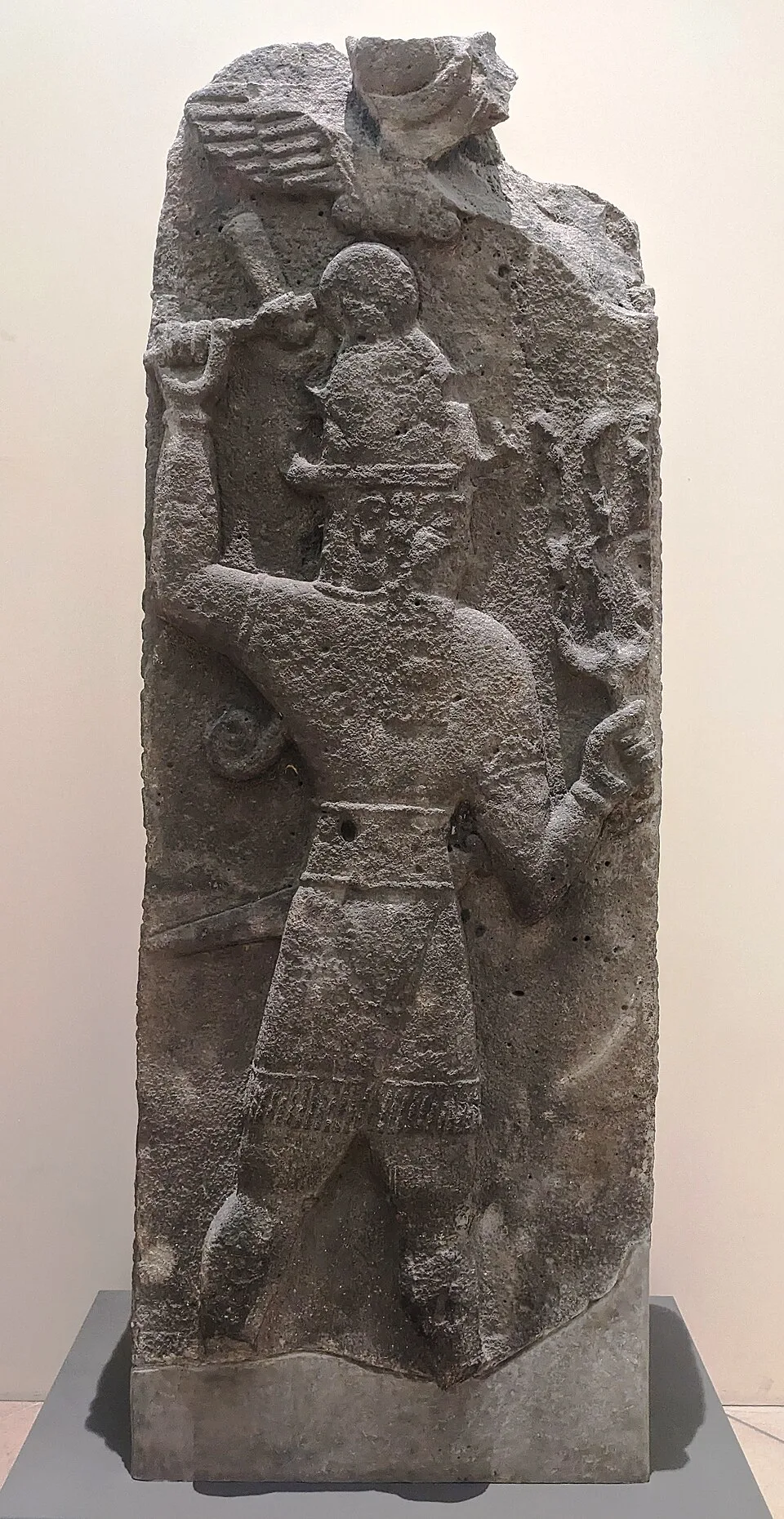
Tarhunz
Luwian · deity · mythic · Recorded classification
Luwian weather-god and head of the pantheon; chariot drawn by horses.
Domains
- storm
- kingship of gods
- agriculture fertility
Powers
- Drive a horse-drawn chariot hurling bundled thunderbolts
- Ripen the vineyards and grain of the land
Epithets
- Tarhunzas of the Vineyard The storm-god who grants the vine and grain; the thundering lord of the Luwian landsIron Age Hieroglyphic Luwian inscriptions (e.g. the İVRİZ relief) (primary)
- Tarhunzas piha??a??i Tarhunz of the ThunderboltWikipedia, 'Tarḫunz' (venerated at Tarhuntassa) (secondary)
- Tarhunzas tuwarsas Tarhunz of the VineyardWikipedia, 'Tarḫunz' (worshipped in Tabal) (secondary)
Relations
- equated with: TeshubIn Hittite-empire cult the Luwian and Hurrian storm-gods were systematically identified behind the dU/dIM logogram. Preserves bull, thunder, kingship of heaven; Teshub adds the Kumarbi succession myth.D. Schwemer, Die Wettergottgestalten Mesopotamiens und Nordsyriens (2001) (secondary)
- interpretatio: BaalshaminThe Karatepe bilingual translates Tarhunzas of Heaven as Baal Shamem — an Iron Age scribal interpretatio in stone. Preserves the heavenly storm-lord; the Phoenician god lacks Tarhunz's grape-and-grain cult.Karatepe bilingual (KAI 26): Luwian 'Tarhunza of Heaven' rendered Phoenician 'Baal Shamem' (primary)
- equated with: TrqqasReciprocal of lycian_trqqas.equated-with — Lycian Trqqas/Trqqnt is the direct linguistic continuation of Luwian Tarhunt- (PIE *terh2- 'overcome'). Same storm-god inherited within Anatolian; the Lycian cult later dissolves into Greek Zeus.H. C. Melchert (ed.), The Luwians (2003); T. R. Bryce, The Lycians (1986) (secondary)
Sources
- existence: Hutter, Aspects of Luwian Religion (in Melchert ed., The Luwians, 2003) (secondary)