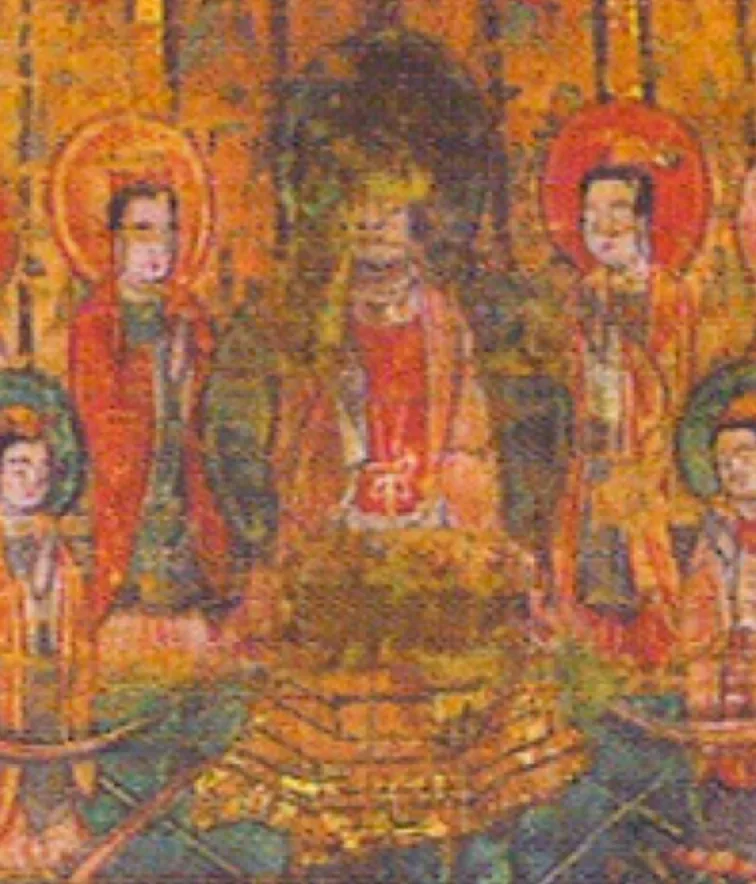
Father of Greatness
The Father of Greatness (Syriac Abā d-Rabbūtā) is the supreme deity of Manichaeism, the wholly good and uncreated God who dwells in eternal repose in the Realm of Light together with his aeons. He is one of the two co-eternal first principles of the dualist system, opposed by the King of Darkness. The Father does not himself descend into the cosmic conflict; instead, when Darkness assaults the borders of Light, he initiates the drama through a graded sequence of evocations, calling forth the Mother of Life, the Living Spirit, and the Third Messenger in three successive 'creations'. In the Iranian-language texts his name is rendered literally as pīd ī wuzurgīh or, adopting Zoroastrian dress, equated with the high god Zurwān; in the Coptic and Greek sources of the Roman west he is the Father of Greatness or Father of Lights.
Children
Domains
- supreme god of light
- realm of light
Powers
- to evoke the divine beings who wage the war of light against darkness
- to reign eternally and unmoved over the Realm of Light
Epithets
- Abā d-RabbūtāPaul Van Lindt, The Names of Manichaean Mythological Figures: A Comparative Study on Terminology in the Coptic Sources (Studies in Oriental Religions 26) (Wiesbaden: Otto Harrassowitz, 1992) (secondary); Werner Sundermann, 'Manicheism ii. The Manichean Pantheon', Encyclopaedia Iranica (online ed., 2009) (secondary)
- ZurwānWerner Sundermann, 'Manicheism ii. The Manichean Pantheon', Encyclopaedia Iranica (online ed., 2009) (secondary)
Sources
- The Father of Greatness is the supreme, uncreated God of the Realm of Light in Manichaeism, from whom all the redeeming divinities are evoked to fight the invasion of Darkness.: Werner Sundermann, 'Manicheism ii. The Manichean Pantheon', Encyclopaedia Iranica (online ed., 2009) (secondary); Iain Gardner and Samuel N. C. Lieu (eds.), Manichaean Texts from the Roman Empire (Cambridge: Cambridge University Press, 2004) (secondary); Paul Van Lindt, The Names of Manichaean Mythological Figures: A Comparative Study on Terminology in the Coptic Sources (Studies in Oriental Religions 26) (Wiesbaden: Otto Harrassowitz, 1992) (secondary)