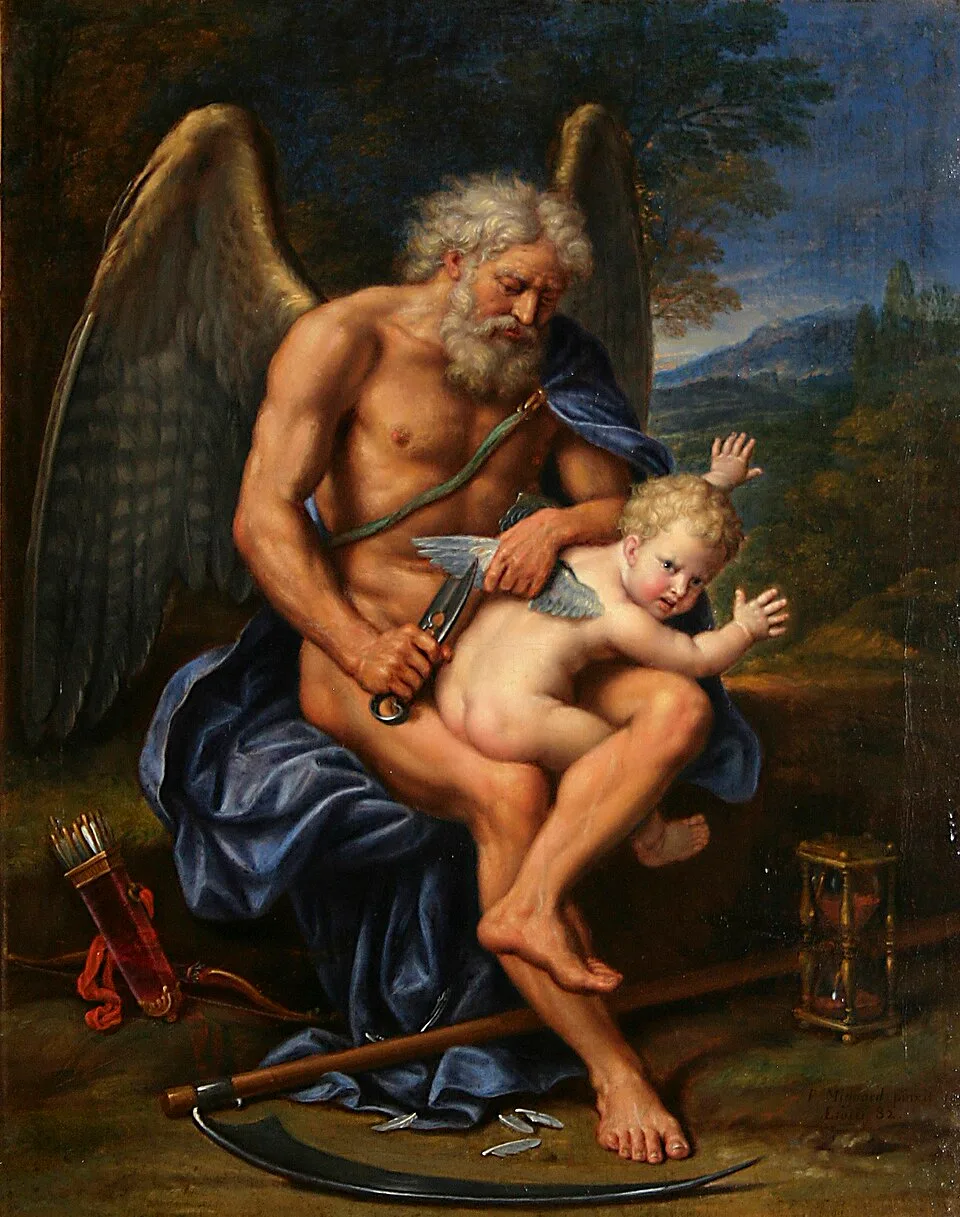
Chronos
Chronos, unaging Time, stands at the head of the Hieronyman and Rhapsodic Orphic theogonies as a self-existent first principle. Damascius describes him as a winged serpent bearing the heads of a bull and a lion with a god's face between, coiled together with Necessity and given the further name Herakles. From him proceed moist Aither, gaping Chaos and misty Erebos, and within these he fashions the silver world-egg from which the firstborn god Phanes bursts. The tradition deliberately exploits the near-homophony of Chronos ('Time') and Kronos the Titan, a wordplay already probed in the fifth-century commentary preserved in the Derveni papyrus. Sources differ on whether Time is truly the absolute beginning or is itself preceded by Water and unformed Matter, as one variant reported by Damascius maintains.
Children
Domains
- time
- cosmogony
Powers
- fashions the primordial world-egg from aither and chaos
Epithets
- ἀγήραος — unagingDamascius, De principiis 123 bis (Orphic fr. 54 Kern) (primary)
- Ἡρακλῆς — Herakles (a name given to the serpent Time in the Hieronyman theogony)Damascius, De principiis 123 bis (Orphic fr. 54 Kern) (primary)
Relations
- spouse: AnankeIn the Rhapsodies unaging Time is coupled with Necessity (Ananke/Adrasteia), the two entwined and spread through the whole cosmos.M. L. West, The Orphic Poems (Oxford, 1983), 194-198 (secondary)
Sources
- Chronos (unaging Time), figured as a winged serpent also called Herakles, is a first principle of the Hieronyman and Rhapsodic theogonies who produces aither, chaos and the cosmic egg.: Damascius, De principiis 123 bis (Orphic frr. 54-58 Kern; Bernabe OF 75-80) (primary); M. L. West, The Orphic Poems (Oxford, 1983), 176-198 (secondary)