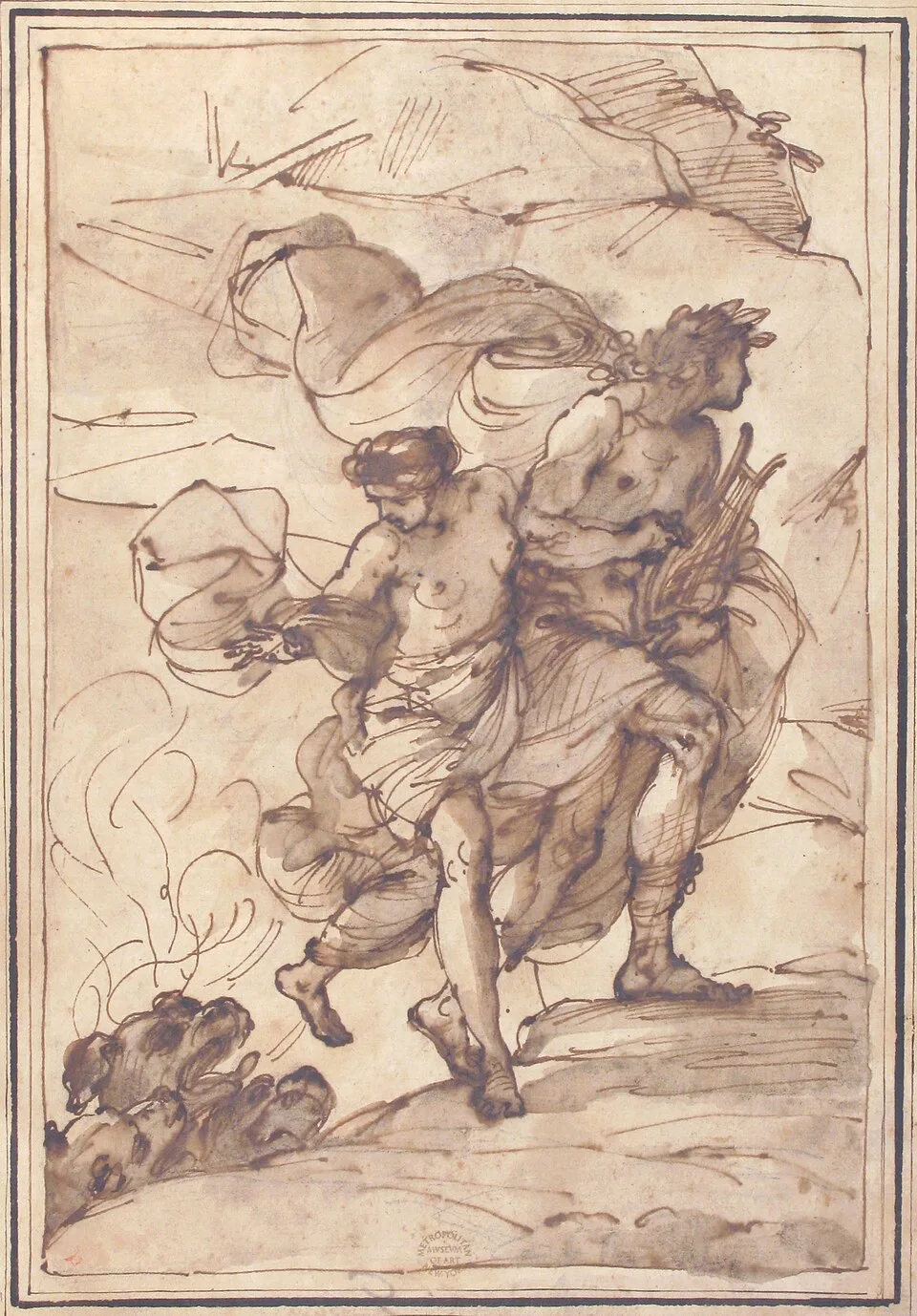
Orpheus
Orpheus is the legendary Thracian singer from whom the whole tradition takes its name and to whom its sacred writings were ascribed. Son of the river-lord Oiagros and the Muse Kalliope (though some make Apollo his father), he plays a lyre so powerful that beasts, trees and stones follow it, the Argonauts are steered past the Sirens by it, and the rulers of the dead themselves are moved to release his wife Eurydice - a boon he forfeits by looking back before reaching the light. Antiquity regarded him as a theologian and the institutor of teletai, crediting him with the Orphic theogonies, the collection of hymns, and books of purifications used by the itinerant initiators Plato calls Orpheotelestai. In one widespread account he meets his own death torn apart by Thracian women or maenads, a fate that mirrors the dismemberment of the god whose mysteries he taught. Modern scholarship treats this ascription as a pseudepigraphic convention by which diverse poems claimed the authority of the primordial singer, while recognising Orpheus himself as the indispensable founding figure of the tradition.
Domains
- sacred song
- mystery founding
Powers
- charms beasts, trees, stones and even the powers of death with his lyre
- founds and reveals the mysteries and their sacred texts
Epithets
- ὁ θεολόγος — the theologianW. K. C. Guthrie, Orpheus and Greek Religion (London, 1935), 1-16 (secondary)
- Θρήϊκιος — the ThracianApollonius Rhodius, Argonautica 1.23-34 (primary)
Sources
- Orpheus, the Thracian singer son of Oiagros and the Muse Kalliope, is the mythic founder-prophet and reputed author of the Orphic mysteries, theogonies and hymns.: Pausanias 9.30; Apollodorus, Bibliotheca 1.3.2; Plato, Protagoras 316d, Republic 364e (primary); R. G. Edmonds III, Redefining Ancient Orphism (Cambridge, 2013), 40-95; W. K. C. Guthrie, Orpheus and Greek Religion (1935) (secondary)