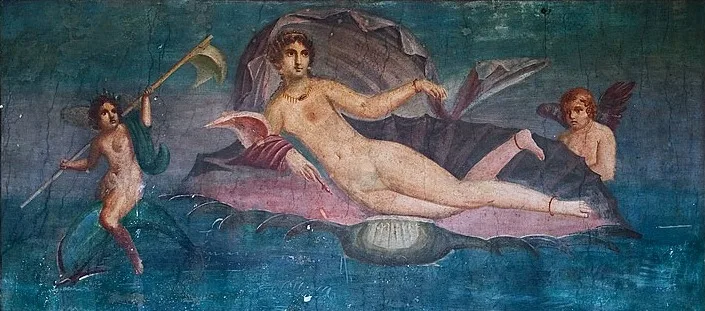
Herentas, goddess of desire
Oscan · deity · Oscan Sabellic religion; pre Roman to Roman Italy · Recorded classification
Herentas is the Oscan goddess of desire, whose name derives from the Italic verb meaning 'to wish' or 'to desire' and who corresponds to the Roman Venus. She is securely attested in Campania, above all by an Oscan altar from Herculaneum of about 100 BCE that was dedicated to 'Herentas of Eryx' by a Samnite-period public magistrate, the inscription declaring on one face 'I am of Herentas'. Through the epithet Herukina she stands behind the famous cult of Venus Erycina, the goddess of Mount Eryx in Sicily, and at the Lucanian sanctuary of Rossano di Vaglio she is fused with the local goddess in the formula Venus-Mefitis, showing how the Oscan power of desire was woven into both Punic-Sicilian and indigenous Italic cults.
Domains
- desire and love
Powers
- to stir longing and desire in mortals
Epithets
- HerukinaKatherine Carver, 'The Goddess of Eryx', University of North Carolina at Asheville Journal of Undergraduate Research (2014). (secondary)
Relations
- ally: Mefitis, goddess of sulphurous vapoursAt Rossano di Vaglio the goddess of desire is joined with Mefitis in the syncretic formula Venus-Mefitis, linking the two goddesses within the Lucanian sanctuary.Adam Adamik, 'The cult of the goddess Mefitis in light of literary and epigraphic sources', Graeco-Latina Brunensia 26.2 (2021), 5-22. (secondary)
Sources
- Herentas is the Oscan goddess of desire, the Sabellic counterpart of Venus, attested on an Oscan altar from Herculaneum and underlying the cult of Venus Erycina.: Roy Merle Peterson, The Cults of Campania (Rome: American Academy in Rome, 1919). (secondary); Katherine Carver, 'The Goddess of Eryx', University of North Carolina at Asheville Journal of Undergraduate Research (2014). (secondary)