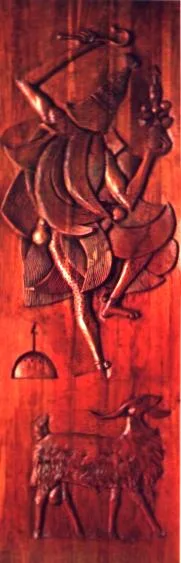
Babalú Ayé
Babalú Ayé, 'father and lord of the world', is the oricha of epidemic disease, smallpox, leprosy, and skin affliction, and by the same power the great healer. To speak his true name is dangerous, so he is addressed obliquely as 'the old one' or by his Arará name Asojano. The same hand that scatters pestilence withdraws it, and he is petitioned above all by the sick and the poor. He is pictured as an aged, limping figure covered with sores, leaning on crutches, dressed in sackcloth, accompanied by dogs that lick his wounds, and sweeping away contagion with a raffia whisk (ajá); his color is purple or burlap-brown. He entered Regla de Ocha largely from the Fon-Ewe (Arará, Dahomey) tradition of Cuba, and his kinship stands apart from the other orichas: the Cuban patakí do not fix his parents among them, naming at most the Arará mother Nanú. In Cuba he is syncretized with Saint Lazarus (San Lázaro), whose December pilgrimage at El Rincón is among the largest religious gatherings on the island.
Domains
- epidemic disease
- healing and pestilence
Powers
- sends and lifts epidemic disease
- heals the afflicted
Epithets
- El Viejo — the old oneBolívar Aróstegui, Los Orichas en Cuba (1990) (secondary)
- Asojano — the Arará name of the lord of pestilenceDavid H. Brown, Santeria Enthroned (2003) (secondary)
Sources
- Babalú Ayé is the oricha of epidemic disease and healing, of Fon-Arará derivation grafted into Regla de Ocha, syncretized in Cuba with Saint Lazarus.: George Brandon, Santeria from Africa to the New World (1993) (secondary); Lydia Cabrera, El Monte (1954) (secondary)
- His parentage is not fixed in the Cuban patakí corpus; where a lineage is named it points to the Arará mother Nanú rather than to the Ocha orichas, and no consistent kinship binds him to them.: David H. Brown, Santeria Enthroned (2003) (secondary)