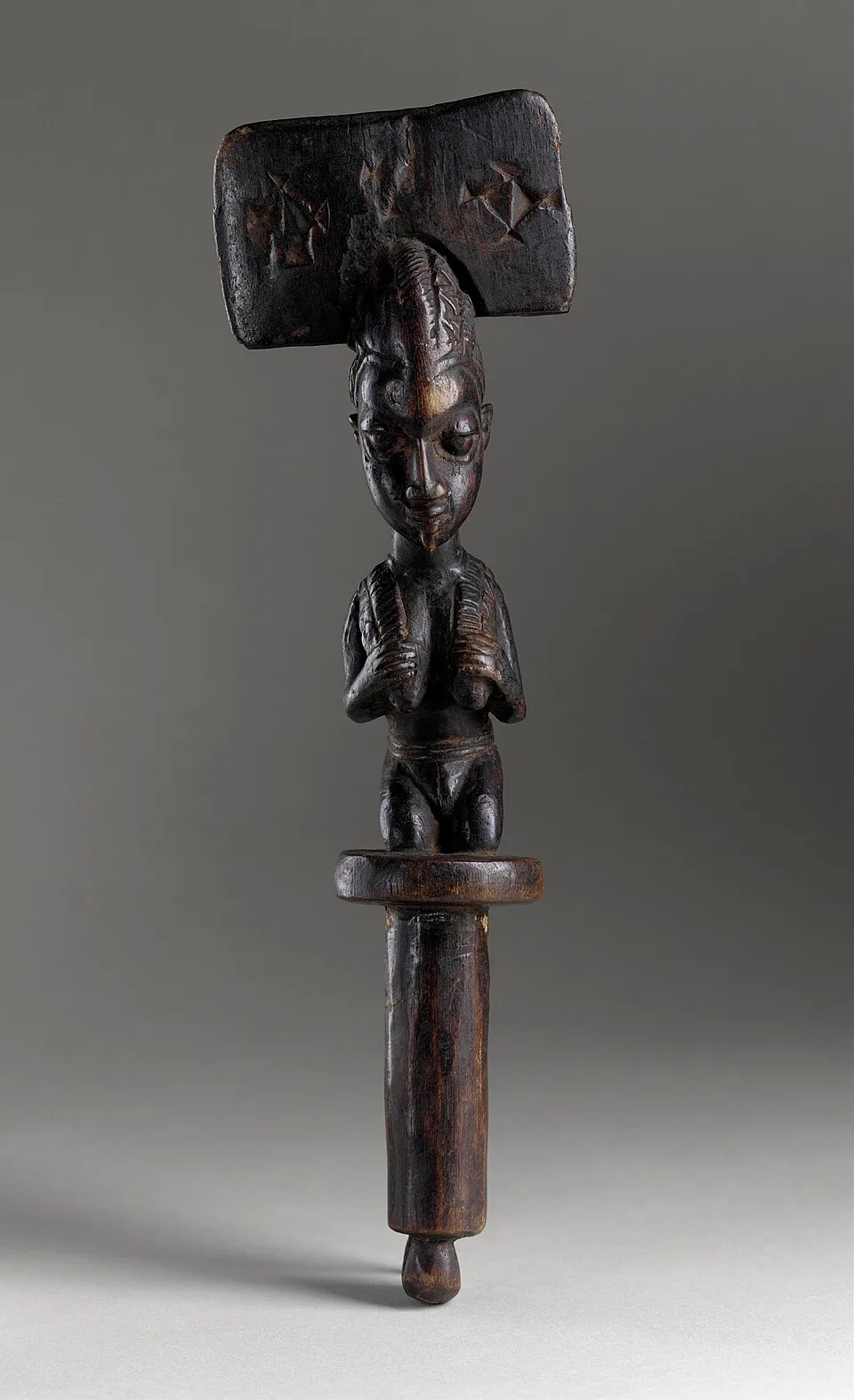
Changó
Changó is the oricha of thunder, lightning, fire, drumming, dance, and virile kingship, the most flamboyant and popular figure of the Lucumí pantheon. He is remembered euhemeristically as the fourth Aláàfin of the Yoruba city of Ọ̀yọ́, a proud and powerful ruler who, in the founding myth of his epithet Obakoso, did not hang but ascended to become an oricha and speak through thunder. He casts polished neolithic celts, the 'thunderstones' (edun ara), where lightning strikes, and his emblems are the double-bladed axe (oshé), the inverted mortar throne, and the batá drums whose patron he is. His colors are red and white, his number six. Cuban patakí name Aggayú as his father and Yemayá as the mother or foster-mother who raised him, though he is also linked to Obatalá as the king of his household; the genealogies vary. His consort is the storm-oricha Oyá, and the river-oricha Ochún is his celebrated lover. In Cuba he is syncretized, in a striking gender reversal, with Saint Barbara.
Parentage
- paternal: Aggayú Solá
- maternal: Yemayá
Domains
- thunder and lightning
- fire and virility
- kingship and justice
Powers
- hurls lightning and thunderstones
- dances and eats fire
- renders royal justice
Epithets
- Obakoso — the king did not hangWilliam Bascom, Shango in the New World (1972) (secondary)
- Kabiosile — royal salutation, 'your majesty'Bolívar Aróstegui, Los Orichas en Cuba (1990) (secondary)
Relations
- spouse: OyáOyá is his warrior consort who fights at his side and carries his thunder.William Bascom, Shango in the New World (1972) (secondary)
- lover: OchúnOchún is the sweet river-oricha who seduces and reconciles with him.Cabrera, El Monte (1954) (secondary)
- rival: OggúnA patakí tells that Changó carried off Oyá from Oggún, making the two orichas rivals.Bolívar Aróstegui, Los Orichas en Cuba (1990) (secondary)
- ally: OrulaBy a well-known patakí Changó ceded the secret of Ifá divination to Orula, taking the batá drum and dance in exchange.William Bascom, Sixteen Cowries (1980) (secondary)
Sources
- Changó is the oricha of thunder, lightning, fire, drumming and kingship, remembered as the deified fourth king of Ọ̀yọ́ and syncretized in Cuba with Saint Barbara.: William Bascom, Shango in the New World (1972) (secondary); Cabrera, El Monte (1954) (secondary)
- Cuban patakí name Aggayú as Changó's father and Yemayá as his mother or foster-mother, while Obatalá is remembered as the king who raised him; the traditions are not uniform.: Natalia Bolívar Aróstegui, Los Orichas en Cuba (1990) (secondary)