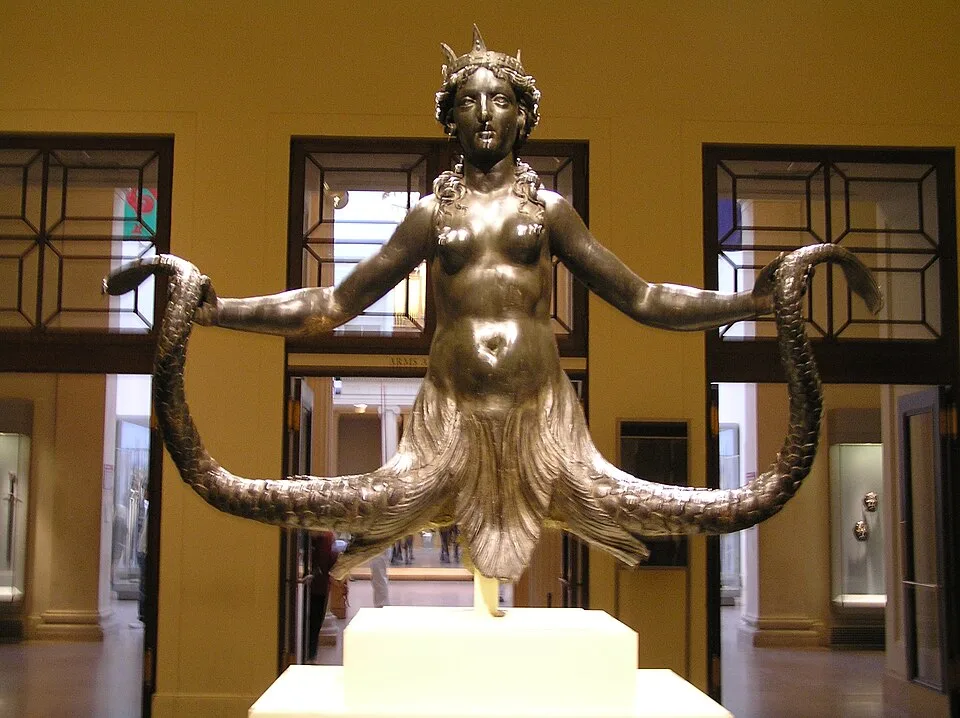
Serpent-Legged Ancestress
Scythian · deity · mythic primordium · Recorded classification
Chthonic serpent-footed ancestress / mistress of animals. Treated as a deity (per the type rule for spirit/ancestress classes), distinct from the war-god and from Argimpasa though scholars debate the overlap. Genuinely unnamed in the native record; term carries the Greek descriptive 'mixoparthenos echidna'.
Parentage
- parent: Earth-and-Water Mother Api
Children
Domains
- fertility
- ancestral motherhood
Powers
- bore the three royal sons to Heracles
- declares herself mistress of the land and keeps Heracles' mares
Epithets
- the Snake-legged Goddess The serpent-bodied ancestral mother who bore the first Scythians to HeraclesHerodotus 4.8–10 (primary)
Relations
- lover: Strongman Forefather (Scythian Heracles)Reciprocal of scythian_herakles.lover — The serpent-legged mistress of Hylaea withheld his strayed mares until he lay with her; from the union came Agathyrsus, Gelonus and Scythes.Herodotus, Histories 4.9-10 (primary)
Sources
- In the Pontic-Greek myth the mother of the Scythian kings is a mixoparthenos, woman above and serpent below, mistress of the land of Hylaia, who keeps Heracles' horses until he fathers three sons on her.: Herodotos, Histories 4.9 (Godley) (primary)
- She corresponds to the widely-attested Scythian anguipede 'Snake-Legged Goddess' of Black-Sea art, a chthonic life-giving ancestress read as a daughter of Api and closely (but not wholly) identified with Argimpasa/Artimpasa; the Greeks assimilated her to Hecate near the Borysthenes.: Y. Ustinova, The Supreme Gods of the Bosporan Kingdom (1999); S.S. Bessonova, Religioznye predstavleniya skifov (1983) (secondary)