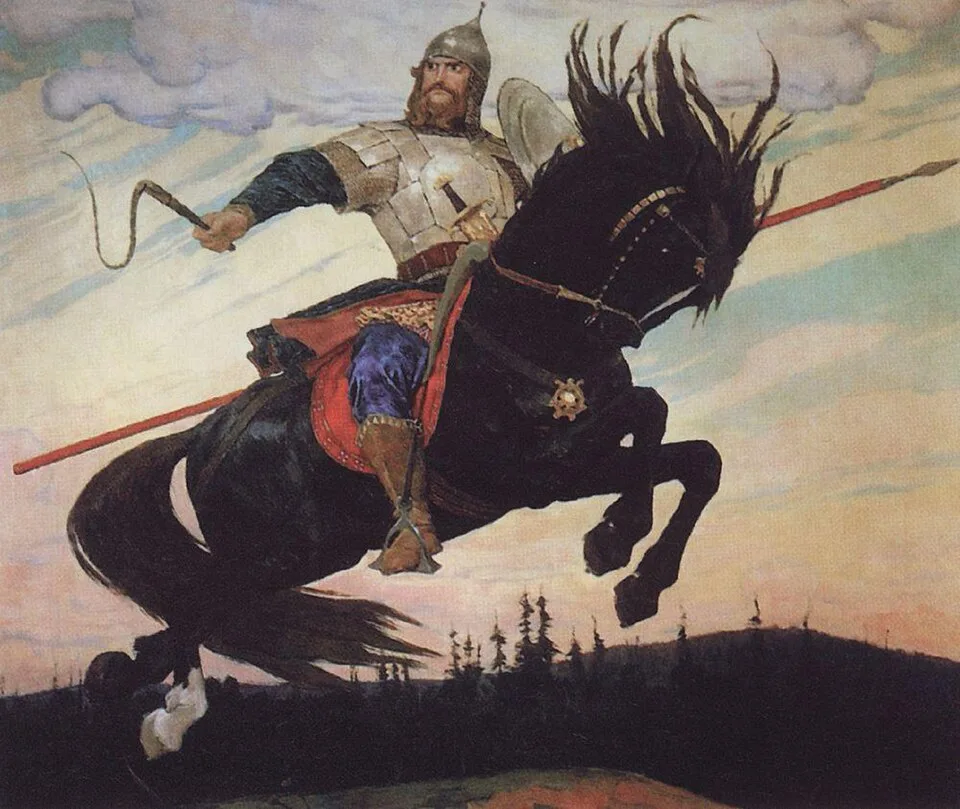
Ilya Muromets
Foremost bogatyr (heroic warrior) of the Russian bylina cycle; peasant-hero from the village of Karacharovo near Murom (modern-day Vladimir Oblast, Russia); historical-legendary figure with archaeologically-attested incorrupt remains at the Pechersk Lavra (Kyiv-Caves Monastery) in Kyiv. The peasant-origin is the foundational social-class signature of the bylina cycle: the foremost bogatyr is not of noble or princely blood but a peasant who rose to the foremost rank of Vladimir's Kievan court through valor — a structural inversion of the typical Indo-European heroic-epic noble-origin convention. Per the foundational bylina narrative, Ilya was paralyzed from birth and could not move from his stove for 33 years, healed miraculously at age 33 by mead from three traveling holy pilgrims (kaliki perekhozhie). Subsequently traveled to Kiev to serve at the court of Vladimir the Great as foremost of the bogatyri; canonical deeds include defeating Solovei the Robber (the Whistling Robber), Idolishche the Foul, and Tugarin Zmeevich (the Dragon-Son). The historical-archaeological evidence is unusually strong: modern medical examinations of the Pechersk Lavra incorrupt-relics (1988) confirm the relics are of an unusually-tall (approx. 177 cm) male who lived in the 12th c. and showed signs of spinal disease and battle-wounds, consistent with the bylina-narrative paralysis-healing-and-warrior elements. Canonized as St. Ilya Muromets 1643; modern patron-saint of Russian Border Guards and (since 2005) Russian Strategic Rocket Forces — a remarkable institutional-religious continuity from medieval folk-hero to Cold-War-era nuclear-deterrent patron.
Powers
- Exert superhuman strength
Relations
- companion: Alyosha PopovichReciprocal of slavic_alyosha_popovich.companion (alphabetical family sweep). (auto reciprocal)
- companion: Dobrynya NikitichFellow bogatyrs of Prince Vladimir's Kievan circle; the byliny pair them (with Alyosha Popovich) as sworn brothers-in-arms at the heroic outpost.Bailey & Ivanova, An Anthology of Russian Folk Epics (1998) (secondary)
Sources
- existence: Bylina cycle — Kirsha Danilov Drevnie rossiiskie stikhotvoreniia (1804); Pavel Rybnikov Pesni (1861-1867); Aleksandr Hilferding Onega Bylinas (1873) (primary); Kievo-Pecherskii Paterik (13th c. compilation) (primary); Pechersk Lavra incorrupt-relics — modern medical examinations (1988) confirm the relics are of an unusually-tall (approx. 177 cm) male who lived in the 12th c. and showed signs of spinal disease and battle-wounds, consistent with the bylina-narrative paralysis-healing-and-warrior elements (archaeological)