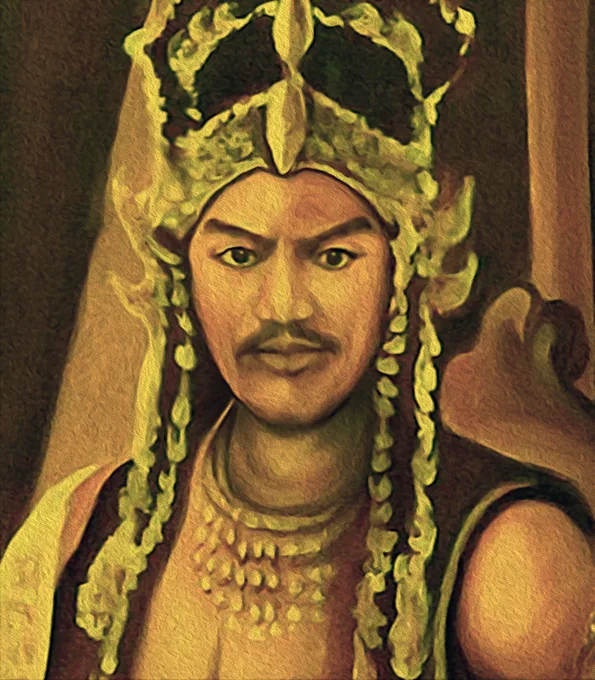
Prabu Siliwangi
Prabu Siliwangi is the paramount culture hero of the Sundanese, the idealized great king of Pakuan Pajajaran around whom the pantun repertoire and later legend revolve. Historians identify him with Sri Baduga Maharaja, also called Jayadewata, who ruled the Sunda kingdom from 1482 to 1521 and is commemorated in the Batutulis inscription at Bogor; his popular name means 'successor of Wangi', linking him to Prabu Wangi, the king who died at Bubat. In legend he is the father of pantun heroes such as Mundinglaya di Kusumah, and after the fall of Pajajaran to the Islamic powers of Banten and Cirebon he is said not to have died but to have withdrawn into the southern forests, ngahiyang, vanishing from the visible world; he and his loyal followers are believed to live on as tigers, the maung of Pajajaran, guardians who may still appear to their descendants. Robert Wessing has analysed this tiger tradition as a mythic resolution of the passage from the old Hindu-Sundanese order to Islam, while the name Siliwangi remains a byword for Sundanese identity.
Domains
- kingship
- tigers
Powers
- to take the form of a tiger
Epithets
- Silih WangiMumuh Muhsin Z. & Miftahul Falah, 'Prabu Siliwangi Between History and Myth', Paramita: Historical Studies Journal 31/1 (2021), pp. 74-82 (secondary)
Relations
- father of: Prince Hero of PajajaranIn the pantun Mundinglaya di Kusumah, first published from oral performance by C.M. Pleyte in 1906, the hero Mundinglaya is the son of Prabu Siliwangi, king of Pajajaran, who sends him on the quest for the heavenly talisman.C.M. Pleyte, 'Raden Moending Laja di Koesoema: Een oude Soendasche ridderroman met eene inleiding over den toekang pantoen', Tijdschrift voor Indische Taal-, Land- en Volkenkunde (1906) (secondary); Ajip Rosidi et al. (eds.), Ensiklopedi Sunda: Alam, Manusia, dan Budaya (Jakarta: Pustaka Jaya, 2000) (secondary)
Sources
- Prabu Siliwangi is the deified legendary great king of Pajajaran, identified with the historical Sri Baduga Maharaja (r. 1482-1521), who in Sundanese myth vanished at the kingdom's fall and endures in the form of a tiger.: Robert Wessing, 'A Change in the Forest: Myth and History in West Java', Journal of Southeast Asian Studies 24/1 (1993), pp. 1-17 (secondary); Mumuh Muhsin Z. & Miftahul Falah, 'Prabu Siliwangi Between History and Myth', Paramita: Historical Studies Journal 31/1 (2021), pp. 74-82 (secondary); C.M. Pleyte, 'Raden Moending Laja di Koesoema: Een oude Soendasche ridderroman met eene inleiding over den toekang pantoen', Tijdschrift voor Indische Taal-, Land- en Volkenkunde (1906) (secondary)