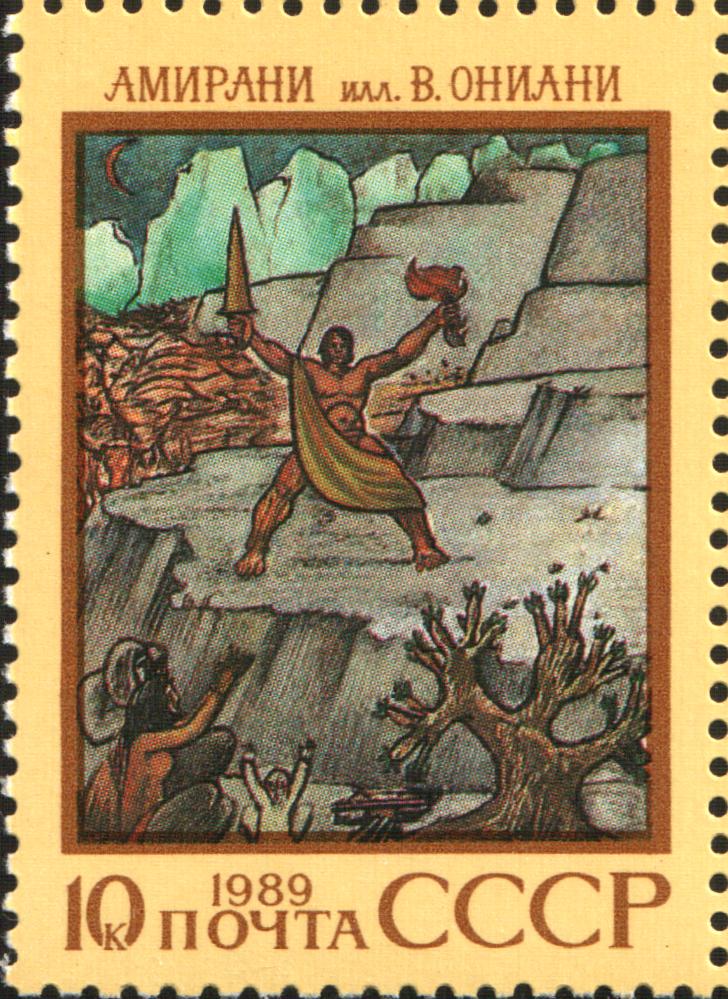
Amirani
Amirani is the great culture-hero of the Georgian epic, and the Svan version of his story is reckoned the fullest and most archaic. He is the son of the huntress-goddess Dæl by a mortal hunter; in the Svan telling the hunter's jealous wife severs Dæl's golden hair as she sleeps, and from the dying goddess the child is cut alive and raised in the world of men, fostered beside the brothers Badri and Usup. Grown to a giant's strength, he wars against the dragons and giants of the mountains and defies God, bringing to mankind the working of iron. For this trespass he is chained to a crag in the Caucasus with his hound Q'ursha at his side; an eagle tears at his liver, which heals each night, and though the dog gnaws his chain thin the smiths renew it every year, so that he strains forever unfree. The parallel with the Greek Prometheus has made him among the most studied figures of Caucasian myth.
Parentage
- parent: DælBorn of the huntress Dæl, cut living from her body at her death.Charachidzé, Georges (1968), Le système religieux de la Géorgie païenne, Paris: Maspero (secondary)
Domains
- heroism
- metallurgy
- defiance of god
Powers
- wrestles giants and dragons
- brings the working of metal to mankind
Epithets
- მიჯაჭვული ამირანი — chained AmiraniChikovani, Mikheil (1966), The Georgian Epic Poem of Amirani, Tbilisi (secondary)
Relations
- parent: DælBorn of the huntress Dæl, cut living from her body at her death.Charachidzé, Georges (1968), Le système religieux de la Géorgie païenne, Paris: Maspero (secondary)
Sources
- Amirani, the chained culture-hero of the Georgian epic, is in the Svan version the son of the huntress-goddess Dæl by a mortal hunter, extracted from her womb at her death.: Charachidzé, Georges (1968), Le système religieux de la Géorgie païenne, Paris: Maspero (secondary); Chikovani, Mikheil (1966), The Georgian Epic Poem of Amirani, Tbilisi (secondary)
- For defying God and bringing metal to humankind he is bound in chains in the Caucasus, where an eagle devours his self-healing liver, in a myth long compared to that of Prometheus.: Charachidzé, Georges (1986), Prométhée ou le Caucase, Paris: Flammarion (secondary)