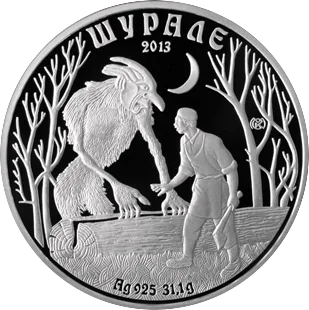
Şüräle
Şüräle is the best-known spirit of the Tatar woodland, a shaggy, man-shaped demon distinguished by a horn on its forehead, backward-turned feet and grotesquely long, thin fingers. It haunts the deep forest at night, calling out to solitary riders, luring them from the path and offering to play at tickling — a game that ends in death, for Şüräle laughs its victims to exhaustion. The most famous tale, given canonical literary form by the poet Ğabdulla Tuqay in 1907, tells how a woodcutter invites the creature to help split a log, then knocks out the wedge so that Şüräle's fingers are trapped fast; when the being howls for the name of its tormentor the man answers 'Byltyr', meaning 'last year', so that the spirit's cries for vengeance against 'Last-year' bring no help. Identified in the ethnographic record with the urman iyäse, the master of the woods, Şüräle has become an emblem of Tatar national culture, celebrated in Farid Yarullin's ballet of 1945.
Domains
- forest
Powers
- tickles victims to death
- leads travellers astray
Epithets
- Урман иясе — Master of the ForestK. Nasyri, Поверья и обряды казанских татар, Kazan, 1880. (primary)
Sources
- Şüräle is a forest demon of Tatar folklore, a hairy man-like being with a horn on its brow and long thin fingers, who tickles lone travellers to death and is defeated by trickery.: K. Nasyri, Поверья и обряды казанских татар, Kazan, 1880. (primary); F. I. Urmanche, Татар мифологиясе, Kazan, 2008–2011, s.v. Шүрәле. (secondary)
- The classic literary redaction is Ğabdulla Tuqay's narrative poem in which a woodcutter tricks Şüräle into jamming its fingers in a split log, then names himself 'Byltyr' (Last-year) so the wounded spirit cannot say who hurt it.: Ğabdulla Tuqay, Шүрәле (Şüräle), 1907. (primary)