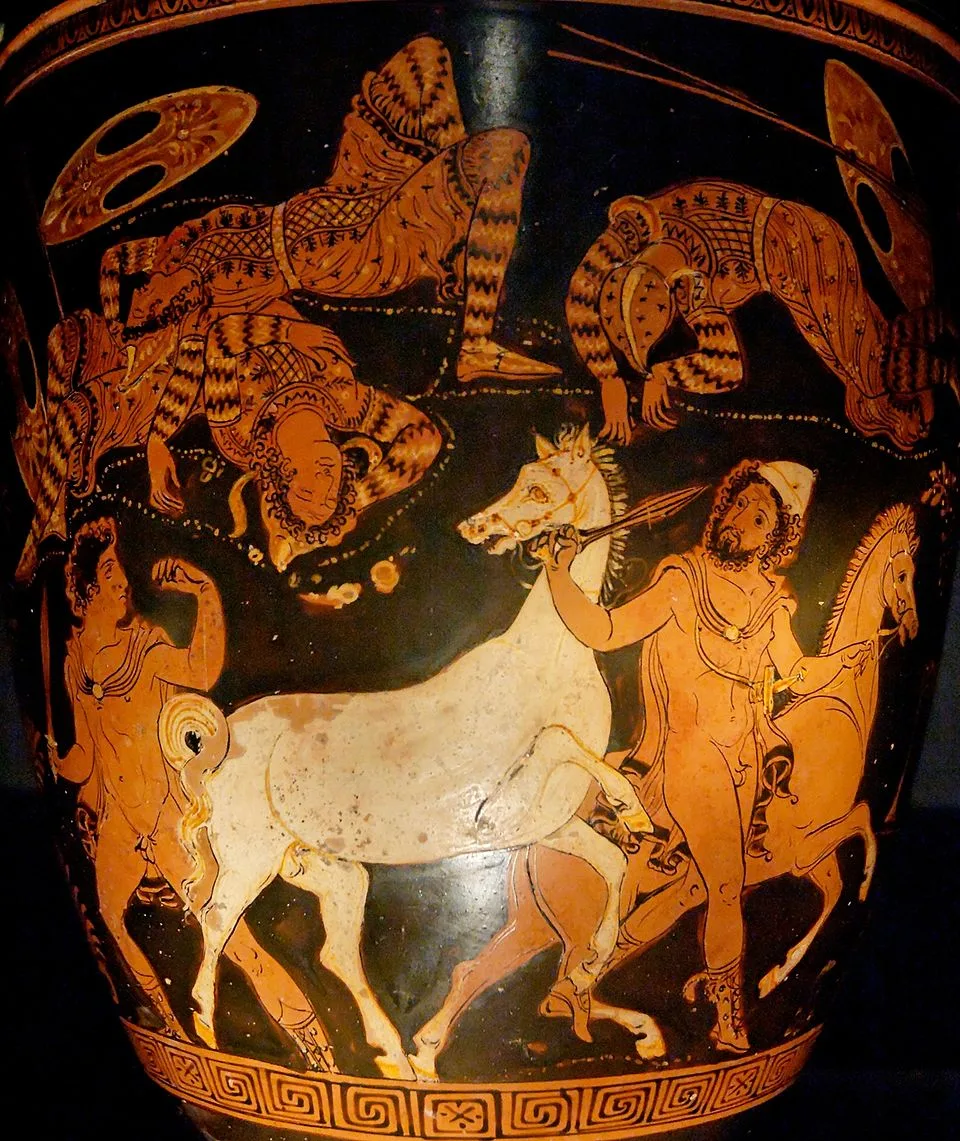
Rhesus, the Hero-Daemon of Mount Pangaion
Thracian · demigod · Mythic/heroic Thrace (Trojan War cycle); cult attested by the Classical period · Recorded classification
Heroized/culture-hero tier (the prompt asks to include attested heroized figures). Classified 'demigod': son of a Muse and the river-god Strymon (or king Eioneus), raised to a man-daemon between mortal and god. His anthrōpodaimōn status is the explicit Thracian model of immortality-without-death, paralleling Zalmoxis. Native theonym leads as the proper name (Rhēsos), transmitted in Greek.
Domains
- heroized dead
- prophecy and oracles
- war and battle
- horsemanship
Powers
- attains hidden immortality without descending to Hades
- would have been invincible had he and his horses drunk and grazed at Troy
- prophesies underground as a man-daemon of the Bistonian mines
Epithets
- ἀνθρωποδαίμων man-daemon, midway between mortal and godEuripides (attrib.), Rhesus 971 (primary)
Relations
- companion: The Thracian Dionysus, Lord of the Mountain FrenzyThe mourning Muse foretells that Rhesus will lie in the silver-veined earth as an anthropodaimon, a 'prophet of Bacchus' on Pangaion.Euripides, Rhesus 962-973 (primary)
Sources
- Rhesus is a Thracian king of the Trojan cycle who, rather than dying into Hades, is given hidden immortality as an anthrōpodaimōn ('man-daemon') in a cavern of Mount Pangaion and made a prophet of the Bacchic mysteries.: [Euripides], Rhesus 962-973 (primary); Homer, Iliad 10.434-502 (primary)
- His Pangaion hero-cult parallels the Getic immortality of Zalmoxis and exemplifies the Thracian/Hellenistic 'heroization' of the dead into immortal man-daemons.: Studies of Thracian heroization and the cult of Rhesus on Mount Pangaion (secondary)