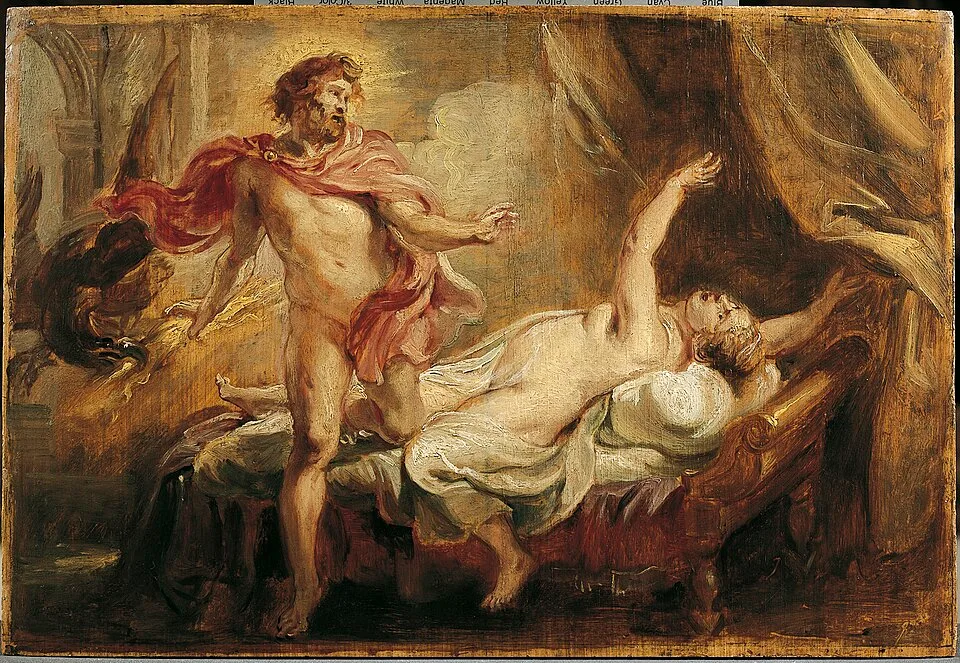
Zemele, the Thraco-Phrygian Earth-Mother
Thracian · deity · Thraco Phrygian substrate of Greek myth; pre Classical, name attested in a Phrygian formula · Recorded classification
Included as the Thraco-Phrygian earth-mother underlying the Greek Semele, mother of Dionysus, since the prompt's traditions are the source-stratum of the Dionysiac complex. Classified 'deity' (the original earth-goddess), though in Greek myth Semele is a mortalized Theban princess (vitalStatus 'deceased' reflects that Greek narrative, in which she dies by Zeus' lightning before being raised). Native form given as the Phrygian-attested zemelō in Greek script; the Thracian Zemele is a reconstruction noted as such.
Domains
- earth and soil
- motherhood and birth
Powers
- brings forth the god of the vine
- is the earth from which life springs
Epithets
- Θυώνη the raving one, her divinized name after her son raises her from HadesPindar, Pythian 3; Diodorus Siculus 4.25 (primary)
Relations
- ancestor of: The Thracian Dionysus, Lord of the Mountain FrenzyThraco-Phrygian earth-mother Zemele, mother of the Thracian Dionysus, who already carries the reciprocal 'descendant of' edge.Diodorus Siculus 3.62-64; Phrygian inscription invoking Diounsis Zemelo (primary); M. L. West, Indo-European Poetry and Myth (2007), on Zemele/Semele (secondary)
Sources
- The name Semele is widely judged to be Thraco-Phrygian, an earth-goddess theonym (Zemelā) from a PIE root for 'earth', cognate with Baltic Žemyna/Žemelė and matching the Phrygian formula 'diōs zemelō' (Zeus and Earth).: Phrygian inscription 'diōs zemelō' (primary); Julius Pokorny, Indogermanisches etymologisches Wörterbuch (Thracian Zemele 'mother earth') (secondary)
- Burkert cautions that while Semele is 'manifestly non-Greek', a firm Thraco-Phrygian 'earth' meaning is hard to prove conclusively.: Walter Burkert, Greek Religion (1985), on Semele and the Dionysiac complex (secondary)