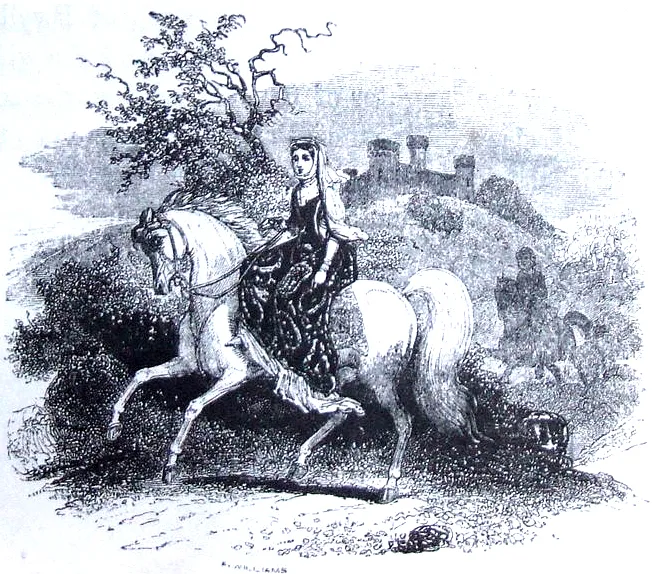
Rhiannon
Welsh Otherworld figure of the Mabinogion First and Third Branches; scholarly-consensus Welsh manifestation of the Gaulish horse-goddess Epona and the Irish goddess Macha. Her name reconstructs to the Brittonic *Rīgantonā ("Great Queen") — a clear theonym pattern. Comes from Annwn (the Welsh Otherworld) on a shining white horse moving at a steady pace yet impossible to catch by the fastest mortal horses; chooses Pwyll, prince of Dyfed, as her consort, breaking her arranged contract with Gwawl. Defeats Gwawl through the bag-trick. Mother of Pryderi by Pwyll. Suffers the famous trial of being unjustly accused of infanticide (her newborn was abducted by a black-clawed apparition while her nursemaids slept; they smeared her with the blood of a slaughtered puppy and accused her of having killed and eaten the child); her punishment was to sit at the gate of Pwyll's castle for seven years, telling visitors what she had allegedly done and offering to carry them on her back as a beast of burden — a punishment-as-horse-form that scholars read as preserving her horse-goddess identity through the Christian-era redaction. Vindicated when Pryderi is restored. After Pwyll's death, married to Manawydan fab Llŷr (the Welsh cognate of the Irish Manannán mac Lir). Suffers further trials in the Third Branch during the Desolation of Dyfed (a seven-year vengeance-enchantment by Llwyd, magician-friend of Gwawl). The Birds of Rhiannon (Adar Rhiannon) — three magical birds whose song wakes the dead and puts the living in a dream — sing for the seven-year Harlech feast in the Second Branch and are mentioned in Culhwch ac Olwen as one of Ysbaddaden's anoethau (impossible tasks). Per the registry's standing precedent (Mongán case in Irish tradition: medieval-literary divine-paternity claim about a historical-or-legendary figure passes strict-criterion under the literary-tradition reading), Rhiannon's scholarly-consensus deity-status combined with her Mabinogion narrative-functional treatment as Otherworld-figure who marries a mortal prince makes her the divine parent for Pryderi's strict ½ demigod classification.
Children
Domains
- horse goddess Brittonic
- sovereignty and Otherworld passage
- birds and enchantment
Powers
- rides a shining white horse at an even pace that no mortal mount can overtake
- commands the three Birds of Rhiannon, whose song wakes the dead and lulls the living to sleep
- bears the horse-block penance, carrying guests on her back as a mare for a false charge of infanticide
- Ride the uncatchable steed
Epithets
- lady of the wondrous birds The Otherworld rider on her white horse, whose three birds (Adar Rhiannon) wake the dead and lull the livingPwyll Pendefig Dyfed; Branwen ferch Llŷr (primary)
- Rhiannon Great Queen (from Brittonic *Rigantona)Bromwich, Trioedd Ynys Prydein (secondary)
Relations
- spouse: Pwyll Pendefig DyfedFirst husband. The marriage takes place after she comes from Annwn to choose Pwyll, defeats Gwawl through the bag-trick, and arranges the wedding feast at Hyfaidd Hen's court.Mabinogion First Branch (primary)
- spouse: ManawydanSecond husband, after Pwyll's death — Pryderi gives Rhiannon to Manawydan in marriage. The Third Branch follows their further trials and the Desolation of Dyfed (a seven-year vengeance-enchantment by Llwyd, friend of Gwawl).Mabinogion Third Branch (Manawydan fab Llŷr) (primary)
- mother of: Pryderi fab PwyllMabinogion First Branch (primary)
- enemy: Gwawl fab CludReciprocal of welsh_gwawl.enemy (alphabetical family sweep). (auto reciprocal)
- enemy: Llwyd ap CilcoedReciprocal of welsh_llwyd.enemy (alphabetical family sweep). (auto reciprocal)
- equated with: EponaConsensus reads Rhiannon < *Rigantona as the Welsh literary reflex of the Gaulish horse-goddess type: riding, magic birds, foal-linked calumniated mother. Names unrelated; Hemming urges caution — functional equation.W. J. Gruffydd, Rhiannon: An Inquiry into the Origins of the First and Third Branches of the Mabinogi (1953) (secondary); M. J. Green, The Gods of the Celts (1986) (secondary)