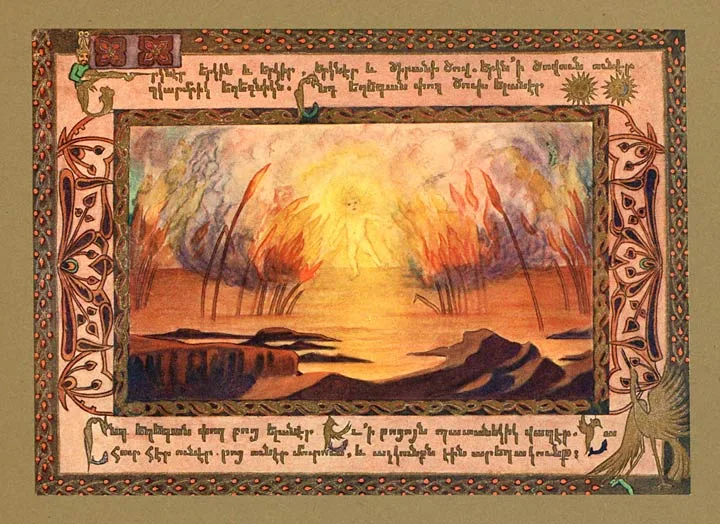
Vahagn
Dragon-slayer war-deity of the Armenian polytheistic pantheon; Iranic-syncretic reflex of Verethragna with extensive Armenian-internal narrative development. The Vahagn-birth hymn preserved by Khorenatsi (Patmutyun Hayots 1.31) is among the oldest surviving fragments of Armenian poetry — the cosmic-egg birth from heaven-earth-sea-reed travail constitutes the foundational Armenian theogonic-poetic image. The dragon-slaying (vishap-kagh-) establishes Vahagn as the Armenian reflex of the Indo-European storm-vs-serpent mythologem (Vedic Indra-Vritra; Iranic Verethragna; Norse Thor-Jörmungandr). His pairing with Astghik in the Aštišat cult-complex parallels the Iranic Mithra-Anāhitā pairing within the Iranic-syncretic frame. The Vahagn-cult was suppressed at the 301 CE Christianization but folk-residual associations of dragon-slaying with Christian saint-figures (notably St. George via Armenian-Christian transmission) preserve the underlying mythologem.
Powers
- Embody and emit fire
- Grant valor and victory
- Slay dragons
Epithets
- Վիշապաքաղ 'Dragon-reaper / Dragon-slayer' — Vahagn's standing epithetMovses Khorenatsi, History of Armenia 1.31 (primary)
Relations
- spouse: AstghikKhorenatsi 2.49 — Vahagn-Astghik divine pairing (primary)
- equated with: HeraclesReciprocal of greek_apollod_heracles.equated-with — Armenian tradition renders Vahagn as Heracles (so the hellenizing translators). Preserves the dragon-slaying strongman; breaks on Vahagn's fiery birth from the reed and his storm-born cosmology.J. R. Russell, Zoroastrianism in Armenia (1987) (secondary)
- equated with: VerethragnaReciprocal of zoroastrian_verethragna.equated-with — Vahagn is the Armenian reflex of Verethragna (via Parthian *Warhagn). Preserves the victory-god core; the Armenian god gains a native dragon-slayer epic and fiery reed-birth hymn absent in the Avesta.J. R. Russell, Zoroastrianism in Armenia (1987) (secondary)
Sources
- existence: Movses Khorenatsi, Patmutyun Hayots 1.31 (the foundational Vahagn-birth hymn citation) (primary); Khorenatsi 2.49 (primary); Agathangelos Ch. 786-810 (primary)
- identification-as-Iranic-Verethragna-reflex: Russell, Zoroastrianism in Armenia (1987) (secondary); Hewsen, "Armenia, Geography of," EI (secondary)