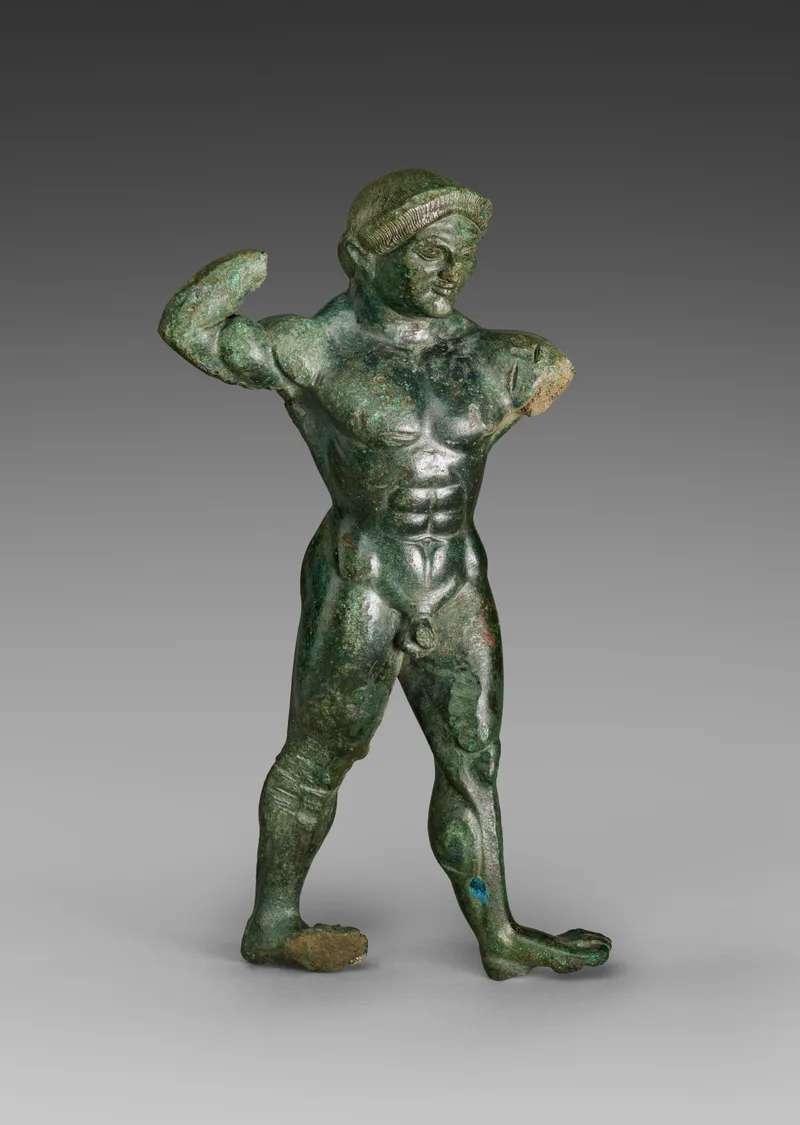
Heracles
Greek · demigod · heroic age · Recorded classification
Son of Zeus and Alcmene. Apollodorus relates his labours, ascent from the pyre on Oeta, reconciliation with Hera, and marriage to Hebe.
Parentage
Recorded default; alternative parentage accounts are listed separately below.
Parentage accounts
Each account is a separate source claim. The parentage and children listed outside these accounts use the recorded default. Selecting an account in the interactive app updates its lineage, descent classification and inherited-power candidates. Linked pedigree accounts are selected together; other records retain their recorded parentage. Claims of ancestry are not proof of biological descent or attested powers.
- Satyrus: transmitted divine ancestryThe quoted pedigree explicitly calls Heracles son of Zeus but does not name his mother. Other accounts remain separately available. This is a dynastic ancestry claim, not established biological history.
Claimed divine ancestry; fraction unquantified because the account is incomplete.
- father: ZeusSatyrus, dynastic genealogy preserved in Theophilus, To Autolycus 2.7 (Greek text) (primary)
Children
- Alexiares
- Anicetus
- Hyllus
- Lamus
- Telephus
- Alopius
- Amestrius
- Antiades
- Antileon
- Antimachus
- Antiphus
- Archedicus
- Archemachus
- Astyanax the Thespiad
- Astybies
- Atromus
- Bucolus
- Buleus
- Capylus
- Celeustanor
- Cleolaus
- Creon the Thespiad
- Dynastes
- Entelides
- Erasippus
- Erythras
- Eumedes
- Eurycapys
- Euryopes
- Eurypylus the Thespiad
- Halocrates
- Hippeus
- Hippodromus
- Hippozygus
- Homolippus
- Iobes
- Laomedon the Thespiad
- Laomenes
- Leucippus
- Leucones
- Lycurgus
- Lyncaeus
- Mentor the Thespiad
- Nephus
- Nicodromus
- Oestrobles
- Olympus
- Onesippus
- Patroclus
- Phalias
- Polylaus
- Teles
- Teleutagoras
- Threpsippas
- Tigasis
- Macaria
- Tlepolemus
Children in alternative accounts
- Hyllus: Satyrus: transmitted divine ancestrySatyrus, dynastic genealogy preserved in Theophilus, To Autolycus 2.7 (Greek text) (primary)
Names and tradition associations
- Heracles Apollodorus, Library 2.4.8–12; 2.7.7 (primary)
- Herakles Apollodorus, Library 2.4.8–12; 2.7.7 (primary)
- Alcides Apollodorus, Library 2.4.8–12; 2.7.7 (primary)
- Hercle Pyrgi tablets c.500 BCE; Tomb of the Augurs (Tarquinia, c.530 BCE); engraved bronze mirrors (Bonfante 1990) (primary)
- Hercules Ovid, Metamorphoses 9.211–323 (primary)
Variant accounts
- apotheosisHomer's Nekyia (Od. 11) shows Heracles in Hades, not on Olympus. Either denies full apotheosis or implies eidolon-doubling — mortal residue in Hades, divine portion on Olympus. Apollodorus harmonizes via the latter.Hom. Od. 11.601-627 (primary)
Domains
- labor
- gateway protection
- athletic contest
- threshold
- monster slaying
- apotheosis deification
Powers
- physical strength extreme
- endurance superhuman
- wrestling skill
- archery skill
- Slay beasts with bare hands and overwhelming might
- Ascend from the funeral pyre to immortality and Olympus
- Ascend to godhood / become immortal
- Exert superhuman strength
Epithets
- ἀλεξίκακος averter of evilPaus. 1.32.5 (secondary)
- καλλίνικος of the beautiful victoryArchilochus fr. 324 (secondary)
- θηροκτόνος beast-slayerEur. HF 1271 (primary)
- Καλλίνικος Of glorious victory; the triumphant Heracles hailed after his laboursArchilochus fr. 324 (the τήνελλα καλλίνικε refrain); Paus. 9.11.6 (primary)
- Ἀλεξίκακος Averter of evil; protector who wards off harm and plagueLact. Plac. on Stat. Theb. (cf. Heracles Alexikakos); Farnell, Greek Hero Cults (secondary)
- Μελάμπυγος Black-buttocked; the robust virile Heracles of the Kerkopes taleschol. Hdt. 7.216; Suda s.v. Μελάμπυγος (secondary)
- Βουφάγος Ox-eater; the gluttonous hero who devours a whole oxcf. Pind. fr. 168 (Heracles' appetite); Lex. on the comic Heracles (primary)
- Σωτήρ saviour, delivererPausanias, Description of Greece 9.27.5 (secondary)
Relations
- mentor: Chiron (the wise centaur, mentor of Heracles, Achilles, Asclepius, Jason) · GreekApollod. 2.5.4 (primary)
- companion: IphiclesReciprocal of greek_apollod_iphicles.companion (the heteropaternal mortal twin).Apollod. 2.4.8-9 (primary)
- killer of: Augeas (king of Elis whose stables Heracles cleaned; son of Helios in dominant tradition; not registered as Helios-line cascade) · GreekAfter Augeas refused payment for the cleansing of his stables (the Fifth Labor), Heracles returned to Elis and killed him.Apollod. 2.7.2; Diod. 4.33.4 (primary)
- killer of: HippolytaKilled during the Ninth Labor (the Girdle of Hippolyta) after Hera-induced fight broke out among the Amazons.Apollod. 2.5.9 (primary)
- killer of: CalaisKilled Calais (with his twin Zetes) after the Argonautic abandonment of Heracles at Mysia.Apollod. 1.9.20; Apoll. Rhod. 1.1298-1308 (primary)
- killer of: ZetesKilled Zetes (with his twin Calais) after the Argonautic abandonment of Heracles at Mysia.Apollod. 1.9.20; Apoll. Rhod. 1.1298-1308 (primary)
- killer of: NeleusKilled Neleus and eleven of his twelve sons during the sack of Pylos after Neleus refused purification.Apollod. 2.7.3 (primary)
- killer of: LinusKilled his music-tutor Linus with the lyre after Linus rebuked him for errors in the lesson; tried under a law of Rhadamanthys allowing self-defense and acquitted.Apollod. 2.4.9; Theoc. Idyll 24.105-110 (primary)
- enemy: EurystheusThe canonical-rivalry of the Twelve Labors imposition; Hera-engineered through the accelerated-birth deception. Eurystheus imposes the Twelve Labors on Heracles per the Perseid-kingship-prerogative-oath that Zeus had spoken.Hom. Il. 19.95-133; Apollod. 2.5.1-12 (primary)
- enemy: HeraHom. Il. 14.250-256 (primary)
- ally: AthenaApollod. 2.5.11 (primary)
- companion: IolausApollod. 2.5.2 (primary)
- former spouse: MegaraApollod. 2.4.12 (primary)
- spouse: DeianiraApollod. 2.7.5-7 (primary)
- lover: OmphaleApollod. 2.6.3 (primary)
- lover: AugeApollod. 2.7.4 (primary)
- spouse: HebePost-apotheosis marriage on Olympus.Hes. Theog. 950-955 (primary)
- equated with: MelqartGreeks identified Phoenician Melqart with Heracles from at least the 5th c. BCE. The Cadiz/Gades cult was the syncretic meeting-point — Phoenician colonial foundation that became the principal "Heracles" cult site in the western Mediterranean. Distinct entries retained because Melqart predates the equation by centuries with independent Tyrian-civic identity (the Tyrian biennial egersis ritual, the cypress-wood-only sacrifice taboo, the Herodotean detail that women were excluded from the rite).Hdt. 2.43-44 (Herodotus visits both the Tyrian Heracles temple and the Egyptian Heracles to investigate the equation; concludes the Phoenician Melqart cult is the older); Diod. 5.20; Sil. Italicus 3.21 (primary); Hdt. 2.43-44 (Herodotus visits both the Tyrian Heracles temple and the Egyptian Heracles to investigate the equation; concludes the Phoenician Melqart cult is the older); Diod. 5.20; Sil. Italicus 3.21 (primary)
- interpretatio: MelqartHdt visits Tyre to compare 'Heracles' cults and concludes the Tyrian god is older. Preserves the mortal-divine civic hero with apotheosis (Melqart's egersis ~ Heracles' pyre); breaks on the Labors.Herodotus, Histories 2.44 (the Tyrian Heracles) (primary)
- interpretatio: SantaSandas/Sandon of Tarsus was honored with an annual pyre Greeks read as Heracles' self-immolation. Preserves the burning-hero apotheosis; breaks on Santa's plague-and-death warband character.Dio Chrysostom, Oration 33.47 (the pyre of Herakles at Tarsus) (primary); M. Hutter, 'Aspects of Luwian Religion', in H. C. Melchert (ed.), The Luwians (2003) (secondary)
- syncretism: VerethragnaCommagene formally fuses Verethragna (Artagnes) with Herakles(-Ares). Preserves irresistible victorious strength; breaks on Verethragna's ten incarnations and abstract 'victory' nature — no labors, no biography.OGIS 383 (Nemrud Dagh: Artagnes-Herakles-Ares) (primary)
- equated with: VahagnArmenian tradition renders Vahagn as Heracles (so the hellenizing translators). Preserves the dragon-slaying strongman; breaks on Vahagn's fiery birth from the reed and his storm-born cosmology.J. R. Russell, Zoroastrianism in Armenia (1987) (secondary)
- equated with: NergalAt Hatra (and Palmyra) Nergal is rendered in Heracles' club-and-lionskin type. Preserves the irresistible warrior who conquers death's realm; breaks on Nergal's plague-lordship and underworld throne.W. al-Salihi, 'Hercules-Nergal at Hatra', Iraq 33 (1971) (secondary)
- interpretatio: Strongman Forefather (Scythian Heracles)Reciprocal of scythian_herakles.interpretatio — Pontic Greeks told the Scythian genealogy with Heracles fathering Scythes on the snake-legged maiden; Hdt also lists 'Heracles' among Scythian gods. Preserves the strongman-forefather; the native name is lost.Herodotus, Histories 4.8-10, 4.59 (primary)
- lover: Astyoche daughter of PhylasReciprocal of greek_apollod_astyoche.lover — Bore Tlepolemus to Heracles; Astyoche already listed as Tlepolemus's mother in the registry.Apollodorus, Bibliotheca 2.7.6 (Heracles fathers Tlepolemus on Astyoche, daughter of Phylas) (primary); Homer, Iliad 2.653-660 (Tlepolemus son of Heracles, Rhodian contingent) (primary)
- counterpart of: HeraklesThe hymn addresses this deity in an Orphic ritual context; Greek genealogy is not imported.Orphic Hymns, 11 (Thomas Taylor numbering; modern hymn 12) (primary)
- counterpart of: HerculesTradition-specific counterpart; this link does not transfer parentage.Virgil, Aeneid 8.184–305 (primary)
- child (dynastic pedigree): HyllusNamed child in the Satyrus pedigree; this claim does not alter conventional default parentage.Satyrus, dynastic genealogy preserved in Theophilus, To Autolycus 2.7 (Greek text) (primary)
- father (dynastic pedigree): ZeusNamed parent in the Satyrus pedigree; select that account to display the claimed lineage.Satyrus, dynastic genealogy preserved in Theophilus, To Autolycus 2.7 (Greek text) (primary)
- ancestor of: Ptolemy I SoterTheocritus presents Heracles as an ancestor of Ptolemy. This is a distant descent claim, not direct parenthood.Theocritus, Idyll 17.13-33 (primary)
Sources
- existence: Hom. Il. 14.323; Hes. Sh. passim; Apollod. 2.4.8-2.7.7 (primary)
- parentage: Hes. Sh. 1-56; Apollod. 2.4.8 (primary)
- apotheosis: Apollod. 2.7.7; Diod. 4.38-39; Hes. Theog. 950-955 (primary)
- identification: Hdt. 2.43-44 (primary)
- Son of Zeus and Alcmene. Apollodorus relates his labours, ascent from the pyre on Oeta, reconciliation with Hera, and marriage to Hebe.: Apollodorus, Library 2.4.8–12; 2.7.7 (primary)