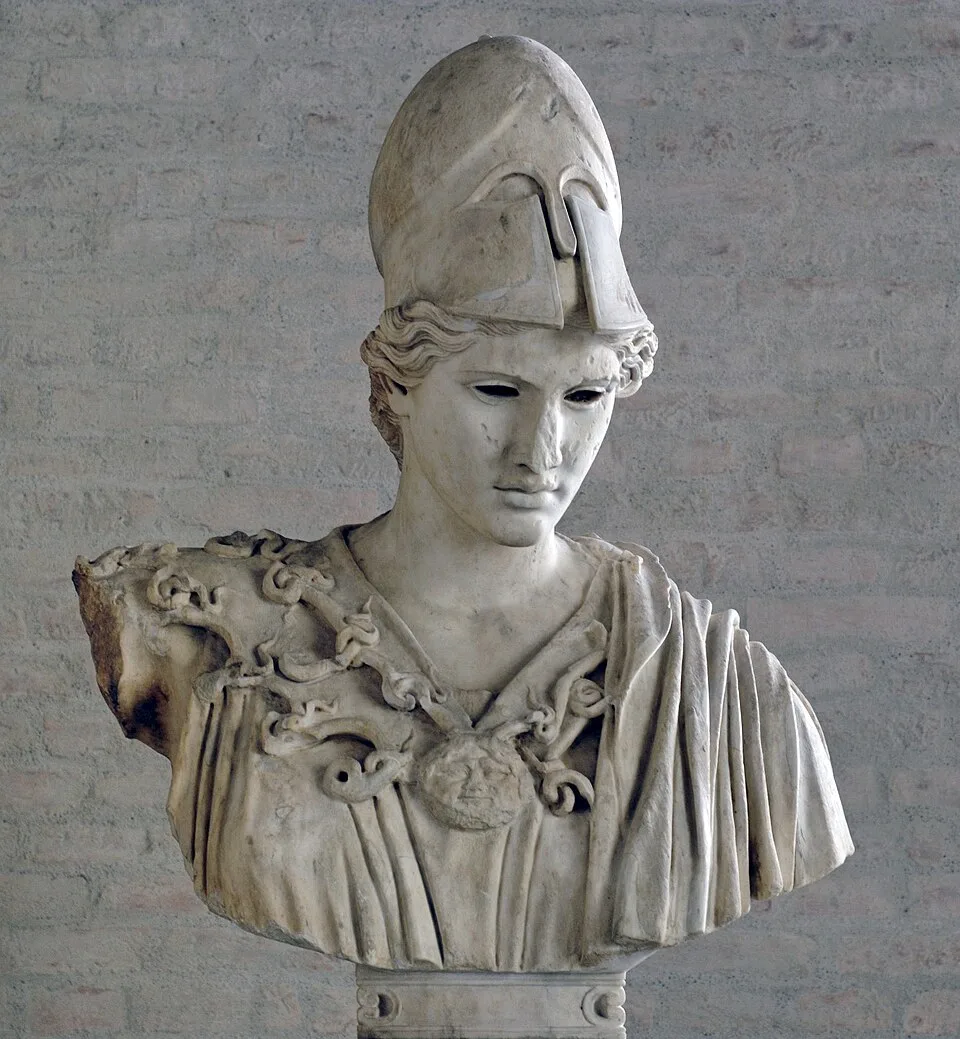
Athena
Greek · deity · primordial · Recorded classification
Greek goddess of wisdom, craft, and disciplined war; born from Zeus's head after he swallowed her pregnant mother Metis. Parthenos ("virgin") epithet. Polias of Athens, where the Acropolis bears her temples — the Parthenon and the Erechtheion (the latter housing the ancient olive-wood xoanon of Athena Polias).
Parentage
- paternal: Zeus
Domains
- wisdom
- craft techne
- war strategy
- civic protection
Powers
- Create the olive tree
- Grant skill in craft and weaving
- Disguise self as mortals and birds
Epithets
- Παλλάς The standard cult-name (perhaps 'maiden' or 'brandisher'), Pallas AthenaHom. Il. 1.200 (Παλλὰς Ἀθηναίη) (primary)
- γλαυκῶπις Bright/gleaming-eyed (or owl-eyed); the recurrent Homeric epithetHom. Il. 1.206; Hes. Theog. 13 (recurrent formula) (primary)
- Παρθένος Virgin/maiden; the title of the Parthenon cult-statue on the AcropolisPaus. 1.24.5-7; cf. Athena Parthenos of Pheidias (primary)
- Πολιάς Of the city; guardian of the Athenian acropolis (the ancient olive-wood image)Paus. 1.26.6-7; Hdt. 5.82 (primary)
- Πρόμαχος She who fights in the front line; the colossal Acropolis bronzePaus. 1.28.2 (the bronze Athena Promachos) (primary)
- Ἐργάνη Worker; patroness of craftsmen, spinners, and artisansPaus. 1.24.3; Soph. fr. 844 (primary)
- Τριτογένεια Trito-born (of Lake/river Triton, or 'truly-born'); ancient cult epithetHom. Il. 4.515; Hes. Theog. 895 (primary)
- Νίκη Victory; Athena Nike, the wingless victory of the Acropolis bastionPaus. 1.22.4 (Athena Nike Apteros) (primary)
- Ἀτρυτώνη The unwearying / indefatigableHomer, Iliad 2.157; Odyssey 4.762 (primary)
- ὀβριμοπάτρη Daughter of a mighty fatherHomer, Iliad 5.747 (primary)
- Ἀλέα Athena Alea of Tegea, chief cult of ArcadiaPausanias 8.45.4 (primary)
Relations
- sibling: HebeFull sibling; shares the same complete attested parentage.
- sibling: AresFull sibling; shares the same complete attested parentage.
- sibling: ApolloFull sibling; shares the same complete attested parentage.
- sibling: AeacusFull sibling; shares the same complete attested parentage.
- sibling: DionysusFull sibling; shares the same complete attested parentage.
- sibling: ArtemisFull sibling; shares the same complete attested parentage.
- sibling: HermesFull sibling; shares the same complete attested parentage.
- equated with: MinervaRoman Minerva is the canonical Latin parallel to Greek Athena through interpretatio Romana; the Etruscan Menrva is the intermediate transmission-layer via the Capitoline Triad.Standard interpretatio Graeca/Romana scholarship; Beard, North & Price, Religions of Rome (1998); Wissowa, Religion und Kultus der Römer (1912) (secondary)
- ally: PerseusReciprocal of greek_apollod_perseus.allyApollod. 2.4.2 (gives the polished shield); Ov. Met. 4.799-803 (places Medusa's head on her aegis) (primary)
- enemy: AresHom. Il. 5.733-863, 21.391-414 (primary)
- ally: HeraclesApollod. 2.5.11 (assists in the labors) (primary)
- interpretatio: MinervaAthena ↔ Minerva per ancient interpretatio, mediated by Etruscan Menrva. Roman Minerva's Capitoline triad role and Quinquatrus craft-and-learning frame are Roman institutional features.Cic. Nat. D. 3.53-59 (primary)
- interpretatio: MenrvaReciprocal of etruscan_menrva.interpretatio.de Grummond, Etruscan Myth, Sacred History, and Legend (2006) (secondary)
- interpretatio: NeithPlato: the patron of Sais is 'in Egyptian Neith, in Greek Athena.' Preserves the armed weaver-goddess of wisdom; breaks on Neith's primeval creatrix role — Athena creates nothing, being herself created.Plato, Timaeus 21e (primary); Herodotus, Histories 2.59, 2.62 (Sais) (primary)
- interpretatio: AnatCypriot bilingual equates Anat with Athena Soteira Nike. Preserves the virgin war-goddess; breaks on Anat's blood-wading ferocity and grief for Baal — Athena's warfare is disciplined, never frenzied.KAI 42 (Phoenician-Greek bilingual, Larnax tis Lapithou: Anat = Athena Soteira Nike) (primary)
- equated with: AllatAllat's sanctuary sculpture and Hellenized dedications render her in Athena's armed type. Preserves the armed city-protectress; breaks on Allat's aniconic betyl tradition and her bride-of-Dushara role.J. F. Healey, The Religion of the Nabataeans (2001), on Allat-Athena statuary at Wadi Ramm (secondary)
- equated with: MaliyaMaliya was identified with Athena in 4th-c. Lycia (coins, inscriptions). Preserves craft-patronage; breaks on Maliya's older spring-and-vegetation nature, which Athena never had.T. R. Bryce, The Lycians in Literary and Epigraphic Sources (1986) (secondary)
- counterpart of: AthenaThe hymn addresses this deity in an Orphic ritual context; Greek genealogy is not imported.Orphic Hymns, 31 (Thomas Taylor numbering; modern hymn 32) (primary)
Sources
- existence: Hom. Il. 1.194-222, 5.733-863; Hes. Theog. 886-900; Apollod. 1.3.6 (primary)
- parthenogenesis: Hes. Theog. 886-900 (born from Zeus's head after Zeus swallowed Metis pregnant with her) (primary)