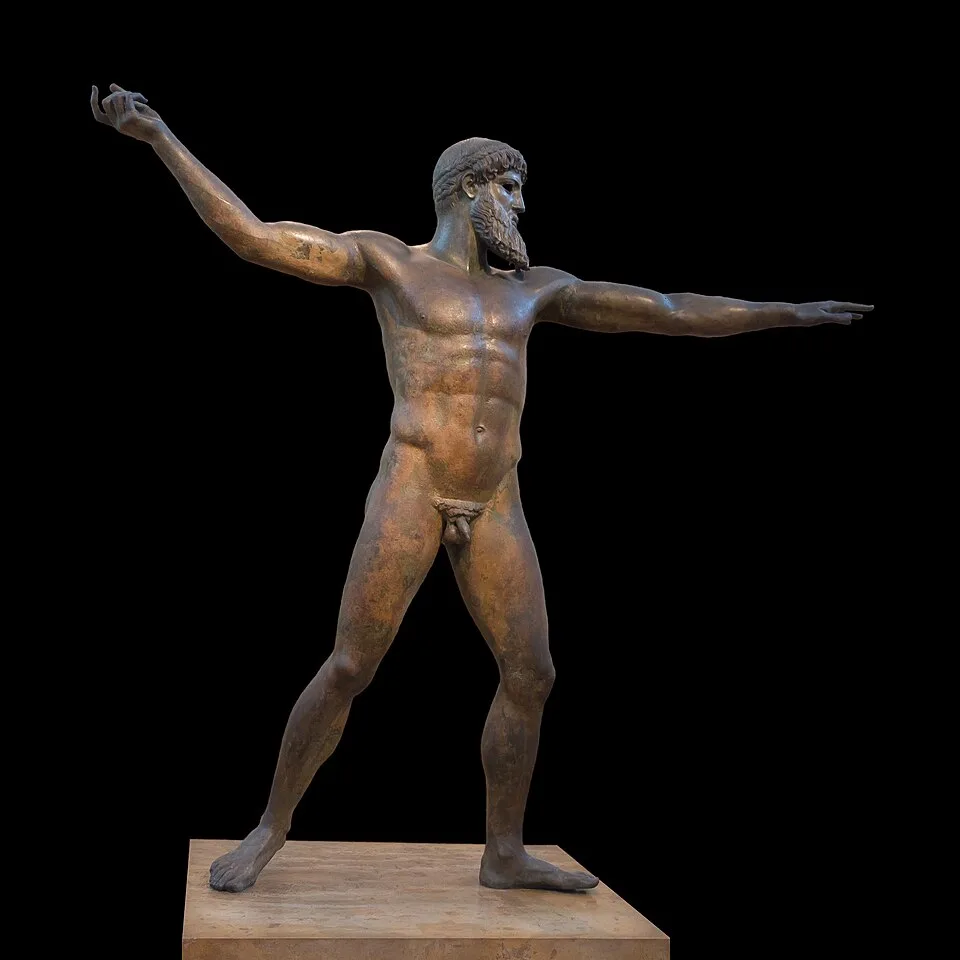
Zeus
Greek · deity · primordial · Recorded classification
King of the Olympian gods and sky-father, wielder of the thunderbolt; youngest son of Cronus and Rhea, who freed his swallowed siblings and overthrew the Titans to take the throne of Olympus. Father of Heracles by the mortal Alcmene.
Parentage
- father: CronusHesiod, Theogony 453–458 (primary)
- mother: RheaHesiod, Theogony 453–458 (primary)
Children
- Aeacus
- Aethlius
- Alexander III of Macedon
- Amphion
- Heracles
- Perseus
- Arcas
- Dardanus
- Eileithyia
- Epaphus
- Helen
- Apollo
- Ares
- Artemis
- Athena
- Calliope
- Clio
- Dionysus
- Erato
- Euterpe
- Hebe
- Hermes
- Melpomene
- Persephone
- Polyhymnia
- Terpsichore
- Thalia
- Urania
- Iasion
- Minos
- Pirithous
- Pollux
- Rhadamanthus
- Sarpedon (Cretan)
- Sarpedon (Lycian)
- Tantalus
- Tityus
- Zethus
Children in alternative accounts
- Aeacus: Apollodorus: Zeus and AeginaApollodorus, Library 3.12.6 (primary)
- Aethlius: Apollodorus: Aetolian ancestryApollodorus, Library 1.7.2 (primary)
- Heracles: Satyrus: transmitted divine ancestrySatyrus, dynastic genealogy preserved in Theophilus, To Autolycus 2.7 (Greek text) (primary)
- Asopus: Zeus and EurynomeApollodorus, Library 3.12.6 (primary)
- Endymion: Apollodorus: Zeus as alternative fatherApollodorus, Library 1.7.5 (primary)
- Hellen: Apollodorus: Zeus as alternative fatherApollodorus, Library 1.7.2 (primary)
Names and tradition associations
- Ammon Herodotus, Histories 2.42, 54–55 (primary)
- Zeus-Oromasdes Bruno Jacobs, Nemrud Dağı, Encyclopaedia Iranica (secondary)
Domains
- sky
- thunder
- fate
- kingship
Powers
- Gather clouds and send storms
- Hurl thunderbolts / strike with lightning
- Send prophetic omens and signs
- Send omens and prophetic signs
- Transform into beasts and elements
Epithets
- Ὀλύμπιος Olympian; he who dwells on Olympus, the supreme cult-titleHom. Il. 1.353; Pind. Ol. 2.12 (primary)
- Ξένιος Of strangers/guests; protector of the guest-host relationship (xenia)Hom. Od. 9.270-271; 14.389 (primary)
- Ὅρκιος Of oaths; guarantor and avenger of sworn oathsPaus. 5.24.9-11 (the Zeus Horkios at Olympia) (primary)
- Κτήσιος Of property/the storeroom; household protector of possessionsAesch. Supp. 445; Harpocration s.v. Κτησίου Διός (primary)
- Ἑρκεῖος Of the courtyard wall (herkos); protector of the household enclosureHom. Od. 22.334-335; Paus. 4.17.4 (primary)
- Νεφεληγερέτα Cloud-gatherer; the standard Homeric formulaic epithetHom. Il. 1.511; 5.736 (recurrent formula) (primary)
- Σωτήρ Saviour; deliverer, invoked in the third libation at symposiaAesch. Supp. 26; Pind. Ol. 5.17 (primary)
- Πανελλήνιος Of all the Greeks; the pan-Hellenic Zeus of AeginaPaus. 1.44.9; 2.30.3-4 (primary)
- αἰγίοχος Aegis-bearing; wielder of the storm-shieldHomer, Iliad 1.202; Hesiod, Theogony 11 (primary)
- τερπικέραυνος Who delights in the thunderboltHomer, Iliad 1.419; Hesiod, Theogony 286 (primary)
- ὑψιβρεμέτης The high-thundering oneHomer, Iliad 1.354; Hesiod, Works and Days 8 (primary)
- εὐρύοπα Wide-thundering / far-sounding (or far-seeing)Homer, Iliad 1.498 (primary)
- μητίετα The all-wise counsellorHomer, Iliad 1.175; Hesiod, Theogony 56 (primary)
Relations
- lover: Electra the PleiadReciprocal of the Atreid/Trojan-cluster genealogy.
- lover: GanymedeReciprocal of the Atreid/Trojan-cluster genealogy.
- enemy: TantalusReciprocal of the Atreid/Trojan-cluster genealogy.
- lover: AeginaApollod. 3.12.6; Pind. Isth. 8.16-23; Ovid Met. 7.474-525 (primary); Apollod. 3.12.6; Pind. Isth. 8.16-23; Ovid Met. 7.474-525 (primary); Apollodorus, Library 3.12.6 (primary)
- lover: Plouto (Lydian/Phrygian nymph of Mt. Sipylus; mother of Tantalus by Zeus) · GreekPaus. 2.22.3; Hyg. Fab. 82, 155 (primary)
- lover: Electra the PleiadApollod. 3.12.1; Hes. cat. fr. 177 (primary); Apollod. 3.12.1; Hes. cat. fr. 177 (primary)
- equated with: IuppiterRoman Iuppiter is the canonical Latin parallel to Greek Zeus through interpretatio Romana; the sky-father-and-thunderbolt iconography is shared, but the Roman cult-institutional form (Capitoline Triad Iuppiter-Iuno-Minerva, Iuppiter Optimus Maximus title) is distinctively Roman.Standard interpretatio Graeca/Romana scholarship; Beard, North & Price, Religions of Rome (1998); Wissowa, Religion und Kultus der Römer (1912) (secondary)
- enemy: TantalusPind. Ol. 1; Hom. Od. 11.582-592 (primary); Pind. Ol. 1; Hom. Od. 11.582-592 (primary)
- lover: DanaeReciprocal of greek_apollod_danae.loverApollod. 2.4.1; Pind. Pyth. 12.17-18; Hor. Carm. 3.16 (primary)
- lover: LaodamiaReciprocal of greek_laodamia_lycian.loverHom. Il. 6.198-199 (primary)
- lover: LedaReciprocal of greek_leda.loverCypria fr. 6; Eur. Hel. 16-22; Apollod. 3.10.7 (primary)
- lover: Antiope of ThebesReciprocal of greek_antiope_thebes.loverHom. Od. 11.260-265; Apollod. 3.5.5 (primary)
- lover: IoReciprocal of greek_io.loverAesch. Prom. 561-886; Apollod. 2.1.3; Ov. Met. 1.583-750 (primary)
- lover: ElaraReciprocal of greek_elara.loverHom. Od. 11.576-581; Apollod. 1.4.1 (primary)
- lover: DiaReciprocal of greek_dia.loverHom. Il. 14.317-318 (primary)
- lover: EuropaReciprocal of greek_europa.loverHom. Il. 14.321-322; Hes. fr. 140; Apollod. 3.1.1 (primary)
- lover: CallistoReciprocal of greek_callisto.loverApollod. 3.8.2; Ov. Met. 2.401-440 (primary)
- sibling: HestiaExternalref-only — greek_hesiod_hestia no longer registeredHes. Theog. 453-457 (primary); Hes. Theog. 453-457 (primary)
- sibling: DemeterReciprocal of greek_hesiod_demeter.siblingHes. Theog. 453-454 (primary)
- sibling: PoseidonReciprocal of greek_hesiod_poseidon.siblingHes. Theog. 453-457 (primary)
- spouse: HeraHes. Theog. 921-923; Hom. Il. 14.295-296 (primary)
- interpretatio: IuppiterGreek Zeus ↔ Roman Iuppiter — cognate Indo-European origin (*Dyēus ph₂tḗr) but the cult-form is distinctively Roman: the Capitoline triad institutional structure, Optimus Maximus title, the triumphator-as-Iuppiter ritual identification, the flamen Dialis taboo system. See Iuppiter entry.Cic. Nat. D. 2.64; Verg. Aen. 1.46-49; Macr. Sat. 1.12.18 (primary)
- equated with: AmunGreek Zeus ↔ Egyptian Amun-Ra at the Siwa Oasis. The Greek label was always "Zeus-Ammon" with the ram horns of Amun. Alexander's 331 BCE visit and reception as son-of-Ammon canonized the equation in Hellenistic iconography.Hdt. 2.42; Arrian Anab. 3.3-4 (Alexander at Siwa); Plut. Alex. 27 (primary)
- interpretatio: TiniaReciprocal of etruscan_tinia.interpretatio.de Grummond, Etruscan Myth, Sacred History, and Legend (2006) (secondary)
- interpretatio: AmunHerodotus equates Theban Amun with Zeus (Zeus Ammon; Siwa oracle). Preserves supreme-king status; breaks on Amun's hiddenness and processional oracle-cult, alien to Olympian Zeus.Herodotus, Histories 2.42 (primary)
- interpretatio: MardukHerodotus names Marduk's Esagila/ziggurat precinct 'Zeus Belos'. Preserves kingship over the gods; breaks on Marduk's earned, assembly-conferred sovereignty vs Zeus's inherited succession.Herodotus, Histories 1.181 (temple of 'Zeus Belos' at Babylon) (primary)
- interpretatio: Ahura MazdaHdt: Persians 'call the whole circle of heaven Zeus'; Commagene fuses Zeus-Oromasdes. Preserves supreme sky-sovereignty; breaks on Mazda's uncreated transcendence and lack of myth-cycle or consort.Herodotus, Histories 1.131 (primary); OGIS 383 (Nemrud Dagh: Zeus-Oromasdes) (primary)
- interpretatio: BaalshaminPhilo: 'Beelsamen, in Phoenician lord of heaven, Zeus in Greek.' Preserves the sky-lord title exactly; breaks on Baalshamin's rain-giving weather portfolio, closer to Zeus's storm aspect than his kingship.Philo of Byblos apud Eusebius, Praep. ev. 1.10.7 (primary)
- syncretism: BaalBaal of Mt. Zaphon continued as Zeus Kasios of Mons Casius, a documented cult fusion of Hellenistic date. Preserves the storm-god's mountain seat and seafarers' cult; breaks on Baal's death-and-return cycle.O. Eissfeldt, Baal Zaphon, Zeus Kasios und der Durchzug der Israeliten durchs Meer (1932) (secondary)
- equated with: TiwazName-cognates from PIE *dyeus. Preserves the inherited 'daylight-sky father' etymon; breaks functionally — Luwian Tiwaz developed into a sun-god and oath-keeper, not a storm-wielding king of gods.M. L. West, Indo-European Poetry and Myth (2007), ch. 4 on *Dyeus (secondary)
- equated with: LefsLydian Lefs/Lews is the standard scholarly identification of the Lydian Zeus in votive and funerary texts. Preserves the rain-bringer aspect; the Lydian god lacks Zeus's pan-pantheon sovereignty.R. Gusmani, Lydisches Wörterbuch (1964), s.v. Lefs/Lews (secondary)
- syncretism: Zibelthiurdos the Lightning-BearerRoman-era dedications to 'Zeus Zbelsurdos' fuse the Thracian lightning-bearer with Zeus. Preserves the thunderbolt; the Thracian god remains a local mountain-storm power without Olympian court functions.D. Detschew, Die thrakischen Sprachreste (1957), s.v. Zbelsurdos (secondary)
- syncretism: Sabazios the Sky-Father HorsemanImperial-period cult fuses the Thraco-Phrygian horseman sky-father with Zeus as 'Zeus Sabazios'. Preserves the *Dyeus-derived sky-father core; breaks on Sabazios's ecstatic rites and serpent-and-hand cult.Epigraphic 'Zeus Sabazios' dedications; cf. Strabo, Geography 10.3.15-18 (primary)
- interpretatio: Sky-Father PapaiosReciprocal of scythian_papaios.interpretatio — Hdt: 'Zeus, in Scythian most rightly named Papaios' ('father'). Preserves the sky-father paired with Earth; breaks on the absence of any Scythian sovereignty-myth or thunder-weapon for Papaios.Herodotus, Histories 4.59 (primary)
- father: CronusHesiod, Theogony 453–458 (primary)
- mother: RheaHesiod, Theogony 453–458 (primary)
- lover: AeginaApollodorus, Library 3.12.6 (primary)
- interpretatio: AmmonHerodotus, Histories 2.42, 54–55 (primary)
- syncretism: Zeus-OromasdesBruno Jacobs, Nemrud Dağı, Encyclopaedia Iranica (secondary)
- counterpart of: ZeusTradition-specific counterpart; this link does not transfer parentage.Orphic Hymns, 14 (Taylor numbering) (primary)
- child (Apollodoran account): EndymionApollodorus, Library 1.7.5 (primary)
- child (Apollodoran account): AethliusApollodorus, Library 1.7.2 (primary)
- child (Apollodoran account): HellenApollodorus, Library 1.7.2 (primary)
- child (dynastic pedigree): HeraclesNamed child in the Satyrus pedigree; this claim does not alter conventional default parentage.Satyrus, dynastic genealogy preserved in Theophilus, To Autolycus 2.7 (Greek text) (primary)
Sources
- existence: throughout Greek corpus (primary)