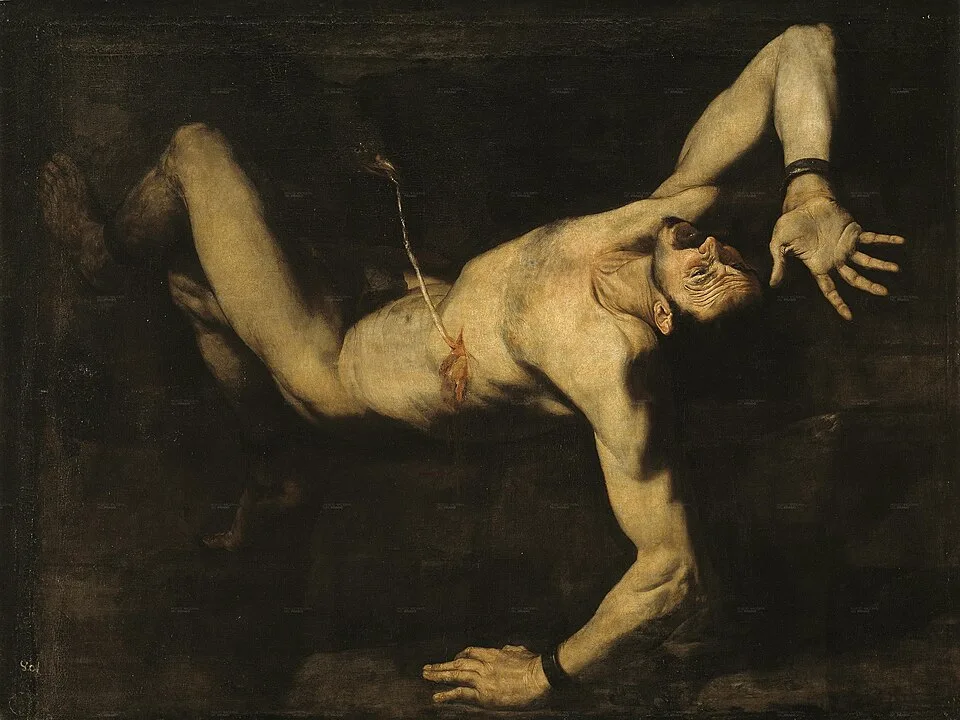
Tityus
Half-Olympian son of Zeus by Elara daughter of Orchomenus (or Minyas in variant traditions). Conceived when Zeus, fearing Hera's wrath, hid Elara beneath the earth; the pregnancy continued underground and the embryo grew enormous from the chthonic-conception conditions. Born from the earth itself when Elara died in childbirth from the size of the embryo — the chthonic-emergence birth-pattern marking Tityus structurally as a giant rather than ordinary demigod (some traditions name Gaia herself as nursing-mother, conflating Tityus with the broader Gigantes mythologem). Encountered Leto traveling to the Pythian sanctuary at Delphi; attempted to rape her at Panopeus in Phocis. Apollo and Artemis came to their mother's aid and shot Tityus down with their arrows — the killing is one of the canonical Apollonian-Artemisian joint-action moments, paralleled in the slaughter of the Niobids and the killing of the giant Orion. In Tartarus, body stretched out covering nine pelethra (nine acres); two vultures eternally tear at his liver, which is eternally regrown — the canonical Greek-and-Roman exemplum of erotic-aggression-against-the-divine punished eternally. Lucretius De Rerum Natura 3.984-994 uses Tityus as the philosophical exemplum for the absurdity of literal-Tartarean-punishment-readings, reading the vultures as allegorical for the torments of love itself. Pausanias 10.4.5 records a tomb-mound (sēma) of Tityus at Panopeus, the place of his killing — the local Phocian cult of the chthonic-giant figure.
Parentage
Domains
- gigantic monstrous aggression
- eternally punished Tartarean exemplum
Powers
- gigantic strength and stature
Epithets
- Τιτυὸς Γαιήϊος 'Tityus son of Earth' — the giant stretched over nine plethra in Tartarus, his liver torn by vulturesHomer, Odyssey 11.576-581 (primary)
- Γαιήϊος son of Gaia / earth-born (he was carried to term by the Earth)Homer, Odyssey 7.324, 11.576 (primary)
Relations
- attempted rape of: Leto (Titaness mother of Apollo and Artemis by Zeus) · GreekHom. Od. 11.580-581; Apollod. 1.4.1 (primary)
- killed by: ApolloApollod. 1.4.1 (primary)
- killed by: ArtemisApollod. 1.4.1 (primary)
Sources
- existence: Homer, Odyssey 11.576-581 (the foundational Tartarean-punishment reference) (primary); Apollodorus, Bibliotheca 1.4.1 (the canonical narrative of conception, attack on Leto, and killing) (primary); Pindar, Pythian 4.90-92 (the lyric reception) (primary); Vergil, Aeneid 6.595-600 (the Roman Tartarean-tableau reception) (primary); Lucretius, De Rerum Natura 3.984-994 (the Epicurean philosophical-allegorical reading) (primary); Pausanias 10.4.5; Strabo 9.3.14 (the Panopeus / Tityon tomb-cult tradition) (primary)