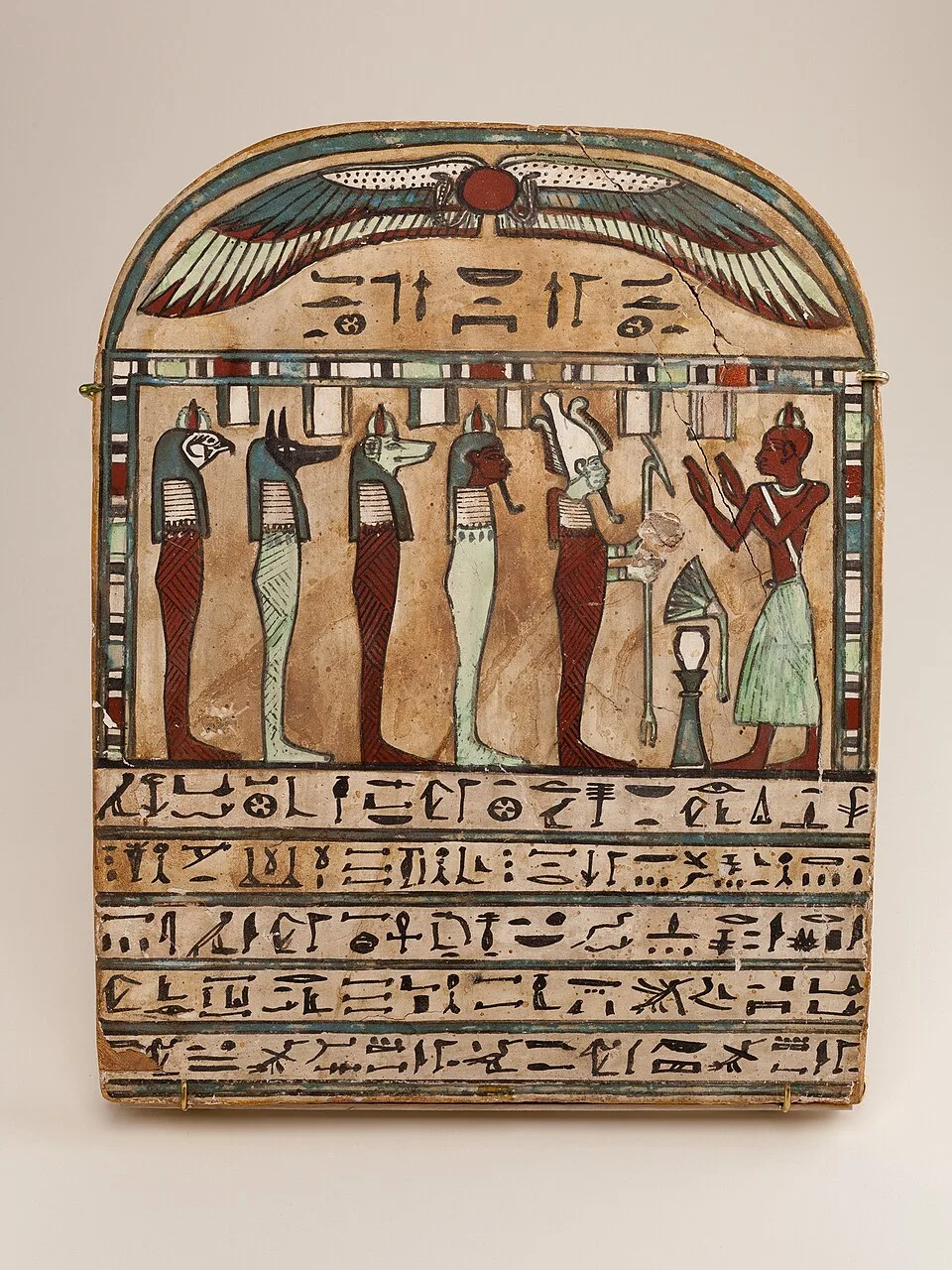
Amun
Egyptian · deity · old kingdom · Recorded classification
Hidden-creator deity, Theban patron, syncretized with Ra as Amun-Ra in the New Kingdom. Doctrinal father of legitimate pharaohs through the formal Birth Cycle iconographic program. Kushite kings of the 25th Dynasty drew their legitimation through their devotion to Amun at Gebel Barkal.
Children
Domains
- creation
- wind air
- fertility
Powers
- kingship egyptian conferral
- oracular judgment
- celestial luminance
- Deliver oracular verdicts
- Create himself and stay hidden
Epithets
- nsw nṯrw King of the gods; the supreme royal title of Amun-Ra in the New KingdomGreat Hymn to Amun, Papyrus Boulaq 17; Cairo CG 58038 (primary)
- kꜣ-mwt.f Bull of his mother; the self-generating procreative AmunKarnak temple texts; cf. Hymns to Amun-Re (New Kingdom) (primary)
- nb nswt tꜣwy Lord of the Thrones of the Two Lands; Amun of KarnakKarnak temple cult-titulary (Ipet-sut), New Kingdom (primary)
- jmn rn.f Hidden of name; Amun whose true name and nature are concealedLeiden Hymns to Amun (Papyrus Leiden I 350) (primary)
- jmn-rꜥ Amun-Ra: the hidden god fused with the sun; supreme deity of the New KingdomCairo Hymn to Amun-Ra (Papyrus Boulaq 17); the Leiden Amun hymns (primary)
Relations
- spouse: Mut
- equated with: ZeusGreek Zeus ↔ Egyptian Amun-Ra at the Siwa Oasis oracle; the Greek-language label for the cult was always "Zeus-Ammon" with the distinctive ram horns of Amun. Alexander the Great's 331 BCE visit and reception as son-of-Ammon canonized the equation in Hellenistic-era iconography. Distinct entries retained because Egyptian Amun-Ra has its own pre-Greek theological development (the Karnak corpus, the New Kingdom Amun-Ra synthesis with the Heliopolitan sun-cult, the Theban triad with Mut and Khonsu) wholly independent of Zeus.Hdt. 2.42 (the Theban Zeus = Amun); Arrian Anab. 3.3-4 (Alexander at Siwa, 331 BCE); Plut. Alex. 27; Curt. 4.7.5-32 (primary)
- father of: HatshepsutHatshepsut Birth Cycle, Deir el-Bahari middle terrace (primary)
- father of: Amenhotep IIIAmenhotep III Birth Cycle, Luxor Temple (primary)
- father of: Ramesses IIRoyal titulary (primary)
- equated with: AmaniReciprocal of amani.equated-with — Kushite Amani of Napata/Gebel Barkal is the Egyptian Amun received as national god of Kush. Preserves the hidden creator and king-maker oracle; the Kushite god's ram-form and Barkal mountain-seat are distinct.L. Török, The Kingdom of Kush: Handbook of the Napatan-Meroitic Civilization (1997) (secondary)
- interpretatio: ZeusReciprocal of greek_hesiod_zeus.interpretatio — Herodotus equates Theban Amun with Zeus (Zeus Ammon; Siwa oracle). Preserves supreme-king status; breaks on Amun's hiddenness and processional oracle-cult, alien to Olympian Zeus.Herodotus, Histories 2.42 (primary)
- lover: AhmoseReciprocal of egyptian_ahmose.lover — Mortal Great Royal Wife; in the doctrinal Birth Cycle Amun fathers Hatshepsut through her (parental edge already on Hatshepsut).Birth Cycle reliefs, Deir el-Bahari (Amun visits Queen Ahmose in the form of Thutmose I to beget Hatshepsut) (primary)
- lover: MutemwiyaReciprocal of egyptian_mutemwiya.lover — Mortal mother of Amenhotep III in the Luxor Birth Cycle (parental edge already on Amenhotep III).Birth Cycle reliefs, Luxor Temple (Amun begets Amenhotep III through Queen Mutemwiya) (primary)
- lover: TuyaReciprocal of egyptian_tuya.lover — Mortal mother of Ramesses II; the divine-paternity claim rests on royal titulary rather than a developed Birth Cycle (parental edge already on Ramesses II).K. Kitchen, Pharaoh Triumphant (1982); Ramesside titulary asserting Amun's divine paternity of Ramesses II through his mother Tuya (secondary)
- has cult form: AmmonHerodotus, Histories 2.42, 54–55 (primary)
- royal patron of: Ptolemy I SoterThe Egyptian throne name calls the ruler beloved of Amun. This is royal favor, not a father-child relationship.Chris Bennett, Egyptian Royal Genealogy, Ptolemy I, notes 12 and 15: Stele Vienna 153; Gauthier, Livre des Rois IV, p. 216 (V) (secondary)
Sources
- existence: Pyramid Texts §446b (primary); Karnak temple corpus (primary); Hatshepsut Birth Cycle, Deir el-Bahari (primary)
- divine-paternity-of-pharaoh: Hatshepsut Birth Cycle, Deir el-Bahari (primary); Amenhotep III Birth Cycle, Luxor Temple (primary)