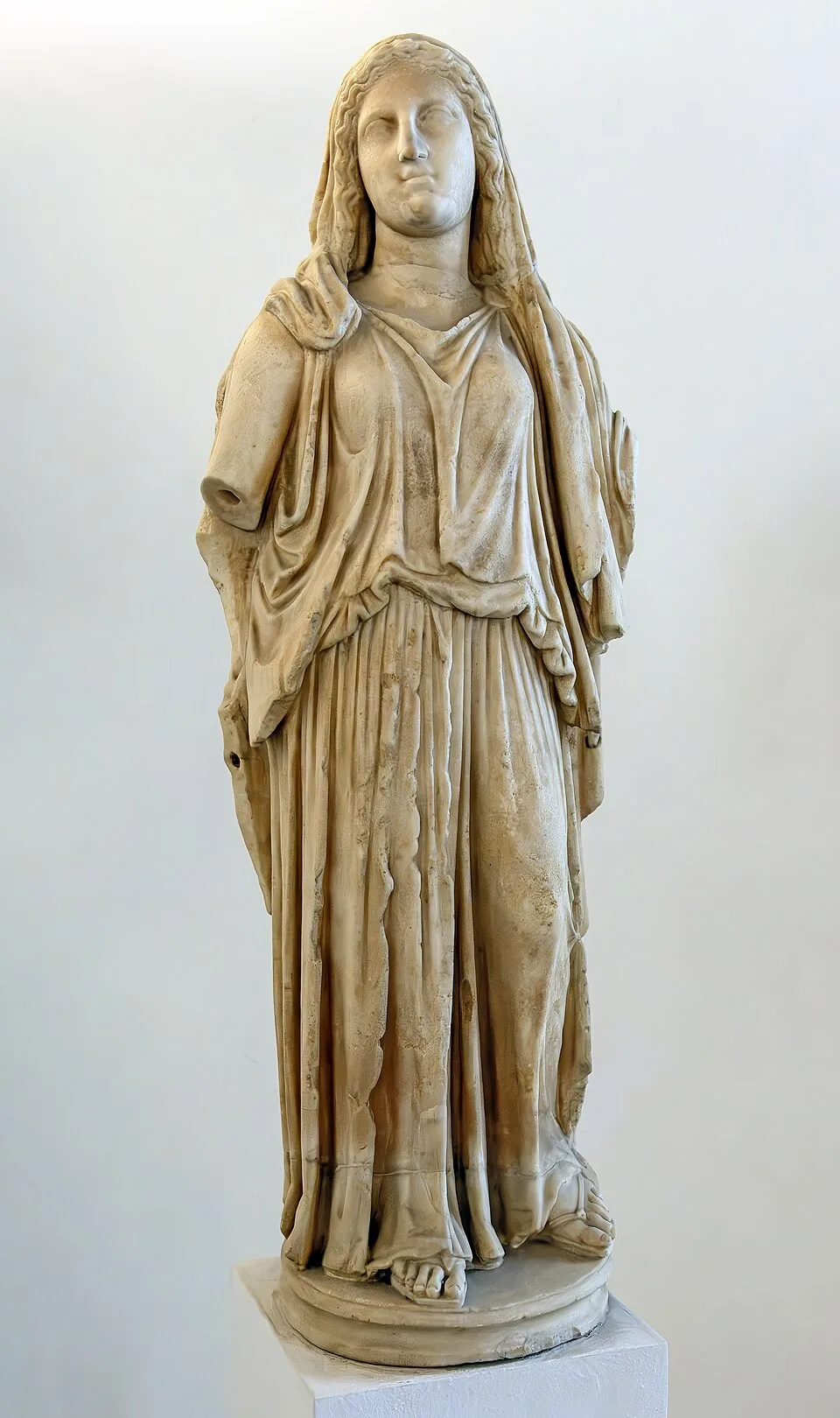
Demeter
Greek · deity · primordial · Recorded classification
Greek goddess of grain and agriculture; mother of Persephone. Defined by the Eleusinian Mysteries — the most important mystery cult of the ancient Mediterranean, attended for roughly 1,500 years until closure by Theodosius I in 392 CE. The Homeric Hymn to Demeter narrates her search for the abducted Persephone, the founding of the Mysteries at Eleusis, and the seasonal cycle.
Parentage
- father: CronusHesiod, Theogony 453–458 (primary)
- mother: RheaHesiod, Theogony 453–458 (primary)
Children
Domains
- agriculture grain
- mysteries
Powers
- Grant or withhold the grain harvest
- Bestow the art of agriculture
Epithets
- Θεσμοφόρος Law-bringer / bringer of order; honoured at the women's ThesmophoriaHdt. 6.91; Aristoph. Thesm. (passim); Paus. 1.42.6 (primary)
- Ἐλευσινία Eleusinian; Demeter of Eleusis, seat of the Great MysteriesHymn. Hom. Cer. 318; Paus. 1.38.6 (primary)
- Καρποφόρος Fruit-bearer; giver of the grain-harvest and cropsPaus. 8.53.7; 1.31.1 (primary)
- Χλόη Of the green shoot; Demeter of the sprouting young cornPaus. 1.22.3; Aristoph. Lys. 835 (primary)
- ἐϋστέφανος Fair-garlanded / fair-crowned; the hymnic epithet of DemeterHymn. Hom. Cer. 224, 307, 470 (primary)
- Χθονία Of the earth; Demeter of HermionePausanias 2.35.4–8 (primary)
- Ἀνησιδώρα Sender-up of gifts (from the earth)Pausanias 1.31.4 (primary)
- Σιτώ Giver of grain and foodAthenaeus, Deipnosophistae 3.109a; Pollux, Onomasticon (secondary)
Relations
- lover: Iasion
- equated with: ŽēmātGrenet reads the mourning vegetation-goddess of the Panjikent murals as a Sogdian counterpart of Demeter.F. Grenet, in "MITHRA ii. Iconography", Encyclopaedia Iranica (scholarly)
- equated with: CeresRoman Ceres is the canonical Latin parallel to Greek Demeter through interpretatio Romana; the plebeian-aedile association and lex sacrata Cereris are distinctively Roman institutional forms.Standard interpretatio Graeca/Romana scholarship; Beard, North & Price, Religions of Rome (1998); Wissowa, Religion und Kultus der Römer (1912) (secondary)
- lover: IasionHom. Od. 5.125-128; Hes. Theog. 969-974 (primary); Hom. Od. 5.125-128; Hes. Theog. 969-974 (primary)
- sibling: ZeusHes. Theog. 453-454 (primary)
- interpretatio: CeresDemeter ↔ Ceres per ancient interpretatio. Roman Ceres has substantial Italic identity (Aventine plebeian counter-temple, Cerealia April 12-19, Lex Sacrata) preceding the Greek equation.Cic. Nat. D. 2.67; Verg. Georg. 1.7 (primary)
- equated with: IsisDemeter ↔ Isis per Greek Hellenistic-era interpretatio Aegyptiaca. The Eleusinian-Isiac mystery overlap drove syncretism throughout the Hellenistic Mediterranean.Hdt. 2.59 (the Egyptian Demeter = Isis); Plut. De Iside 27, 38; Apul. Met. 11.5 (Isis aretalogy listing her many names) (primary)
- interpretatio: IsisHdt: 'Isis is in the Greek tongue Demeter.' Preserves grain-giving and mourning-search for a lost kin (Persephone/Osiris); breaks on Isis's magic, queenship, and wifely rather than maternal grief.Herodotus, Histories 2.59 (primary); Diodorus Siculus 1.13.5, 1.25 (primary)
- father: CronusHesiod, Theogony 453–458 (primary)
- mother: RheaHesiod, Theogony 453–458 (primary)
- counterpart of: DemeterThe hymn addresses this deity in an Orphic ritual context; Greek genealogy is not imported.Orphic Hymns, 39 (Thomas Taylor numbering; modern hymn 40) (primary)
Sources
- existence: h.Hom.Dem. passim; Hes. Theog. 453-454, 969-974; Apollod. 1.5 (primary)
- parentage: Hes. Theog. 453-454 (daughter of Cronus and Rhea, sister of Zeus) (primary)