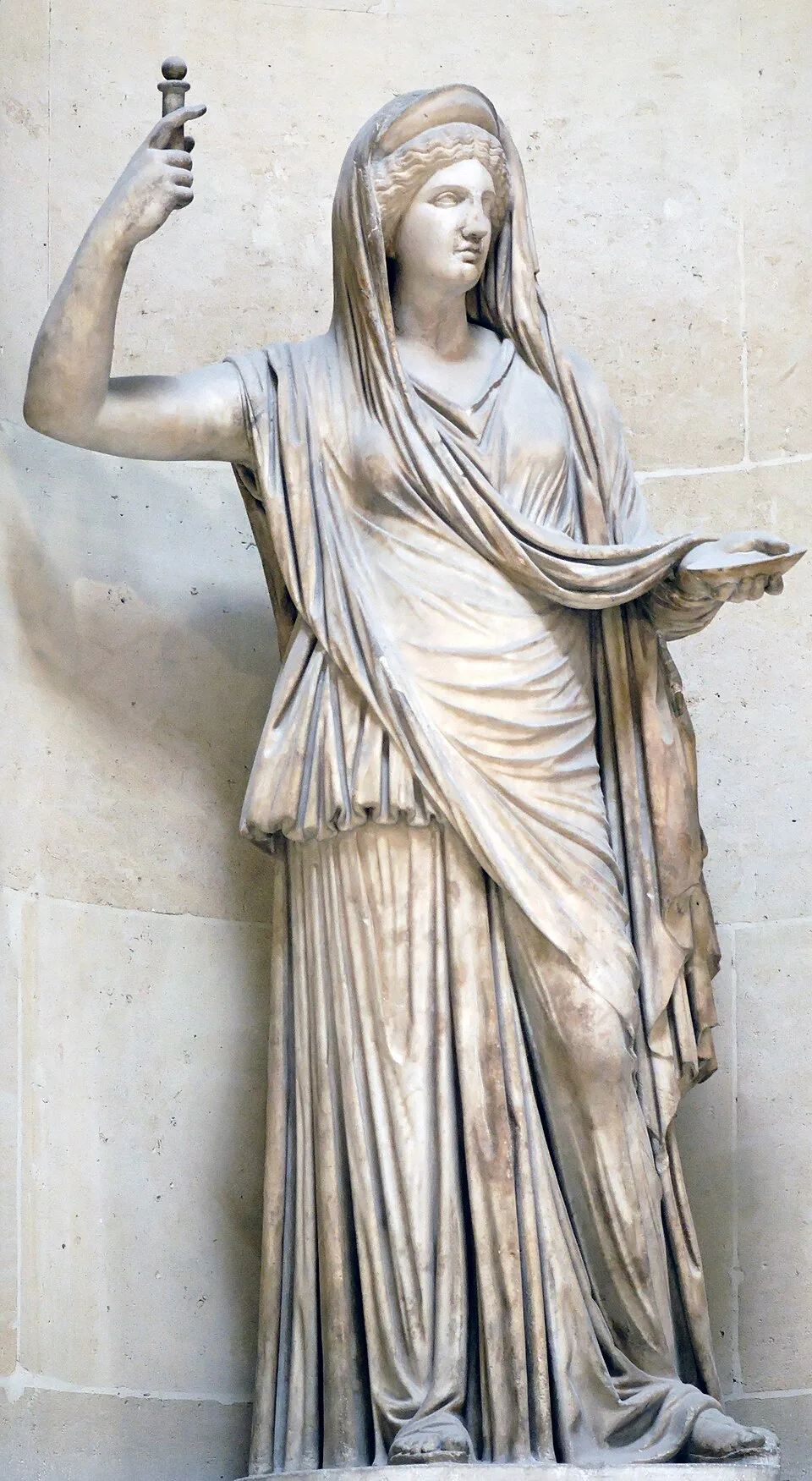
Hera
Greek · deity · primordial · Recorded classification
Greek queen of the gods; sister-wife of Zeus; mother of Ares, Hephaestus, Hebe, Eileithyia. Defining antagonist of Heracles throughout the Heraclean labors corpus. Major cult sites at the Argive Heraion, Samos, and Olympia (where her temple predates Zeus's).
Parentage
- father: CronusHesiod, Theogony 453–458 (primary)
- mother: RheaHesiod, Theogony 453–458 (primary)
Children
Domains
- marriage sovereignty
- queen of gods
Powers
- Beguile and seduce via the love-girdle
- Beguile with irresistible desire
- Inflict madness and persecution
- Inflict maddening persecution
Epithets
- βοῶπις Ox-eyed / cow-eyed; the constant Homeric epithet of HeraHom. Il. 1.551 (βοῶπις πότνια Ἥρη) (primary)
- λευκώλενος White-armed; recurrent Homeric formulaic epithetHom. Il. 1.55, 1.195 (recurrent formula) (primary)
- Ἀργεία Argive; Hera of the great Heraion of Argos, her chief Greek cult-seatPaus. 2.17.1-7; Hom. Il. 4.8 (Ἀργείη Ἥρη) (primary)
- Τελεία Of fulfilment/marriage; patroness of the completed (married) statePaus. 8.22.2; Aristoph. Thesm. 973 (primary)
- Παρθένος Maiden; aspect of Hera renewed virgin annually by the Kanathos springPaus. 2.38.2-3 (the bath at Kanathos near Nauplia) (primary)
- χρυσόθρονος Golden-thronedHomer, Iliad 1.611 (primary)
- πότνια Ἥρη Queenly/revered Hera; the formulaic title of addressHomer, Iliad 1.551 (primary)
- Ἀκραία Of the heights; Hera of the citadel (Argos, Corinth)Pausanias 2.24.1 (primary)
Relations
- equated with: UniEtruscan Uni is the canonical Etruscan parallel to Greek Hera; transmitted via Etruscan-to-Roman cult-evolution into Roman Iuno (the Capitoline Triad Tinia-Uni-Menrva → Iuppiter-Iuno-Minerva).Standard interpretatio Graeca/Romana scholarship; Beard, North & Price, Religions of Rome (1998); Wissowa, Religion und Kultus der Römer (1912) (secondary)
- equated with: IunoRoman Iuno is the canonical Latin parallel to Greek Hera through interpretatio Romana; shared queen-of-the-gods-and-marriage iconography. The Capitoline Triad position and the Iuno Moneta mint-association are distinctively Roman.Standard interpretatio Graeca/Romana scholarship; Beard, North & Price, Religions of Rome (1998); Wissowa, Religion und Kultus der Römer (1912) (secondary)
- sibling: HestiaExternalref-only — greek_hesiod_hestia no longer registeredHes. Theog. 453-457 (primary); Hes. Theog. 453-457 (primary)
- spouse: ZeusHes. Theog. 921-923; Hom. Il. 14.295-296 (primary)
- enemy: HeraclesHom. Il. 14.250-256; Apollod. 2.4.8 (drove Heracles to madness, sent serpents to his cradle) (primary)
- interpretatio: IunoHera ↔ Iuno per ancient interpretatio. Italic Iuno has substantial pre-Hera identity (Lanuvian Sospita, Capitoline geese, Moneta, Matronalia, the evocatio from Veii). See Iuno entry.Cic. Nat. D. 2.66; Verg. Aen. 1.36-75 (primary)
- interpretatio: UniReciprocal of etruscan_uni.interpretatio.de Grummond, Etruscan Myth, Sacred History, and Legend (2006) (secondary)
- interpretatio: AtargatisReciprocal of aramean_atargatis.interpretatio — Lucian calls the Hierapolis goddess Hera (enthroned beside a Zeus-Hadad) while admitting she blends Athena, Aphrodite, Selene and more — the ancient author himself flags how poorly the equation fits.Lucian, De Dea Syria 31-32 (primary)
- father: CronusHesiod, Theogony 453–458 (primary)
- mother: RheaHesiod, Theogony 453–458 (primary)
- counterpart of: HeraThe hymn addresses this deity in an Orphic ritual context; Greek genealogy is not imported.Orphic Hymns, 15 (Thomas Taylor numbering; modern hymn 16) (primary)
Sources
- existence: Hom. Il. 1.55-56, 14 entire; Hes. Theog. 454-457, 921-923; Apollod. 1.3.1 (primary)
- parentage: Hes. Theog. 454-457 (daughter of Cronus and Rhea) (primary)