Uni
Etruscan · deity · archaic · Recorded classification
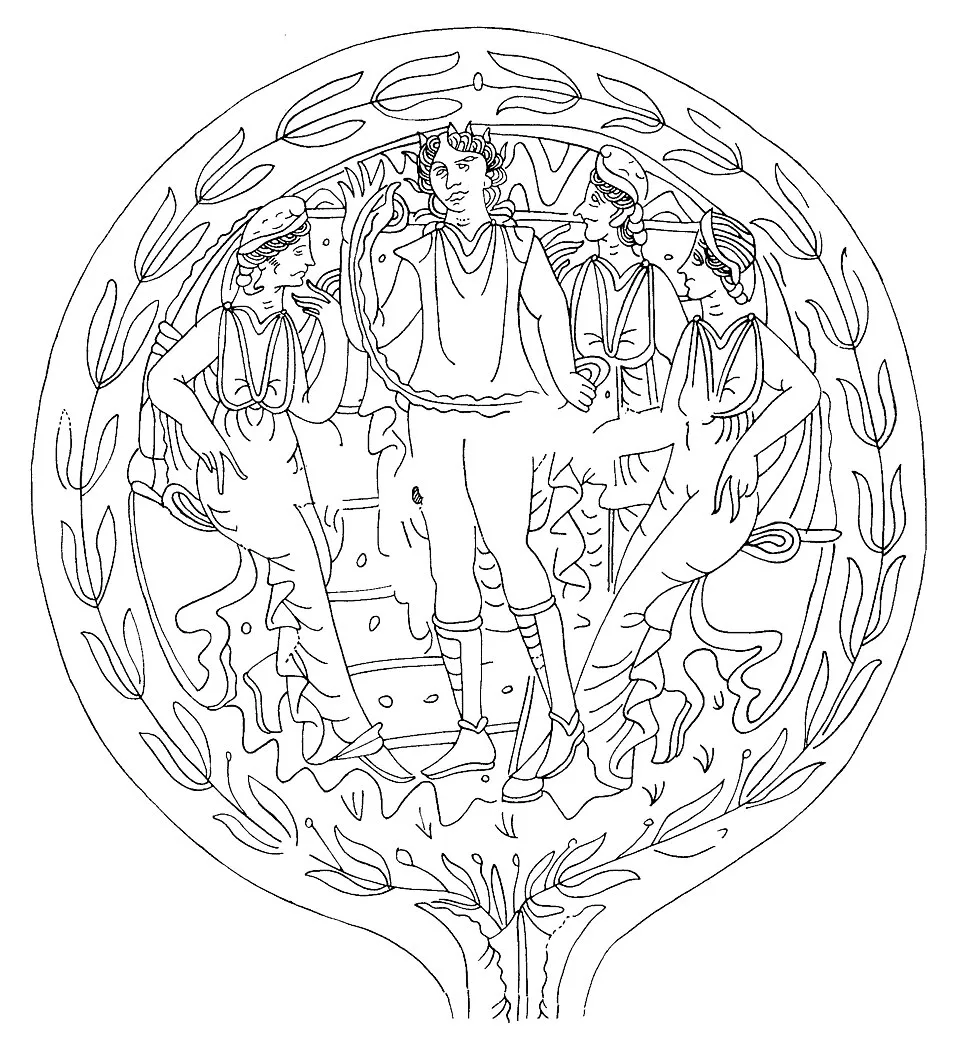
Supreme goddess of the Etruscan pantheon and consort of Tinia. Second member of the Etruscan triad (Tinia-Uni-Menrva) that became the model for the Roman Capitoline triad. The Volterra mirror depicts her breast-feeding of the adult Hercle — the ritual-as-adoption that integrates the Greek hero into Etruscan divinity. The Pyrgi tablets identify her bilingually with Phoenician Astarte, making her the structural anchor of cross-Mediterranean syncretism. Translated to Rome as Iuno Regina via Camillus's evocatio of 396 BCE.
Domains
- queen of the gods
- sovereignty and marriage
Powers
- Confer divine sonship by suckling
Epithets
- 𐌖𐌍𐌉 𐌌𐌀𐌗 Uni invoked on the Pyrgi Tablets, equated with Phoenician AstartePyrgi Tablets (Etruscan-Phoenician bilingual, c. 500 BCE) (primary)
Relations
- equated with: IunoUni is the direct Etruscan ancestor of Roman Iuno via the Capitoline Triad Tinia-Uni-Menrva → Iuppiter-Iuno-Minerva transmission.Capitoline Triad transmission scholarship; Beard, North & Price, Religions of Rome (1998); Cornell, The Beginnings of Rome (1995) (secondary)
- equated with: HeraUni is the Etruscan parallel to Greek Hera and the direct origin of Roman Iuno through Etruscan-to-Roman cult transmission (the Capitoline Triad Tinia-Uni-Menrva is the direct ancestor of Iuppiter-Iuno-Minerva).Standard interpretatio Graeca/Romana scholarship; Beard, North & Price, Religions of Rome (1998); Wissowa, Religion und Kultus der Römer (1912) (secondary)
- spouse: TiniaEtruskische Spiegel corpus (primary)
- foster mother of: HercleVolterra mirror (primary); Volterra mirror (primary)
- syncretism: AstarteThe Pyrgi tablets are the foundational document of Mediterranean cross-tradition syncretism — the bilingual Etruscan-Phoenician dedication explicitly identifies Uni with Phoenician Astarte.Pyrgi tablets c.500 BCE (primary); Pyrgi tablets c.500 BCE (primary)
- interpretatio: HeraCic. Nat. D. 3.42; Bonfante 1986 (primary)
- interpretatio: IunoUni ↔ Iuno per the Veii evocatio of 396 BCE — Camillus formally summoned Uni from her Veientine cult-place into Rome under the Roman name Iuno Regina. The ritual-evocatio is the most-attested case of explicit Etruscan-to-Roman deity-translation.Bonfante 1986; Liv. 5.21-22 (the Veii evocatio of Uni-as-Juno into Rome) (primary)
- interpretatio: AstarteReciprocal of phoenician_astarte.interpretatio — The Pyrgi bilingual dedicates one sanctuary 'to Astarte' (Phoenician) = 'to Uni' (Etruscan) — a state-level ancient equation. Preserves supreme-goddess rank; Uni's Hera-like matronage fits Astarte poorly.Pyrgi gold tablets (KAI 277), c. 500 BCE (primary)