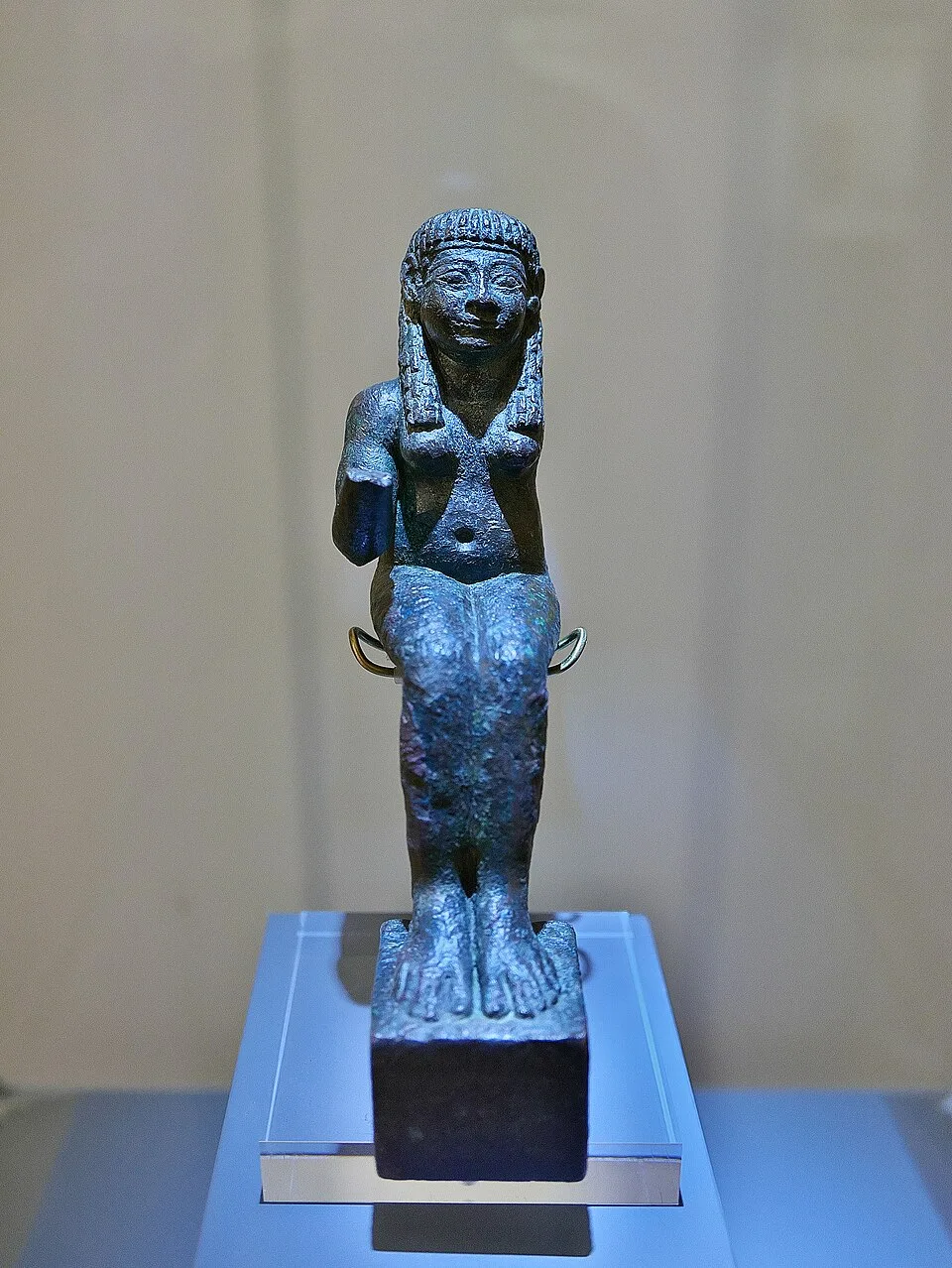
Astarte
Phoenician · deity · mythic · Recorded classification
Great Phoenician goddess of love, war, and the evening-star (Venus); chief goddess of Sidon, Tyre, and Byblos, served by royal priests.
Domains
- love and sex
- war
Powers
- Kindle sexual desire, beauty, and procreation
- Ride armed into battle as war-goddess
- shines as the evening star (Venus) and governs the heavens
Epithets
- ʿštrt šm bʿl Astarte, Name of Baal; her cultic title as Baal's manifest presenceEshmunazar sarcophagus inscription (KAI 14); Ugaritic ʿṯtrt-šm-bʿl (primary)
- rbt ʿštrt Lady Astarte; the great goddess of Sidon, Tyre, and ByblosSidonian royal inscriptions (KAI 14); cf. 1 Kings 11:5 (Ashtoreth) (primary)
Relations
- lover: EshmunDamascius: the goddess (Astronoe, identified with Astarte) loved the hunter youth, who unmanned himself fleeing her; she revived him as a god.Damascius, Life of Isidore, apud Photius, Bibliotheca cod. 242 (primary)
- spouse: MelqartReciprocal of phoenician_melqart.spouse — Paired chief god and goddess of Tyre; Astarte's part in Melqart's annual egersis is the standard scholarly reading.Bonnet, Melqart: Cultes et mythes de l'Heracles tyrien (1988) (secondary)
- equated with: AthtartReciprocal of canaanite_athtart.equated-with — Ugaritic ʿAṯtartu and Phoenician ʿAštart are the same goddess in Bronze and Iron Age streams. Preserves war, love, and the Venus-star; the Iron Age Phoenician goddess gains far greater cultic prominence.DDD (2nd ed. 1999), s.v. 'Astarte'; M. S. Smith, The Early History of God (2002) (secondary)
- interpretatio: AphroditeReciprocal of greek_hesiod_aphrodite.interpretatio — Philo: 'Astarte the Phoenicians say is Aphrodite'; Hdt derives Ourania's cult from Phoenicia. Preserves love + evening-star; breaks on Astarte's war portfolio, which Greek Aphrodite largely shed.Philo of Byblos apud Eusebius, Praep. ev. 1.10.32 (primary); Herodotus, Histories 1.105 (Aphrodite Ourania at Ascalon) (primary)
- equated with: InannaʿAštart and Ištar descend from common Semitic *ʿAṯtar-, sharing the love-war-Venus complex. Cognate development, not borrowing: each goddess's cult, consorts, and myths evolved independently.DDD (2nd ed. 1999), s.v. 'Astarte' (secondary)
- interpretatio: UniThe Pyrgi bilingual dedicates one sanctuary 'to Astarte' (Phoenician) = 'to Uni' (Etruscan) — a state-level ancient equation. Preserves supreme-goddess rank; Uni's Hera-like matronage fits Astarte poorly.Pyrgi gold tablets (KAI 277), c. 500 BCE (primary)
- equated with: AphroditeHdt. 1.105 ("the most ancient temple of Aphrodite was founded from the Phoenician Ascalon shrine"); Paus. 1.14.7; Tac. Hist. 2.3 (the conical Paphian stone) (primary)
- equated with: IsisPlut. De Iside 15-16 (the Byblos Astarte who hosted Isis on her quest for Osiris's body) (primary)
Sources
- existence: Sidonian royal sarcophagi (Tabnit, Eshmunazar II); Byblos inscriptions (primary); Britannica, Astarte (secondary)