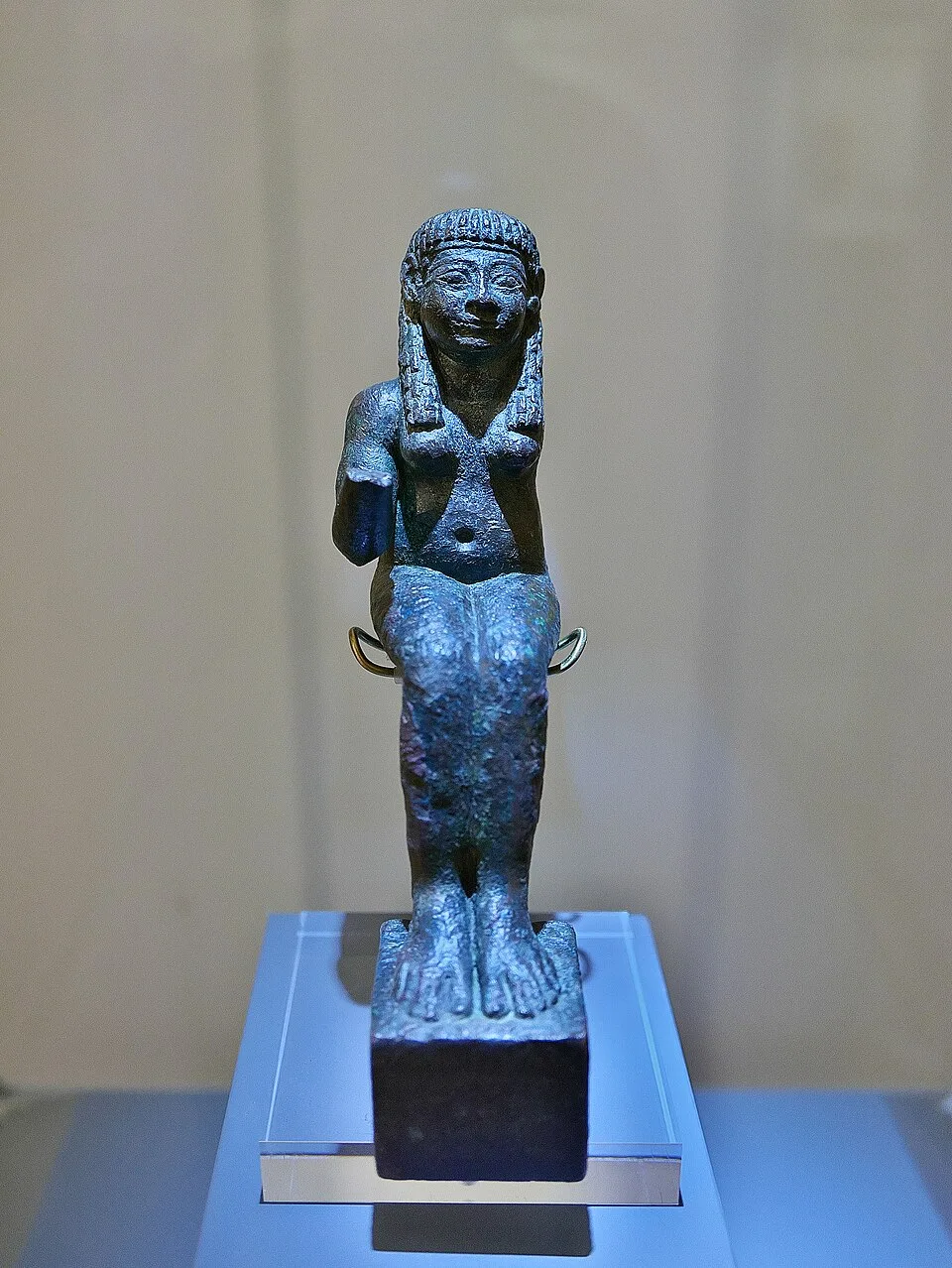
Athtart
Canaanite · deity · mythic · Recorded classification
Astral goddess of war and love, 'Name of Baal' (ʿṯtrt-šm-bʿl); prominent in cult, paired with Anat as Baal's restrainer in the myth.
Domains
- war
- love fertility
Powers
- Stay Baal's hand from killing Yam's envoys
- Hex Yam by Baal's name and command the rout
Epithets
- 𐎓𐎘𐎚𐎗𐎚 𐎌𐎎 𐎁𐎓𐎍 'Athtart, Name of Baal' — her principal cult-title at UgaritKTU 1.16 vi 56 (primary)
Relations
- equated with: AtargatisReciprocal of aramean_atargatis.equated-with — The name Atarʿate fuses ʿAttart (Astarte) with ʿAnat — Atargatis is linguistically built on Athtart. Preserves the great-goddess complex; Atargatis adds the fish-and-dove sanctity and Hierapolis cult.DDD (van der Toorn, Becking, van der Horst, eds., 2nd ed. 1999), s.v. 'Atargatis' (secondary)
- equated with: AstarteUgaritic ʿAṯtartu and Phoenician ʿAštart are the same goddess in Bronze and Iron Age streams. Preserves war, love, and the Venus-star; the Iron Age Phoenician goddess gains far greater cultic prominence.DDD (2nd ed. 1999), s.v. 'Astarte'; M. S. Smith, The Early History of God (2002) (secondary)
- equated with: AthtarReciprocal of sabaean_athtar.equated-with — South Arabian Athtar and Ugaritic Athtart are cognates of common Semitic *ʿAṯtar- with flipped gender: the southern Venus-deity is male, a rain-and-irrigation avenger, not a goddess of love and war.DDD (2nd ed. 1999), s.v. 'Astarte'; J. Ryckmans, 'The Old South Arabian Religion', in Yemen: 3000 Years of Art and Civilisation (1988) (secondary)
Sources
- existence: Ugaritic Baal Cycle, KTU 1.2 (with Anat restraining Baal) (primary); Ugaritic ritual texts, KTU 1.39; 1.112; god-list KTU 1.118 (primary)