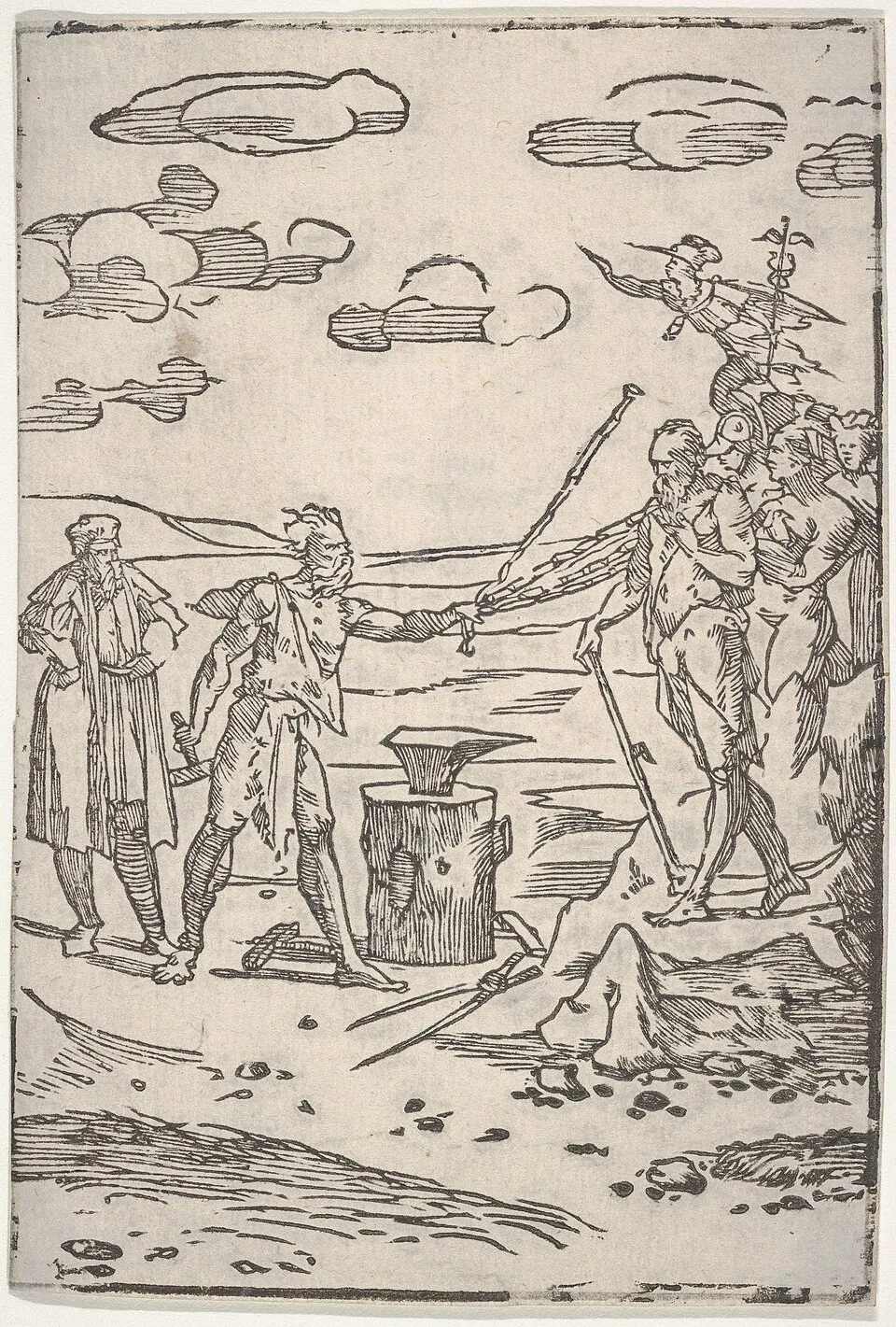
Hephaestus
Greek · deity · primordial · Recorded classification
Greek smith-god, master craftsman of Olympus; lame from a fall thrown from Olympus (varying etiologies: Hera throws him because of his birth-deformity per Hesiod; Zeus throws him for siding with Hera in marital quarrel per Homer). Forge mythologically located on Lemnos, beneath Mt Etna, or beneath Mt Olympus depending on source. Husband of Aphrodite; cuckolded by her affair with Ares. Forged the Shield of Achilles (Iliad 18) and the Aegis of Zeus.
Parentage
- maternal: Hera
Children
Domains
- metalworking craft
- fire divine
Powers
- Animate metalwork into living automata
- Forge wondrous, magical artifacts
Epithets
- Ἀμφιγυήεις Lame/crooked in both feet; the standard Homeric epithetHom. Il. 1.607; Od. 8.300 (primary)
- κυλλοποδίων Of the crooked foot; club-footed (Homeric epithet)Hom. Il. 18.371; 20.270 (primary)
- κλυτοτέχνης Famed/renowned for craft; the master-smithHom. Il. 1.571; Hes. Theog. 945 (primary)
- πολύμητις Of many devices; the inventive craftsman-godHom. Il. 21.355 (primary)
- περικλυτός The far-famed / very renownedHomer, Iliad 1.607; Odyssey 8.300 (primary)
- Λήμνιος Lemnian; of Lemnos, where he fell and his fire-cult centredHomer, Iliad 1.593; Sophocles, Philoctetes 986–987 (primary)
Relations
- lover: Anticleia of EpidaurusReciprocal of greek_anticleia_periphetes.loverApollod. 3.16.1 (primary)
- spouse: AphroditeCaught Aphrodite and Ares in golden chains during their affair.Hom. Od. 8.266-366 (primary)
- interpretatio: VolcanusHephaestus ↔ Vulcan per ancient interpretatio. Roman Vulcan was originally a destructive-fire god (the Volcanalia of August 23 was apotropaic — to ward off summer fires from the granaries) rather than a craftsman-god; the metalworking-deity emphasis came with the Greek equation.Cic. Nat. D. 2.65, 3.55; Verg. Aen. 8.370-453 (primary)
- equated with: PtahGreek Hephaestus ↔ Egyptian Ptah at Memphis. Ptah is craftsman-creator at Memphis; Hellenistic-era equation produced the syncretic Ptah-Hephaestus cult that persisted at Memphis through the Ptolemaic period.Hdt. 2.99 (the Egyptian Hephaestus = Ptah at Memphis); Plut. De Iside 21 (primary)
- interpretatio: PtahHdt consistently calls Ptah of Memphis 'Hephaestus'. Preserves the divine craftsman; breaks on Ptah's creation-by-speech theology (Memphite Theology) — Hephaestus makes things, Ptah thinks the world.Herodotus, Histories 2.3 (temple of Hephaestus at Memphis) (primary)
- interpretatio: Kothar-wa-HasisPhilo equates Chousor (Kothar-wa-Hasis) with Hephaistos. Preserves the divine smith-architect who arms the gods; breaks on Kothar's magic-and-incantation side and his seat at distant Memphis and Caphtor.Philo of Byblos apud Eusebius, Praep. ev. 1.10.11 (Chousor = Hephaistos) (primary)
- counterpart of: VolcanusLatin mythographic counterpart of the Greek record; identities and accounts remain distinct.Hyginus, Fabulae, Preface; Hesiod, Theogony 453–458, 912–939 (primary)
- counterpart of: HephaistosTradition-specific counterpart; this link does not transfer parentage.Orphic Hymns 65 (Taylor; modern 66) (primary)