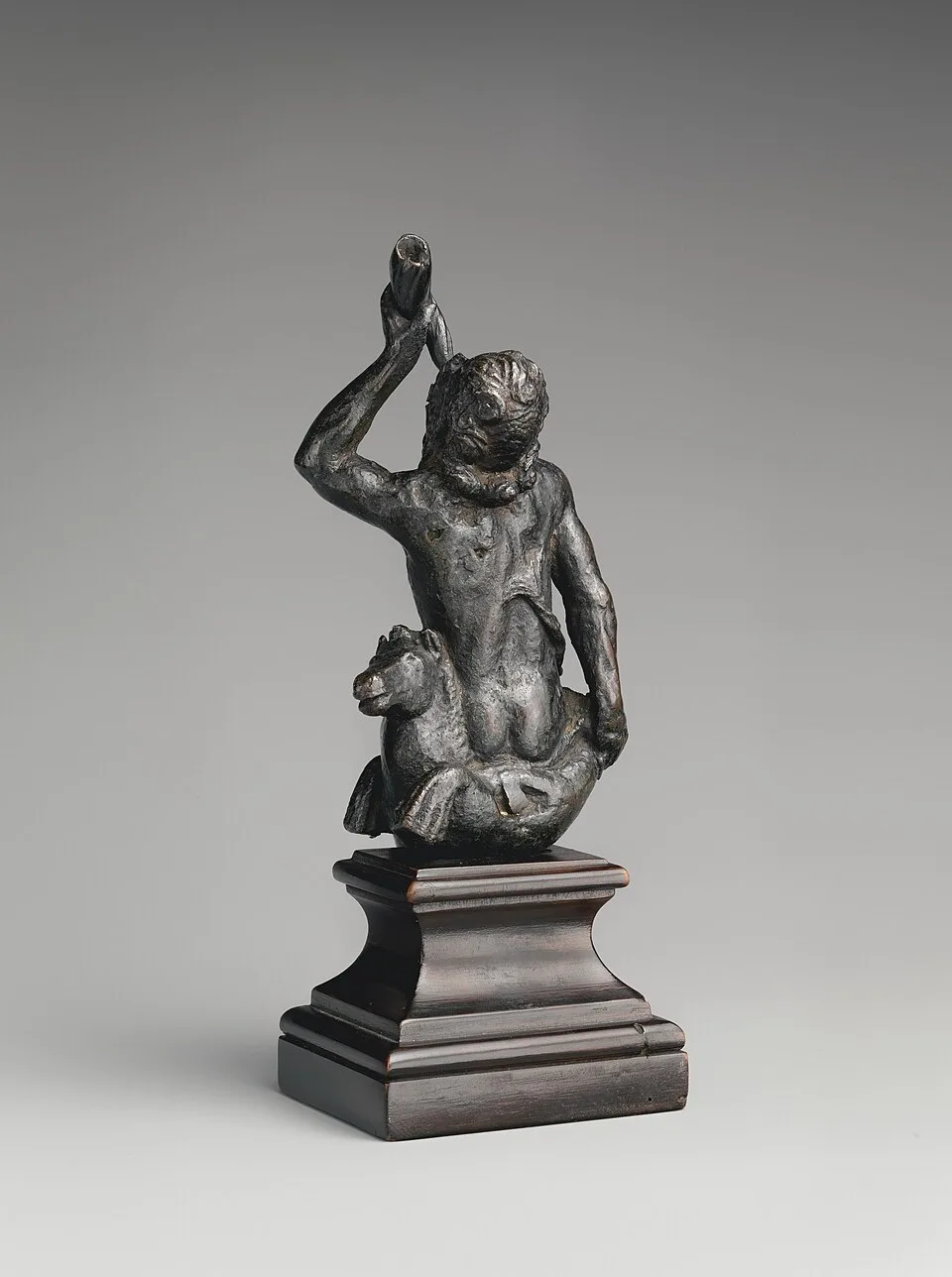
Poseidon
Greek · deity · primordial · Recorded classification
Greek god of sea, earthquakes, horses; brother of Zeus. Defining antagonist of Odysseus throughout the Odyssey for the blinding of his son Polyphemus. Lost the contest with Athena over Athens (offered a saltwater spring; Athena offered the olive tree). The Isthmian Games were his Panhellenic festival.
Parentage
- father: CronusHesiod, Theogony 453–458 (primary)
- mother: RheaHesiod, Theogony 453–458 (primary)
Children
Children in alternative accounts
- Asopus: Acusilaus: Poseidon and PeroApollodorus, Library 3.12.6 (primary)
Domains
- sea
- earthquakes
- horses
Powers
- Create the horse
- Raise and calm sea-storms
- Shake the earth / cause earthquakes
- Transform into animal shapes
Epithets
- Ἐνοσίχθων Earth-shaker; he who shakes the earth (earthquake-god)Hom. Il. 7.455; 8.208 (recurrent formula) (primary)
- Γαιήοχος Earth-holder / earth-embracer; encircler and upholder of the landHom. Il. 13.43; Od. 9.528 (primary)
- Ἵππιος Of horses; horse-god and creator of the horsePaus. 8.25.7; 1.30.4 (Poseidon Hippios at Colonus) (primary)
- Ἀσφάλιος Securer/steadfast; he who keeps the earth secure against quakesPaus. 3.11.9; 7.21.7 (Poseidon Asphalios) (primary)
- κυανοχαίτης Dark-haired / sea-blue-maned; constant Homeric epithetHom. Il. 13.563; Od. 9.536 (primary)
- Πελάγιος Of the open sea; lord of the deep watersFarnell, Cults of the Greek States IV, 1-55 (Poseidon's marine epithets) (secondary)
- ἐννοσίγαιος Earth-shaker; he who makes the earth quakeHomer, Iliad 13.43 (primary)
- Ἑλικώνιος Of Helike; god of the Panionian league at MykaleHomer, Iliad 20.404; Herodotus 1.148 (primary)
- Φυτάλμιος The nurturing; fosterer of growth (cult at Troezen)Pausanias 2.32.8 (primary)
Relations
- lover: Libya
- lover: Pitane
- lover: Chione the Boread
- equated with: NeptunusRoman Neptunus is the canonical Latin parallel to Greek Poseidon through interpretatio Romana; the pre-equation Italic Neptune was a freshwater/spring deity (Neptunalia festival) and the marine-Poseidon identification was added through Hellenic interpretatio.Standard interpretatio Graeca/Romana scholarship; Beard, North & Price, Religions of Rome (1998); Wissowa, Religion und Kultus der Römer (1912) (secondary)
- lover: EurynomeReciprocal of greek_eurynome.loverHes. fr. 43a; Apollod. 2.3.1 (primary)
- lover: TyroReciprocal of greek_tyro.loverHom. Od. 11.235-259; Apollod. 1.9.8 (primary)
- lover: AethraReciprocal of greek_aethra.loverBacch. 17; Plut. Thes. 6; Apollod. 3.15.7 (primary)
- sibling: ZeusHes. Theog. 453-457 (primary)
- interpretatio: NeptunusPoseidon ↔ Neptune per ancient interpretatio. Roman Neptune was originally a freshwater-spring deity (Neptunalia July 23, with shelter-building in foliage to escape summer heat); only equated with Poseidon under Greek influence.Cic. Nat. D. 2.66; Verg. Aen. 1.124-156 (primary)
- interpretatio: Horse-Lord of the Waters ThagimasadasReciprocal of scythian_thagimasadas.interpretatio — Hdt: 'Poseidon, in Scythian Thagimasadas', worshipped only by the Royal Scythians. Preserves the water-and-horse pairing — the strongest functional fit in his list; breaks on sea and earthquake.Herodotus, Histories 4.59 (primary)
- father: CronusHesiod, Theogony 453–458 (primary)
- mother: RheaHesiod, Theogony 453–458 (primary)
- counterpart of: PoseidonThe hymn addresses this deity in an Orphic ritual context; Greek genealogy is not imported.Orphic Hymns, 16 (Thomas Taylor numbering; modern hymn 17) (primary)
Sources
- existence: Hom. Il. 13, 20; Od. 1.20-21, 5.282-381, 9.526-535; Hes. Theog. 930-933; Apollod. 1.4 (primary)
- parentage: Hes. Theog. 453-457 (primary)