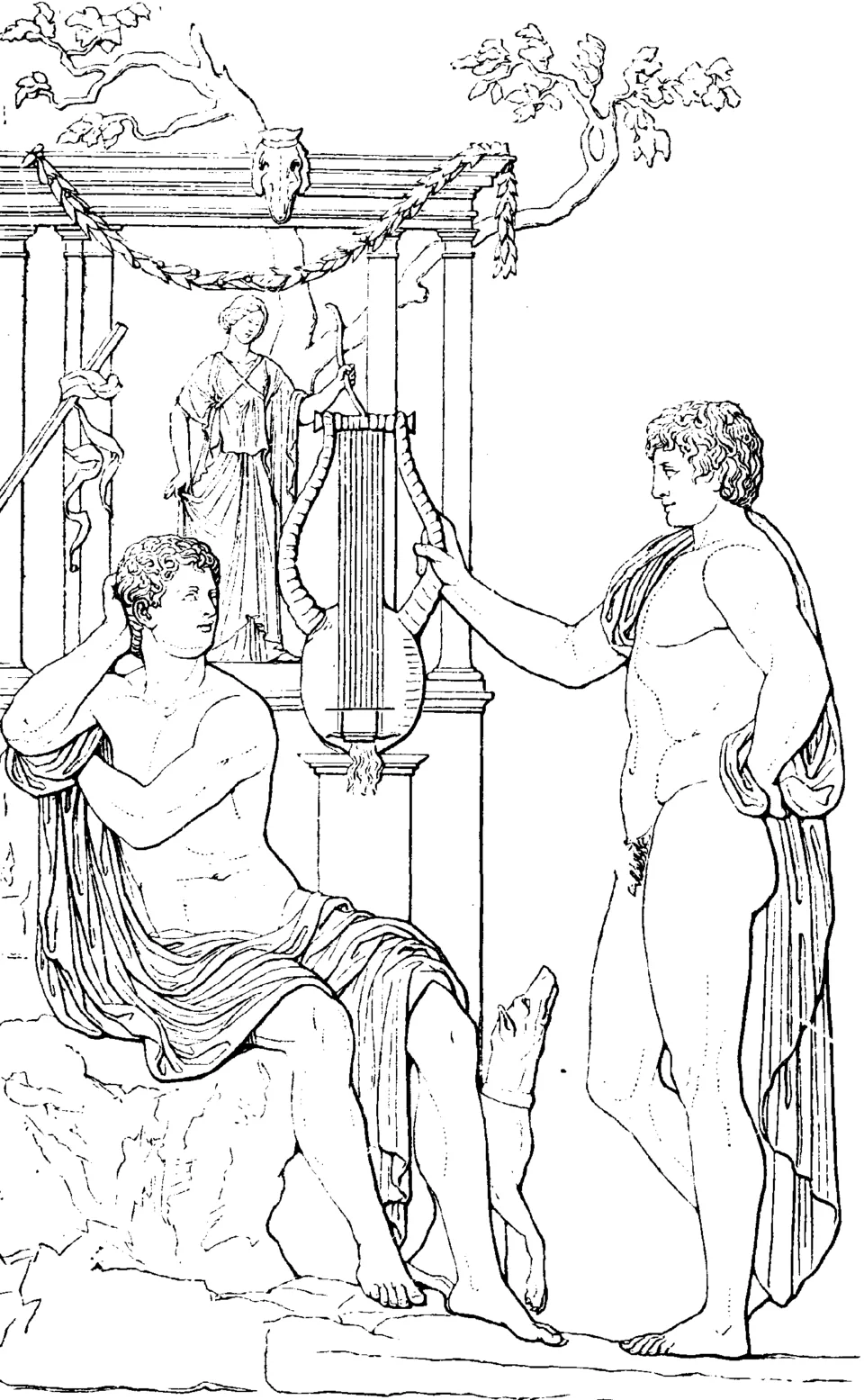
Zethus
Half-Olympian son of Zeus by Antiope daughter of Nycteus; twin of Amphion. Conceived when Zeus appeared to Antiope in satyr-form (per Apollodorus 3.5.5); Antiope fled to Sicyon, was brought back, and bore the twins on Mount Cithaeron during the journey. Exposed and raised by a herdsman. Diverged from his musical brother Amphion in temperament — Zethus the practical hunter-herdsman, Amphion the contemplative musician. The brothers' debate over the active vs. contemplative life is the structural axis of Euripides's lost Antiope (c. 410 BCE), preserved in fragments and reconstructed from Plato's Gorgias 484e-486d quotation; the dichotomy becomes foundational for the Greek philosophical reception of the bios theoretikos / bios praktikos opposition. After recognition by Antiope, the twins killed Lycus and tied his wife Dirce to the horns of a wild bull in vengeance — the canonical Dirce-bull tableau preserved in the Farnese Bull sculpture (now Naples Archaeological Museum), one of the largest surviving ancient sculpture-groups. Took the kingship of Thebes; built the second walls of the city, with Zethus carrying the stones while Amphion charmed them into place with the lyre — the canonical division-of-labor that exemplifies the active/contemplative dichotomy. Married Aëdon daughter of Pandareus; Aëdon's envy of Niobe led to the accidental killing of their son Itylus and her transformation into a nightingale (the etiology of the nightingale's lament). Death-narrative is variant — some accounts have Zethus dying of grief, others give him a lifespan parallel to Amphion. Pausanias reports the Theban tradition pointing to the joint tomb of the twins north of Thebes, with seasonal soil-transfer rites between Tithorea (Phocis) and Thebes.
Parentage
- paternal: Zeus
- maternal: Antiope of Thebes
Children
Domains
- theban kingship and wall building
- active life and physical strength
Powers
- physical strength stone bearing
- hunter and herdsman skill
Relations
- spouse: Aedon
- sibling: AmphionReciprocal of greek_amphion.siblingHom. Od. 11.260-265 (primary)
- twin sibling: AmphionTwin brother; the active/contemplative paired-figure structure is foundational to the cycle.Hom. Od. 11.260-265 (primary)
- spouse: Aedon (wife of Zethus, transformed into a nightingale after killing her son Itylus) · GreekAëdon daughter of Pandareus; transformed into nightingale after the accidental killing of Itylus. Entry pending.Hom. Od. 19.518-523; Paus. 9.5.9 (primary)
- parent of: Itylus (son of Zethus and Aedon, accidentally killed by his mother) · GreekSon accidentally killed by Aëdon. Entry pending.Hom. Od. 19.518-523 (primary)
- killer of: Dirce (second wife of Lycus of Thebes, killed by Amphion and Zethus by being tied to a bull) · GreekDirce, wife of Lycus; tied to the horns of a wild bull. Entry pending.Apollodorus 3.5.5; the Farnese Bull sculptural tradition (primary)
- killer of: Lycus of Thebes (regent of Thebes, killed by Amphion and Zethus) · GreekLycus, brother-or-uncle of Antiope, regent of Thebes who imprisoned Antiope. Entry pending.Apollodorus 3.5.5 (primary)
Sources
- existence: Homer, Odyssey 11.260-265 (the foundational reference: Zethus and Amphion as Antiope's sons by Zeus, founders of Thebes) (primary); Homer, Odyssey 19.518-523 (the Aëdon-Itylus episode) (primary); Hesiod, fr. 181-182 Merkelbach-West (the early Theban genealogy) (primary); Apollodorus, Bibliotheca 3.5.5 (the canonical narrative) (primary); Euripides, Antiope (lost play, c. 410 BCE; fragments preserved in P.Oxy. 3317; the active/contemplative debate) (primary); Plato, Gorgias 484e-486d (Callicles' citation of the Antiope debate) (primary); Cicero, De Republica 1.18.30 (Roman reception of the active/contemplative debate) (primary); Pausanias 9.5.6-9 (Theban cult-tradition and tomb-tradition) (primary); Hyginus, Fabulae 7-8 (primary); the Farnese Bull (Toro Farnese), now Naples Archaeological Museum — colossal sculptural rendering of the Dirce-bull-vengeance scene; 1st c. BCE Roman copy of a Hellenistic original (primary)