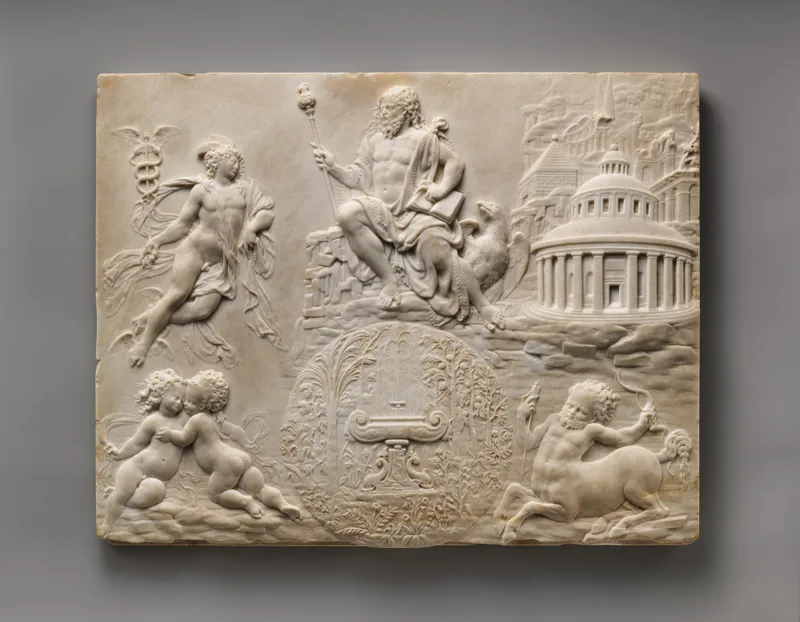
Iuppiter
Head of the Roman state cult; senior member of the Capitoline triad (with Iuno and Minerva). Distinct from Greek Zeus despite cognate Indo-European origin — Roman Iuppiter's cult is institutionally embedded in the Roman state in ways Zeus's never was: the consul's oath of office, the triumph terminus, the spolia opima at Feretrius, the flamen Dialis taboo system, the Capitoline triad temple sharing. The triumphator literally enacted Iuppiter on the triumph route — quadriga, vermilion face, laurel crown — climaxing at the Capitoline temple where the laurel branch went into the god's lap. Per Beard/North/Price, Religions of Rome (1998); Wissowa, Religion und Kultus der Römer (1912); Dumézil, Archaic Roman Religion (1970); Coarelli, Il Foro Romano (1983-85).
Parentage
- father: SaturnHyginus, Fabulae, Preface: children of Saturn and Ops (primary)
- mother: OpsHyginus, Fabulae, Preface: children of Saturn and Ops (primary)
Children
Children in alternative accounts
- Mars: Hyginus: Jupiter and JunoHyginus, Fabulae, Preface (primary)
Domains
- sky thunder
- state cult supremacy
- oath binding
- triumph
Powers
- Hurl the thunderbolt
- Send sky-omens
Epithets
- Optimus Maximus Best and GreatestLiv. 1.55.4; Cic. Cat. 3.21 (primary)
- Capitolinus of the CapitolLiv. 1.55 (primary)
- Feretrius the smiter / he who is borne (the spoils to)Liv. 1.10.5; etymology debated — fero "carry" or ferire "strike" (primary)
- Lapis the StonePolyb. 3.25.6-9 (primary)
- Latiaris of the LatinsLiv. 1.31.3 (primary)
- Stator The Stayer; he who halts the rout of armies (vowed by Romulus)Livy 1.12; 10.36-37; Cic. Cat. 1.11.33 (primary)
- Tonans The Thunderer; Jupiter the thundering, with a temple vowed by AugustusSuet. Aug. 29, 91; Hor. Carm. 3.5.1; Ov. Fast. 2.69 (primary)
- Elicius He who is drawn forth; Jupiter summoned for signs/lightning-lore (Numa)Livy 1.20; Ov. Fast. 3.327-328 (primary)
Relations
- equated with: ZeusIuppiter is the Roman state-cult equivalent of Greek Zeus; shared sky-father-and-thunderbolt iconography. The equation was canonical from at least the early Republican period and formalized in Latin literature (Verg. Aen. passim).Standard interpretatio Graeca/Romana scholarship; Beard, North & Price, Religions of Rome (1998); Wissowa, Religion und Kultus der Römer (1912) (secondary)
- interpretatio: ZeusIuppiter ↔ Zeus per ancient interpretatio. Both descend from Proto-Indo-European *Dyēus ph₂tḗr (Iuppiter = Iou-piter / "Sky-Father", Zeus also "Sky-Father"). The cognate origin is genuine but Roman Iuppiter has substantial Roman-only features the registry treats as distinctive: the Capitoline triad institutional structure (no Greek parallel — Zeus did not share his temple with Hera and Athena), Optimus Maximus title, the triumphator-as-Iuppiter ritual identification, the flamen Dialis taboo system, the Iuppiter Lapis stone-oath, the Feretrius spolia opima cult.Cic. Nat. D. 2.64; Verg. Aen. 1.46-49 (Iuppiter speech adapting Hom. Il. 24); Macr. Sat. 1.12.18 (primary)
- interpretatio: TiniaReciprocal of etruscan_tinia.interpretatio.de Grummond, Etruscan Myth, Sacred History, and Legend (2006) (secondary)
- father: SaturnHyginus, Fabulae, Preface: children of Saturn and Ops (primary)
- mother: OpsHyginus, Fabulae, Preface: children of Saturn and Ops (primary)
Sources
- existence: Liv. 1.10, 1.55-56, 27.8; Cic. Nat. D. 2.64-67; Verg. Aen. 1.42-45, 1.260-296; Ov. Fast. passim; Macr. Sat. 1.10-12 (primary)
- cult-foundation: Liv. 1.55-56, 2.8.6-9 (dedication 509 BCE) (primary)
- identification: Cic. Nat. D. 2.64; Macr. Sat. 1.12 (primary)