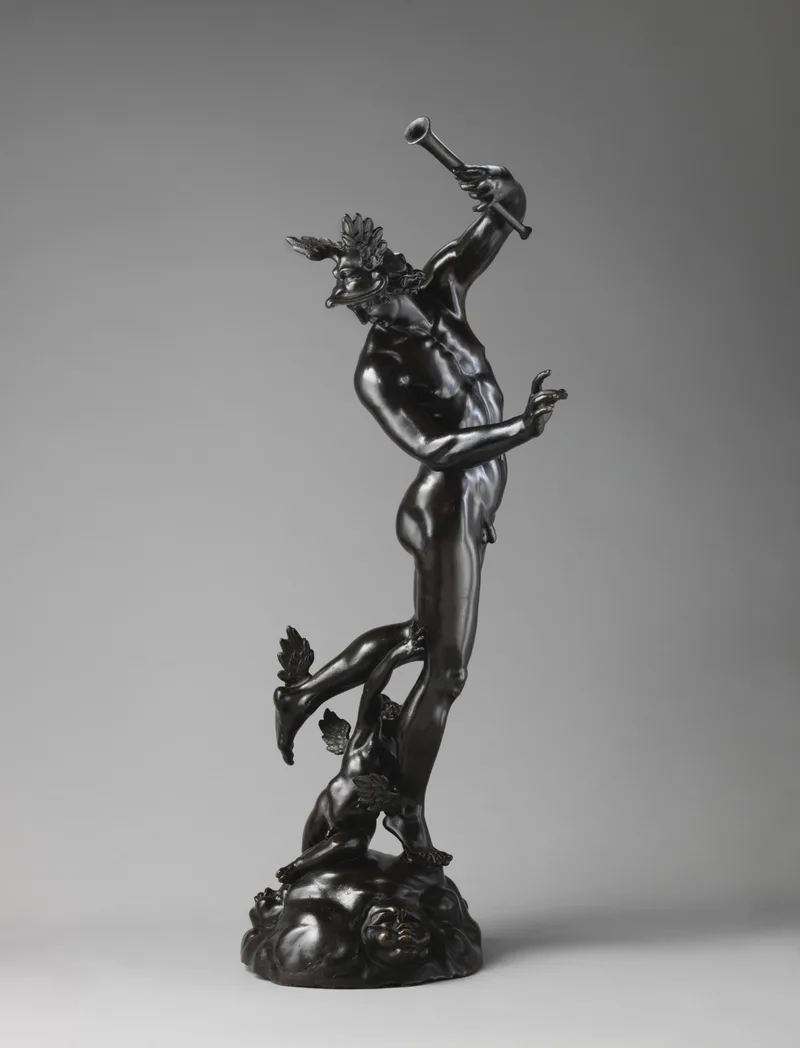
Mercurius
Roman · deity · early republic · Recorded classification
Roman merchant-god; cult arrived 495 BCE with Aventine temple dedication. Etymology mercator → Mercurius marks the primary commercial function. Distinct from Greek Hermes despite ancient interpretatio: Roman cult emphasizes merchants' patronage (the collegium mercatorum, the Mercuralia ritual purification of goods), de-emphasizes the psychopomp and trickster aspects central to Greek Hermes.
Parentage
- father: IuppiterParentage in the cited Latin account.Hyginus, Fabulae, Preface: mercurius (primary)
- mother: MaiaParentage in the cited Latin account.Hyginus, Fabulae, Preface: mercurius (primary)
Domains
- commerce
- messenger
- luck and gain
Powers
- Conduct the souls of the dead
- Drive the winds
- Give and banish sleep
Epithets
- Mercurius from mercator/merx — 'god of merchandise'; his Aventine temple dedicated 495 BCELivy 2.21.7 (primary); Festus, s.v. Mercurius (primary)
- Mercurius Augustus the Augustan Mercury (imperial-cult byname of trade-guilds)Latin dedicatory inscriptions (CIL); imperial cult (secondary)
Relations
- equated with: TurmsRoman Mercurius derives from Etruscan Turms through the Etruscan-to-Roman cult-evolution layer; the psychopomp function is preserved from the Etruscan inheritance.Capitoline Triad transmission scholarship; Beard, North & Price, Religions of Rome (1998); Cornell, The Beginnings of Rome (1995) (secondary)
- equated with: HermesMercurius is the Roman state-cult equivalent of Greek Hermes; shared messenger/commerce/thievery iconography. The Roman emphasis on commerce (mercator etymology) makes Mercurius institutionally distinct.Standard interpretatio Graeca/Romana scholarship; Beard, North & Price, Religions of Rome (1998); Wissowa, Religion und Kultus der Römer (1912) (secondary); Hesiod, Theogony 938–939 (primary)
- interpretatio: HermesMercury ↔ Hermes per ancient interpretatio. The Roman emphasis on mercantile function (mercator etymology, purse iconography, merchants' guild founding) is distinct from Greek Hermes's broader liminal-psychopomp role.Cic. Nat. D. 3.56 (primary); Hesiod, Theogony 938–939 (primary)
- syncretism: TurmsEtruscan Turms is the direct intermediary between Greek Hermes and Roman Mercury, attested on Etruscan bronze mirrors (Turms shown with kerykeion and petasos in Hermes-derived iconography).Bonfante 1990 (secondary)
- interpretatio: TurmsReciprocal of etruscan_turms.interpretatio.de Grummond, Etruscan Myth, Sacred History, and Legend (2006) (secondary)
- father: IuppiterParentage in the cited Latin account.Hyginus, Fabulae, Preface: mercurius (primary)
- mother: MaiaParentage in the cited Latin account.Hyginus, Fabulae, Preface: mercurius (primary)
- counterpart of: HermesLatin mythographic counterpart of the Greek record; identities and accounts remain distinct.Hyginus, Fabulae, Preface; Hesiod, Theogony 453–458, 912–939 (primary)
Sources
- existence: Liv. 2.21.7, 2.27.5-6; Cic. Nat. D. 3.56; Ov. Fast. 5.663-692; Verg. Aen. 4 (primary)
- aventine-foundation: Liv. 2.21.7 (primary)