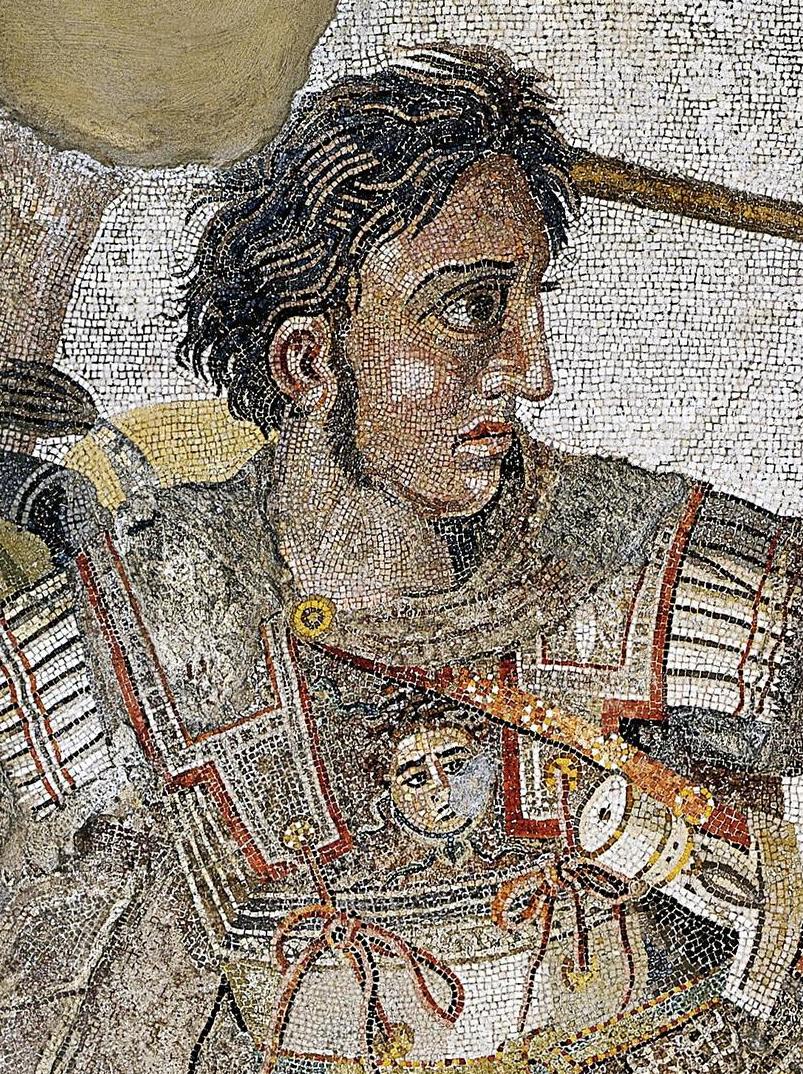
Alexander III of Macedon
King of Macedon (336-323 BCE), conqueror of the Achaemenid Persian Empire, and one of the foundational political-cultural figures of the ancient Mediterranean and West Asian worlds. Demigod son of Zeus (in the syncretic Zeus-Ammon form recognized at the Siwa Oracle 332 BCE) by the Aiakid Epirote princess Olympias under the Mongán-pattern reading; biological son of Philip II of Macedon under the historical-skeptical reading (recorded in variants[]). The strict-criterion classification follows the registry's standing precedent: contemporaneous sincere divine-paternity recognition by oracular tradition (Siwa 332 BCE) plus sustained sincere maternal claim (Olympias's lifelong assertion) plus continuing posthumous cult-canonization (the Lysimachus ram-horn tetradrachms, the Hellenistic Alexander-cult, the Alexander-Romance tradition) constitutes a strict ½ demigod case structurally parallel to Mongán in Irish, Šulgi in Mesopotamian, Pryderi in Welsh, and Bhishma in Hindu. Educated by Aristotle 343-340 BCE; tamed Bucephalus aged 12; ascended to Macedonian throne 336 BCE after Philip's assassination at Aegae; consolidated Greece by destruction of Thebes 335 BCE; crossed the Hellespont 334 BCE and visited his Aiakid ancestor Achilles's tomb at Sigeion; defeated Darius III at Granicus (334), Issus (333), and Gaugamela (331); cut the Gordian knot at Gordium 333 BCE; besieged and took Tyre 332 BCE; founded Alexandria-by-Egypt 331 BCE; received Siwa Oracle Zeus-Ammon recognition 332 BCE; conquered the Achaemenid heartland 331-329 BCE; campaigned through Bactria-Sogdiana 329-327 BCE; married Roxana 327 BCE; conducted the Indian campaign 327-325 BCE with the Hydaspes victory over Porus 326 BCE; survived the catastrophic Gedrosian Desert march 325 BCE; returned to Babylon 324 BCE; died at Babylon 10/11 June 323 BCE aged 32 in the palace of Nebuchadnezzar II. Founded c. 70 cities, conquered c. 5.2 million square kilometers, never lost a battle. The Alexander-Romance (Pseudo-Callisthenes) extended his demigod-status into legendary cycles in Greek, Latin, Syriac, Armenian, Persian (Shahnameh's Iskandar), Arabic (the Quranic Dhul-Qarnayn of Sura 18 — identification contested but widely held), Hebrew, Coptic, Ethiopic, and Mongolian traditions — making Alexander the most translated and most widely-traditional demigod figure across Eurasian literary history. Posthumously deified across the Hellenistic world; the Soma at Alexandria-by-Egypt was his pilgrimage-cult center through Roman times (visited by Augustus, Caligula, Septimius Severus, Caracalla); the tomb's location is now lost.
Parentage
- parent: ZeusZeus (= Egyptian Amun in the syncretic Zeus-Ammon form) recognized as paternal deity through the Siwa Oracle.Arrian Anab. 3.3-4; Plut. Alex. 27; the Siwa Oracle recognition 332 BCE (primary)
- parent: OlympiasPlut. Alex. 2-3 (primary)
Variant accounts
- biological-paternity-by-Philip-II-of-Macedon
Domains
- kingship of Macedon and Asia
- foundation of Hellenistic world
Powers
- pothos divine yearning
Epithets
- Ἀλέξανδρος ὁ Μέγας 'Alexander the Great' — the standing epithet of magnitudePlutarch, Life of Alexander (title-tradition) (primary)
- υἱὸς Ἄμμωνος 'Son of Ammon' — title hailed by the oracle at Siwah and used in Egyptian/Greek cultArrian, Anabasis 3.3-4 (primary); Plutarch, Alexander 27 (primary)
- ὁ Μέγας 'the Great' — his universal epithetPlutarch, Alexander (passim) (primary)
- Διὸς υἱός 'Son of Zeus' — proclaimed at the oracle of Ammon at SiwaPlutarch, Alexander 27 (primary)
Relations
- parent: OlympiasPlut. Alex. 2-3 (primary)
- parent: ZeusZeus (= Egyptian Amun in the syncretic Zeus-Ammon form) recognized as paternal deity through the Siwa Oracle.Arrian Anab. 3.3-4; Plut. Alex. 27; the Siwa Oracle recognition 332 BCE (primary)
- social father: Philip II of MacedonPhilip II of Macedon entry pending. Argead-dynastic biological father in the historical-skeptical reading; recorded as social-father under the Mongán-pattern dual-paternity convention.Plut. Alex. 2-10; Diod. 16-17 (primary)
- spouse: Roxana (Bactrian-princess first wife of Alexander the Great, mother of Alexander IV) · GreekRoxana (Roxāne, Sogdian noblewoman) entry pending. Married 327 BCE; mother of Alexander IV.Arrian Anab. 4.19; Plut. Alex. 47 (primary)
- spouse: Stateira II (Persian-princess second wife of Alexander the Great, daughter of Darius III) · GreekStateira II / Barsine of Persia entry pending. Married at Susa weddings 324 BCE; killed by Roxana after Alexander's death.Arrian Anab. 7.4; Plut. Alex. 70 (primary)
- father of: Alexander IV (posthumous son of Alexander the Great by Roxana, killed by Cassander c. 309 BCE) · GreekAlexander IV of Macedon (¼ quartigod by lineage) entry pending. Born posthumously August 323 BCE to Roxana; murdered with his mother by Cassander 309 BCE aged 14.Diod. 19.52, 20.28; Just. 14.6 (primary)
- sister: Cleopatra of MacedonPlut. Alex. 9; Diod. 16.91 (primary)
- beloved: Hephaestion (companion-and-beloved of Alexander the Great, dies 324 BCE at Ecbatana) · GreekHephaestion entry pending. The defining male-friendship pair of the late-classical world; explicit Achilles-Patroclus parallel sustained by Alexander himself. Hephaestion's death at Ecbatana 324 BCE produced Alexander's catastrophic grief and the founding of his cult as a hero.Plut. Alex. 47, 72; Arrian Anab. 7.14-16 (primary)
- descendant of: Achilles (greatest of the Greek warriors at Troy, son of Peleus and the Nereid Thetis; not registered as cascade descendant under strict rule) · GreekThrough his mother Olympias, Aiakid descent from Neoptolemos son of Achilles, from Aeacus, and ultimately from Zeus.Plut. Alex. 2, 15; Aiakid genealogy (primary)
- descendant of: HeraclesThrough his Argead paternal line, Heraclid descent — the basis of the lion-headdress iconography on his coinage.Argead royal genealogy claiming Heraclid descent through Caranus, founder of the Macedonian royal house (primary)
- sibling: Cleopatra of MacedonFull sister via Philip II and Olympias. Reciprocal of greek_cleopatra_of_macedon.sibling.Heckel, Who is Who in the Age of Alexander (2006), s.v. Cleopatra (secondary)
Sources
- existence: Arrian, Anabasis Alexandri (the most reliable surviving narrative, drawing on the now-lost contemporary accounts of Ptolemy I and Aristobulus); Plutarch, Vita Alexandri; Diodorus Siculus 17 (the only complete contemporary-style narrative that survives, written 1st c. BCE); Quintus Curtius Rufus, Historiae Alexandri Magni (1st c. CE); Justin's epitome of Pompeius Trogus 11-12; the Alexander-Romance tradition (Pseudo-Callisthenes c. 3rd c. CE); the Babylonian astronomical diaries (cuneiform contemporary records of Alexander's movements and death-date) (primary)
- parentage: Plut. Alex. 2-3 (the serpent-impregnation narrative); Plut. Alex. 27; Arrian Anab. 3.3-4 (the Siwa Oracle recognition 332 BCE); Diod. 17.49-51; Curt. 4.7.5-32; the Lysimachus posthumous tetradrachms ram-horn iconography (primary)