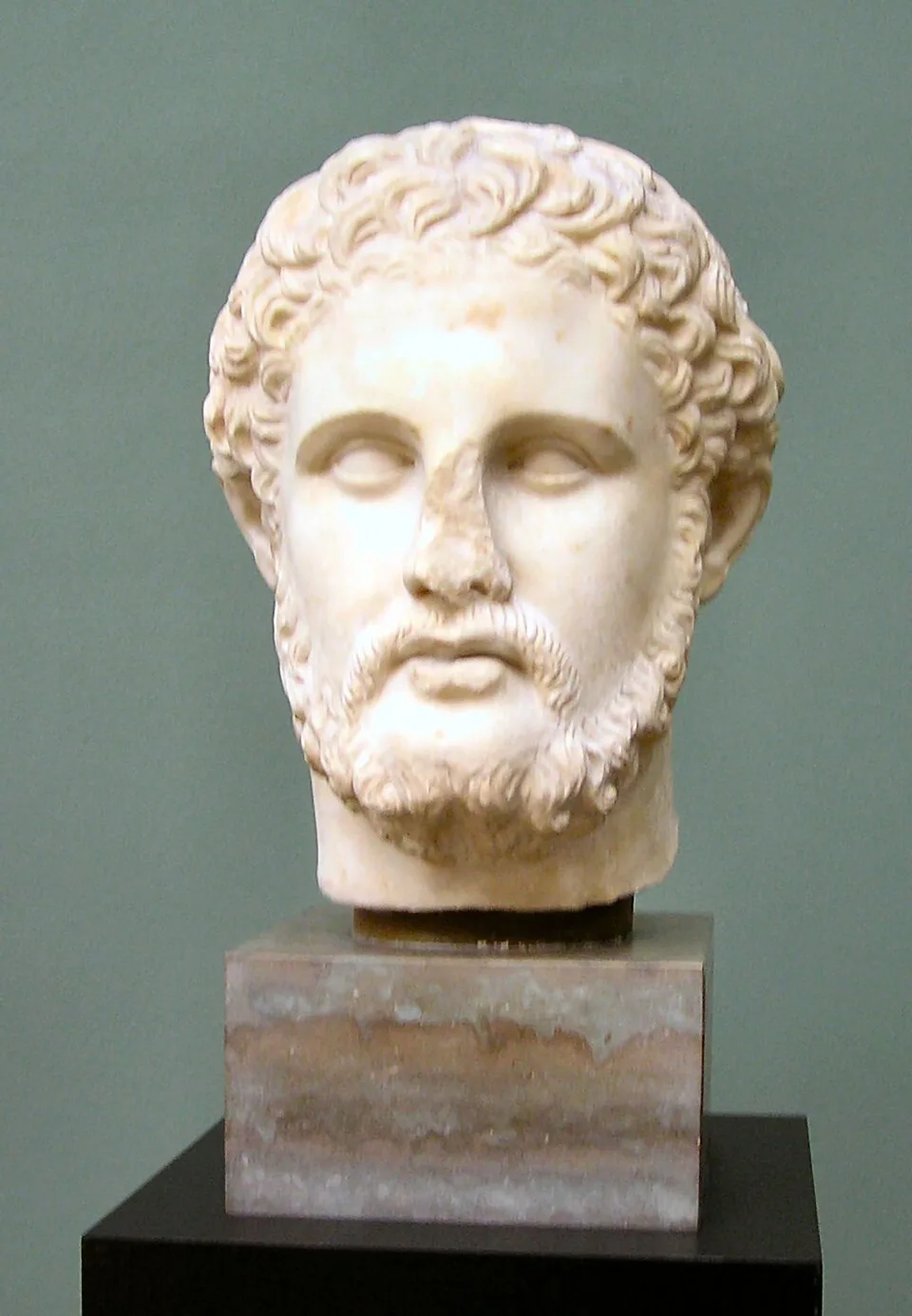
Philip II of Macedon
King of Macedon 359-336 BCE; father of Alexander the Great by Olympias of Epirus. Argead royal house, claiming Heraclid descent through Caranus. Held as Theban hostage 368-365 BCE in his youth; observed Epaminondas's reformed tactics that became the foundation of his own military reforms. Reformed the Macedonian phalanx (sarissa-armed pike-formation), Companion Cavalry (Hetairoi), and siege-engineering corps — the military system that enabled Alexander's subsequent conquests. Married Olympias of Epirus c. 357 BCE; Alexander born 21 July 356 BCE; Cleopatra of Macedon born c. 355 BCE. Defeated the Athens-Thebes coalition at Chaeronea (August 338 BCE); established the League of Corinth (337 BCE) as hegemon; began preparations for the Persian invasion that Alexander would execute. Married Cleopatra Eurydice in 337 BCE — the marriage that estranged Olympias and produced the wedding-banquet Attalus-toast scandal. Assassinated October 336 BCE at the wedding of his daughter Cleopatra of Macedon to Alexander I of Epirus, in the theater at Aegae, by his own bodyguard Pausanias of Orestis. Buried at Aegae (modern Vergina); Tomb II of the Vergina royal tombs (Andronikos 1977-1978) widely identified as his. Under the Mongán-pattern dual-paternity classification of Alexander, Philip is recorded as social-father with Zeus-Ammon as paternal deity per the Siwa Oracle 332 BCE recognition.
Parentage
Recorded default; alternative parentage accounts are listed separately below.
- father: Amyntas III of MacedonDiodorus Siculus, Library of History 15.60.3 (primary)
- mother: Eurydice, mother of Philip IIJustin, Epitome of Pompeius Trogus 7.4 (J. S. Watson translation) (primary); Strabo, Geography 7.7.8, Greek text: Eurydice daughter of Sirras (primary)
Parentage accounts
Each account is a separate source claim. The parentage and children listed outside these accounts use the recorded default. Selecting an account in the interactive app updates its lineage, descent classification and inherited-power candidates. Linked pedigree accounts are selected together; other records retain their recorded parentage. Claims of ancestry are not proof of biological descent or attested powers.
- Amyntas III and Eurydice — reported historical familyThe immediate parents are historical reports. Upstream links carry their individual sources; the group name does not attribute every generation to Herodotus.
Descent unresolved; fraction unquantified because the account is incomplete.
- father: Amyntas III of MacedonDiodorus Siculus, Library of History 15.60.3 (primary)
- mother: Eurydice, mother of Philip IIJustin, Epitome of Pompeius Trogus 7.4 (J. S. Watson translation) (primary); Strabo, Geography 7.7.8, Greek text: Eurydice daughter of Sirras (primary)
Complete cited pedigree (10 ancestral accounts)
- Amyntas III of MacedonDiodorus’s paternal report; the competing Menelaus account is a separate choice.Diodorus Siculus, Library of History 15.60.3 (primary)
- Arrhidaeus, father of Amyntas IIIThis connecting generation is mediated through Bennett; it does not amend Satyrus.
- father: Amyntas, son of Alexander IThis step is reported by Bennett’s genealogy discussion.Chris Bennett, Egyptian Royal Genealogy, Arsinoe, note 2.v (reporting Syncellus p. 500 and Beloch, Griechische Geschichte IV.2, p. 177) (secondary)
- Amyntas, son of Alexander ISecondary reporting of Syncellus, not the conjectured insertion into Satyrus’s text.
- father: Alexander I of MacedonSyncellus is consulted through Bennett, not independently collated.Chris Bennett, Egyptian Royal Genealogy, Arsinoe, note 2.v (reporting Syncellus p. 500 and Beloch, Griechische Geschichte IV.2, p. 177) (secondary)
- Alexander I of MacedonThe immediate father is explicit in Herodotus; the group continues through his earlier king-list.
- father: Amyntas I of MacedonHerodotus, Histories 8.139 (primary)
- Amyntas I of MacedonThe Macedonian ancestry given in Histories 8.139. This account includes Argaeus between Perdiccas and Philip; it is not silently merged with the Satyrus quotation.
- father: Alcetas I of MacedonHerodotus, Histories 8.139 (primary)
- Alcetas I of MacedonThe Macedonian ancestry given in Histories 8.139. This account includes Argaeus between Perdiccas and Philip; it is not silently merged with the Satyrus quotation.
- father: Aeropus I of MacedonHerodotus, Histories 8.139 (primary)
- Aeropus I of MacedonThe Macedonian ancestry given in Histories 8.139. This account includes Argaeus between Perdiccas and Philip; it is not silently merged with the Satyrus quotation.
- father: Philip I of MacedonHerodotus, Histories 8.139 (primary)
- Philip I of MacedonThe Macedonian ancestry given in Histories 8.139. This account includes Argaeus between Perdiccas and Philip; it is not silently merged with the Satyrus quotation.
- father: Argaeus I of MacedonHerodotus, Histories 8.139 (primary)
- Argaeus I of MacedonThe Macedonian ancestry given in Histories 8.139. This account includes Argaeus between Perdiccas and Philip; it is not silently merged with the Satyrus quotation.
- father: Perdiccas I of MacedonHerodotus, Histories 8.139 (primary)
- Eurydice, mother of Philip IIHer mother is unnamed in the adopted Greek text. Arrhabaeus is a grandfather, not a direct parent.
- father: SirrasGreek text and the inscription discussed by Landucci support Sirras as her father. Some older translations print a different reading.Strabo, Geography 7.7.8, Greek text: Eurydice daughter of Sirras (primary); Franca Landucci Gattinoni, Illyrians and Macedonians in the Fifth Century BC: An impossible peace, Karanos Supplement I (2024), pp. 125-126 and notes 28-35 (secondary)
Children
Children in alternative accounts
- Ptolemy I Soter: Philip II and Arsinoe — reported alternativePausanias, Description of Greece 1.6.2 (primary)
Domains
- kingship of Macedon
- hegemon of League of Corinth
- reformer of Macedonian phalanx and Companion Cavalry
Relations
- spouse: OlympiasPlut. Alex. 2-10 (primary)
- social father: Alexander III of MacedonArgead-dynastic biological father in the historical-skeptical reading; under the Mongán-pattern strict-criterion classification, Zeus-Ammon is recorded as paternal and Philip as social-father.Plut. Alex. 2-3 (primary)
- father of: Cleopatra of MacedonPlut. Alex. 9; Diod. 16.91 (primary)
- descendant of: HeraclesHeraclid descent through the Argead line — basis of the lion-headdress iconography on Argead coinage that Alexander continued.Argead royal genealogy claiming Heraclid descent through Caranus, founder of the Macedonian royal house (primary)
- father: Amyntas III of MacedonDiodorus Siculus, Library of History 15.60.3 (primary)
- mother: Eurydice, mother of Philip IIJustin, Epitome of Pompeius Trogus 7.4 (J. S. Watson translation) (primary); Strabo, Geography 7.7.8, Greek text: Eurydice daughter of Sirras (primary)
- reported son: Ptolemy I SoterPausanias reports that some Macedonians considered Ptolemy a son of Philip; this is not the conventional Lagid account.Pausanias, Description of Greece 1.6.2 (primary)