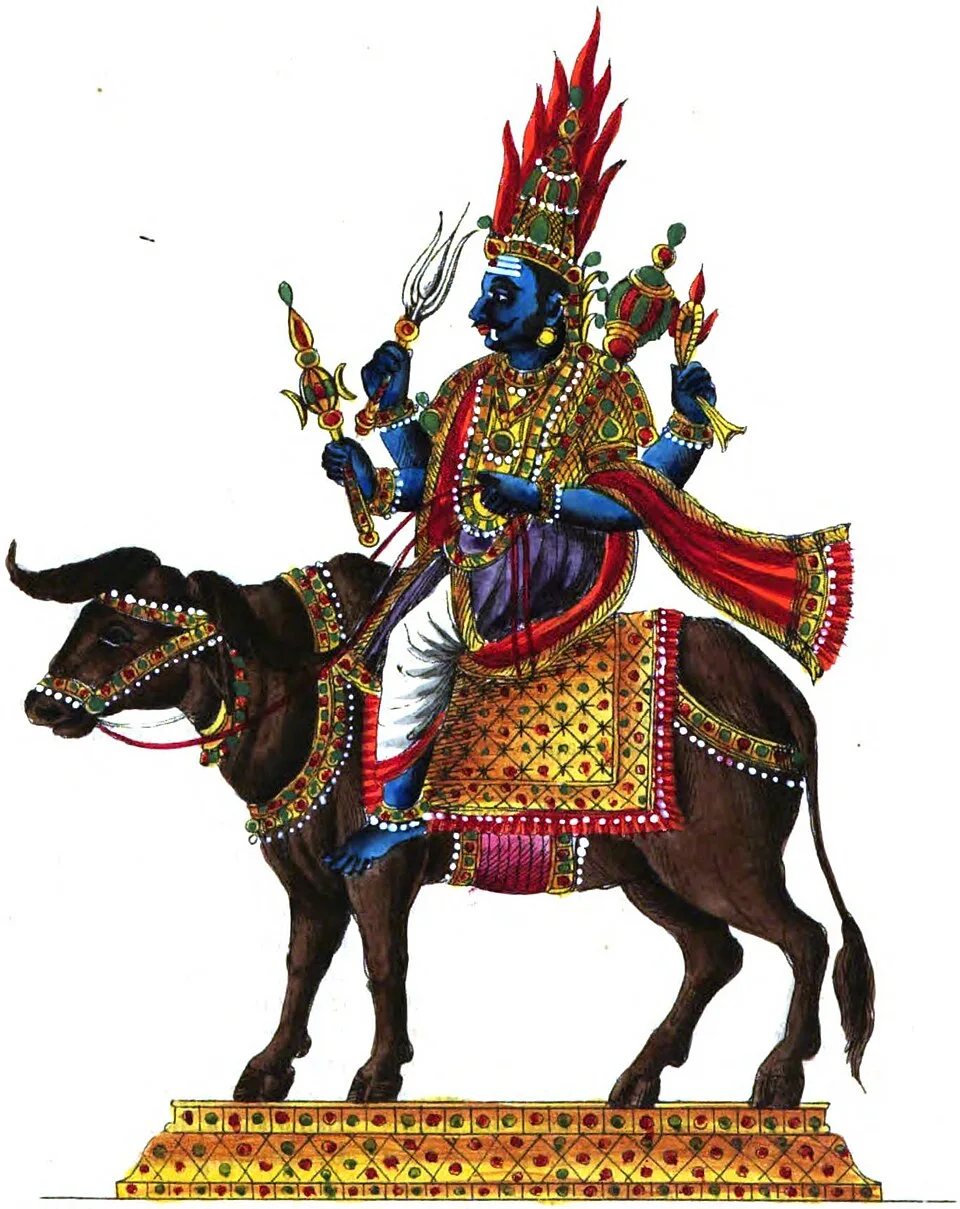
Yama
Buddhist · deity · mythic · Recorded classification
Buddhist lord of death and sovereign of the naraka realms who questions the dead about the divine messengers; their fate is the result of their own karma. A dharmapāla in Tibetan tradition (see Shinje).
Domains
- realm of the dead naraka
- judgement of the departed
Powers
- Interrogate the dead on the divine messengers
- Consign beings to their karmic destination
Epithets
- यमराज King Yama, lord and judge of the hell-realmsDevadūta Sutta, Majjhima Nikāya 130 (Yama and the divine messengers) (primary)
- 閻魔 Yama as judge of the dead; East Asian Buddhist formJapanese Buddhist tradition; Jūō (Ten Kings of Hell) cult (secondary)
- 閻羅王 King Yama, sovereign of the underworld courtsScripture of the Ten Kings (十王經); Chinese Buddhist underworld tradition (primary)
- धर्मराज King of the Dharma/LawYama Dharmarāja tradition (Tibetan Buddhism) (secondary)
Relations
- syncretism: YamaThe Vedic first-mortal and king of the fathers is absorbed as overseer of the narakas who interrogates the dead about the divine messengers; judgment becomes karmic display, and Yama himself is a being awaiting release.Devadūta Sutta, Majjhima Nikāya 130; cf. Ṛgveda 10.14 for the Vedic figure (primary); Alex Wayman, 'Studies in Yama and Māra', Indo-Iranian Journal 3 (1959) (secondary)
- equated with: ShinjeReciprocal of tibetan_shinje.equated-with — gShin-rje is the Tibetan Yama: lord of the dead and judge translated wholesale, then re-cast as the tamed dharmapāla Kālarūpa/Dharmarāja, subdued by Mañjuśrī-Yamāntaka — a protector role beyond the Indian canon's Yama.René de Nebesky-Wojkowitz, Oracles and Demons of Tibet (1956), ch. on gShin-rje; D. Snellgrove, Indo-Tibetan Buddhism (1987) (secondary)
Sources
- existence: Pali Canon, Devadūta-sutta (MN 130), Majjhima Nikāya (primary)