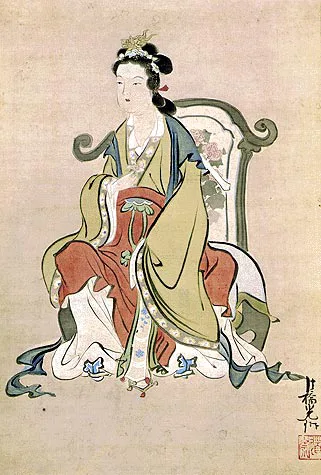
Xiwangmu
Goddess of Mount Kunlun in the western mythological geography; goddess of immortality, fertility, and longevity; controller of the peaches of immortality (pantao) that grow on the cosmic Mount Kunlun and ripen every 3,000 years. The figure exhibits one of the most-distinctive iconographic transformations in Chinese mythology: in the earliest strata (Shanhaijing, c. 4th-3rd c. BCE), Xiwangmu is depicted in semi-bestial form (tiger-teeth, leopard-tail, jade-piped voice, dishevelled hair); in the later Han-Tang strata, she is rationalized into the imperial-court-style Queen Mother figure presiding over the peach-of-immortality banquets. The transformation reflects the broader Han-period rationalization of pre-Han mythological material into the imperial-bureaucratic-cosmological framework. The Tang-Song-period peach-of-immortality banquet narrative — at which Xiwangmu hosts the celestial gods at her Mount Kunlun palace and serves the peaches that ripen every 3,000 years — became a foundational topos of Chinese literature, painting, and theater (notably the Sun Wukong / Journey to the West episode in which Sun Wukong steals the peaches). Some scholars (Cahill 1993) connect the figure to broader Inner Asian-Eurasian goddess complexes (Saka/Scythian goddess parallels), reflecting potential Bronze-Age cultural-contact substrate.
Powers
- Keeps the elixir of immortality
- Presides over the calamities of heaven
- Governs the five destructive forces (punishments)
- Whistles/howls with beastly cry
Epithets
- 西王母 Queen Mother of the West, goddess of Mount Kunlun and immortalityShanhaijing 山海經 (Classic of Mountains and Seas); Mu Tianzi Zhuan 穆天子傳 (primary)
- 瑤池金母 Golden Mother of the Jade Pond; her Daoist temple titleDaoist liturgical tradition; the Yáochí (Jasper Pool) peach-banquet myth (secondary)
- 王母娘娘 Royal Mother, the Lady-Queen; popular devotional nameChinese folk religion; popular cult of the Queen Mother (secondary)
Relations
- spouse: Jade EmperorLate popular/Journey-to-the-West identification of Xiwangmu as Wangmu Niangniang, consort of the Jade Emperor; her classical consort Dongwanggong is not in registry.Wu Cheng'en, Journey to the West (Xiyouji), ch. 5 (Peach Banquet of the Queen Mother) (primary); Cahill, Transcendence and Divine Passion: The Queen Mother of the West in Medieval China (1993) (secondary)
Sources
- existence: Shanhaijing / Classic of Mountains and Seas (compiled 4th c. BCE-1st c. CE) (primary); Mu Tianzi Zhuan / Tale of King Mu (4th c. BCE) (primary); Han-period stone reliefs depicting Xiwangmu (primary); Suzanne Cahill, Transcendence and Divine Passion: The Queen Mother of the West in Medieval China (1993) (secondary)