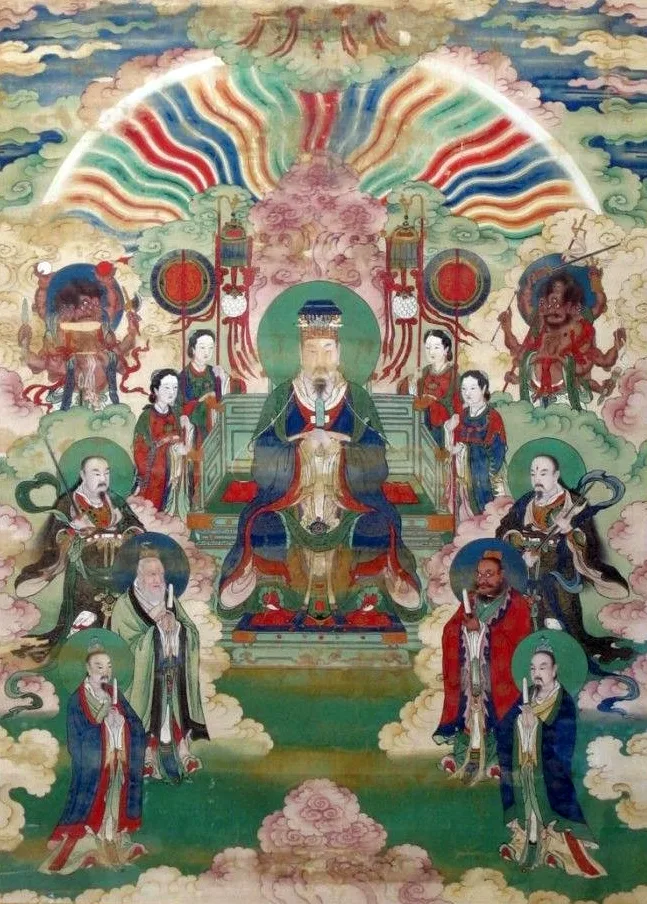
Jade Emperor
Supreme deity of the folk-Daoist pantheon; Lord of Heaven in the institutionalized Tang-Song imperial-state religious framework. The Jade Emperor presides over the celestial bureaucracy that mirrors the imperial-state administration — Heaven's Court is structured as the Chinese imperial bureaucracy with celestial officials, regional administrators, and ranked deities reporting to the Jade Emperor. Tang-period institutionalization by Emperor Xuanzong (713-756 CE) elevated the figure from local-folk-religion to imperial-state pantheon supremacy; the Song-period elaborated the celestial-bureaucracy framework. The Jade Emperor's birthday on the 9th day of the 1st lunar month (Tian Gong Sheng) is one of the major festivals of the Chinese folk-Daoist calendar, widely observed in Taiwan, Singapore, Malaysia, and other diaspora communities. The figure exists in productive tension with the older Heaven (Tian) abstraction of the Zhou-Confucian frame and with the Three-Pure-Ones (San Qing) Daoist-cosmological-supreme triad — the Jade Emperor is supreme in folk-Daoist pantheonic-administrative practice while the Three-Pure-Ones are theologically-cosmologically prior in formal Daoist theology.
Parentage
Recorded default; alternative parentage accounts are listed separately below.
No parents recorded in the default.
Parentage accounts
Each account is a separate source claim. The parentage and children listed outside these accounts use the recorded default. Selecting an account in the interactive app updates its lineage, descent classification and inherited-power candidates. Linked pedigree accounts are selected together; other records retain their recorded parentage. Claims of ancestry are not proof of biological descent or attested powers.
- Jade Emperor scripture: princely manifestation
deity by descent in this account.
- father: JingdeGaoshang Yuhuang benxing jijing, upper scroll, Qingwei tiangong shentong pin 1, Jingde and Baoyueguang narrative (primary)
- mother: BaoyueguangGaoshang Yuhuang benxing jijing, upper scroll, Qingwei tiangong shentong pin 1, Jingde and Baoyueguang narrative (primary)
Children
Names and tradition associations
- Śakra Gaoshang Yuhuang benxing jijing, upper scroll, Qingwei tiangong shentong pin 1, Jingde and Baoyueguang narrative (primary)
Variant accounts
- Manifestation and cultivationThe scripture narrates a prince born after the queen’s dream, his abdication and long cultivation. It also describes the deity’s enduring Dao body; the human-birth story is an account of manifestation.Gaoshang Yuhuang benxing jijing, upper scroll, Qingwei tiangong shentong pin 1, Jingde and Baoyueguang narrative (primary)
- source review correctionReplace unconditional equivalence with the source-bounded relationship status.Gaoshang Yuhuang benxing jijing, upper scroll, Qingwei tiangong shentong pin 1, Jingde and Baoyueguang narrative (primary)
Powers
- Commands the celestial bureaucracy of gods
Epithets
- 玉皇大帝 Jade August Great Emperor; supreme sovereign of HeavenSong-dynasty state canonization; M. Strickmann & official Daoist liturgy (secondary)
- 昊天金闕無上至尊自然妙有彌羅至真玉皇上帝 Full canonized title bestowed by Emperor Huizong (Song) in 1116Song shi 宋史 (History of Song), ritual treatises; Huizong's 1116 edict (primary)
- 玉皇上帝 Jade August Supreme Lord; the Tang-Song imperial formTang-Song state religion; identification with Shangdi (高上玉皇) (secondary)
- 天公 The Lord of Heaven; popular Hokkien/folk nameSouthern Chinese folk religion; the Tiāngōng-shēng birthday observance (9th day, 1st lunar month) (secondary)
Relations
- sibling: YaojiHis sister Yaoji (Yúnhuá), whose son by a mortal is Erlang Shen — the Heavenly Court's nephew.Investiture of the Gods (Fengshen Yanyi); Erlang Baojuan (primary)
- disputed identification: ŚakraThe legacy equation is not established by the reviewed scripture; its Maspero passage remains unverified.Gaoshang Yuhuang benxing jijing, upper scroll, Qingwei tiangong shentong pin 1, Jingde and Baoyueguang narrative (primary)
- spouse: XiwangmuReciprocal of chinese_xiwangmu.spouse — Late popular/Journey-to-the-West identification of Xiwangmu as Wangmu Niangniang, consort of the Jade Emperor; her classical consort Dongwanggong is not in registry.Wu Cheng'en, Journey to the West (Xiyouji), ch. 5 (Peach Banquet of the Queen Mother) (primary); Cahill, Transcendence and Divine Passion: The Queen Mother of the West in Medieval China (1993) (secondary)
Sources
- existence: Daozang (Daoist Canon) (primary); Tang-Song imperial-state-cult institutionalization records (primary); Livia Kohn, ed., Daoism Handbook (2000) (secondary)