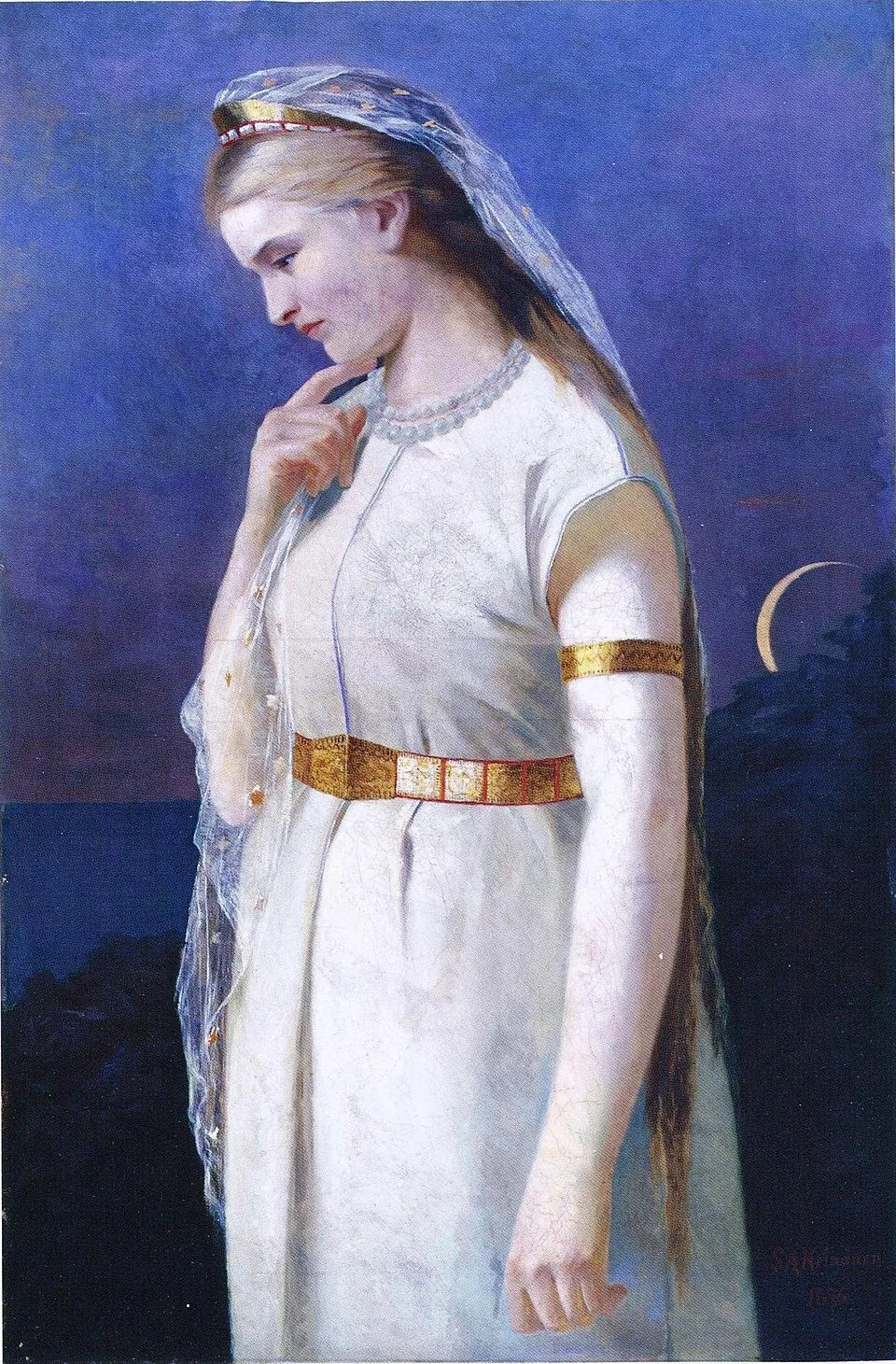
Aino
Tragic maiden of the Kalevala; sister of Joukahainen (the young Karelian sage who challenged Väinämöinen to the singing-contest of Runo 3). When Joukahainen was sung into a swamp by Väinämöinen during the canonical singing-contest, in desperation pledged his sister Aino as marriage-payment to the old sage in exchange for being released — the canonical sister-as-property bride-pledge that became the foundational tragic-precondition of her subsequent narrative. On learning of the marriage-pledge, Aino fell into deep mourning, weeping inconsolably and rejecting all the marriage-preparations urged on her by her mother (Runo 4 — one of the most-poignant lyric passages of the Kalevala). Walked to the seashore; removed her clothing on the rocks; entered the water and swam out to a great rock in the sea; sat upon the rock; sang her death-song; and sank into the sea, drowning herself rather than marry Väinämöinen (Runo 5). After her death, was transformed (per some recensions) into a salmon. When Väinämöinen subsequently fished for her in the sea, caught her in fish-form but did not recognize her until after she had escaped his net forever, making the Aino-as-uncaught-fish-of-recognition the foundational lost-love tragic-tableau of the Kalevala. Akseli Gallen-Kallela's Aino Triptych (1891, Ateneum Museum Helsinki) — depicting Aino as fish caught by Väinämöinen, Aino mourning before her mother, and Aino entering the sea — is the foundational visual depiction of the Aino-narrative and one of the iconic works of late-19th-c. Finnish national-romantic painting. The name Aino ("the Only One, the Unique One") has been continuously popular in modern Finnish-female naming since the 19th-c. national-romantic period and remains one of the most-common Finnish female given-names — the foundational tragic-maiden figure subsequently inverted into a positive-affirmative naming-tradition.
Powers
- drowns and becomes a maiden of Vellamo, taking salmon-form
- Turns into a salmon and slips from Väinämöinen's grasp
Epithets
- Vellamon neiti 'maiden of Vellamo' — what she becomes among the water-spiritsKalevala (Lönnrot), Runo 5 (primary)
Relations
- sibling: Joukahainen
- lover: VäinämöinenPledged to the old sage by her brother's rash oath; she refused the match and drowned, mocking him afterward as a fish in his net.Kalevala (Lonnrot 1849), Runos 3-5 (primary)
Sources
- existence: Kalevala Runos 3-5 (Lönnrot 1835/1849) (primary); Akseli Gallen-Kallela, Aino Triptych (1891), Ateneum Museum Helsinki (archaeological); Kuusi, Finnish Folk Poetry: Epic (1977) — analysis of the Aino-narrative (secondary)