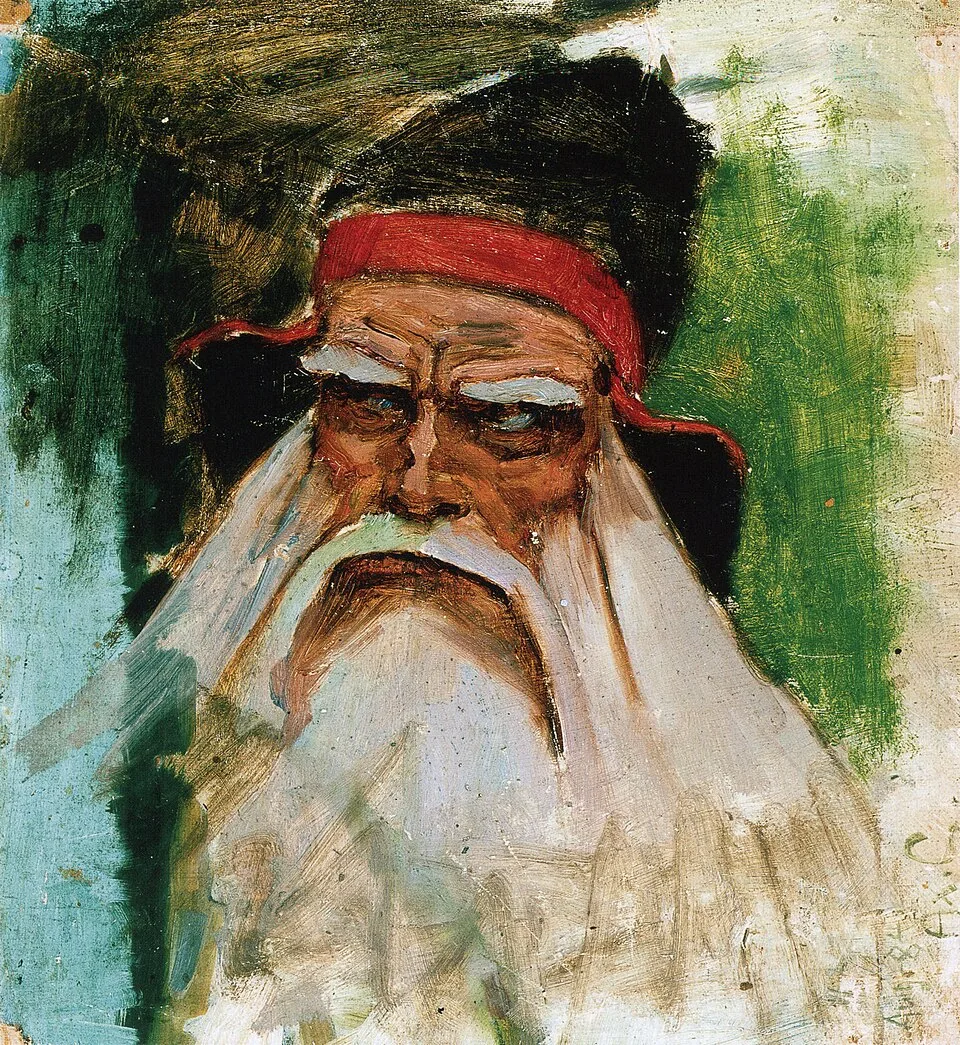
Väinämöinen
Central figure of the Kalevala; foundational sage-shaman-poet of the Finnish-Karelian oral-epic tradition. Born to the cosmic-primordial-mother Ilmatar (the air-spirit-virgin who descended into the sea and became impregnated by the wind and waves) at the cosmogonic emergence of the Kalevala-cosmos; spent thirty additional years in his mother's womb before emerging as a fully-grown sage. parentIds=[] per registry conventions for cosmic-emergence figures. Canonical deeds include singing the world into ordered form (Runo 2), the singing-contest with Joukahainen (Runo 3), the courtship of Aino (Runo 4-5), the descent to Tuonela seeking the words of magic (Runo 16), the Sampo-commissioning to Ilmarinen (Runo 10), the canonical Sampo-recovery expedition (Runos 39-43), the composition of the kantele from the jawbone of a great pike (Runo 40), and the departure in his copper-boat at the rise of the Christian-era child-Jesus-figure born of Marjatta (Runo 50) — the canonical polytheistic-to-Christian transition narrative of the Kalevala. The kantele (5-stringed plucked harp) he composed remains the foundational Finnish musical-instrument and a central iconographic attribute. The "promised return when the Finnish people need him" preserves the broader Indo-European-and-Eurasian sleeping-king-and-savior-figure mythologem (Welsh Arthur, Norse Holger Danske, Armenian Mher the Younger), encoding Finnish national-cultural-identity anchors. The Akseli Gallen-Kallela painting "Väinämöinen's Departure" (1906) and Jean Sibelius's Kalevala-themed compositions (Kullervo Symphony 1892, Lemminkäinen Suite 1896, Pohjola's Daughter 1906, Tapiola 1926) established the late-19th-c. and early-20th-c. Finnish national-romantic artistic canon anchored in the Väinämöinen-figure.
Powers
- Sing magic into being
Epithets
- vaka vanha Väinämöinen Steadfast old Väinämöinen — his standing formulaic epithetKalevala (Lönnrot), recurring epithet-formula (primary); SKVR (Suomen Kansan Vanhat Runot) runo-corpus (primary)
- tietäjä iän-ikuinen The eternal sage / age-old knower-seerKalevala (Lönnrot), recurring epithet-formula (primary)
- laulaja iän-ikuinen The eternal singer / age-old singerKalevala (Lönnrot), Väinämöinen epithet-formula (primary)
Relations
- enemy: Joukahainen
- lover: AinoReciprocal of finnish_aino.lover — Pledged to the old sage by her brother's rash oath; she refused the match and drowned, mocking him afterward as a fish in his net.Kalevala (Lonnrot 1849), Runos 3-5 (primary)
- companion: LemminkäinenReciprocal of finnish_lemminkainen.companion — Joins the Sampo expedition as third hero and rouses Louhi's pursuit by singing on the homeward voyage.Kalevala (Lonnrot 1849), Runos 39-43 (primary)
- enemy: LempoReciprocal of finnish_lempo.enemy — With Hiisi he turns the axe in the sage's hand as he builds the boat, gashing his knee.Kalevala (Lonnrot 1849), Runo 8 (primary)
- enemy: LouhiReciprocal of finnish_louhi.enemy — After the Sampo raid the Mistress of Pohjola pursues him as a giant bird, then hides the sun and moon until forced to release them.Kalevala (Lonnrot 1849), Runos 43, 47-49 (primary)
- companion: Sampsa PellervoinenReciprocal of finnish_pellervoinen.companion — The slender sower who plants the forests and plant life at the sage's bidding when the bare world is first greened.Kalevala (Lonnrot 1849), Runo 2 (primary)
- descendant of: IlmatarBorn of the air-maiden Ilmatar after seven hundred years in her womb upon the primal sea; no father is named.Kalevala (Lonnrot 1849), Runo 1 (primary)
- companion: IlmarinenThe sage sends the smith to forge the Sampo and later sails with him to steal it back; rival suitors of the Maiden of Pohjola in Runos 18-19.Kalevala (Lonnrot 1849), Runos 10, 39-43 (primary)
- equated with: Väinämöinen the Eternal SageOne epic sage: Lönnrot's Kalevala Väinämöinen was compiled chiefly from Viena/Olonets Karelian singers' runos; the Karelian entry is the oral-corpus form, the Finnish one the national-romantic redaction.Suomen Kansan Vanhat Runot (SKVR) I, Viena Karelian epic runos (primary); A.-L. Siikala, Itämerensuomalaisten mytologia (2012) (secondary)
- equated with: Song GodDocumented literary derivation, not folk cognate: Faehlmann's song-god Vanemuine remakes Finnish Väinämöinen for Estonian pseudo-mythology (1840s); folklorists since Loorits flag the fabrication.F. R. Faehlmann, Esthnische Sagen (Verhandlungen der Gelehrten Estnischen Gesellschaft, 1840s) (primary); O. Loorits, Grundzüge des estnischen Volksglaubens (1949-57) (secondary)
Sources
- existence: Kalevala (compiled by Elias Lönnrot, 1st edition 1835, expanded final 1849 edition) (primary); Kanteletar (Lönnrot 1840-1841) (primary); Suomen Kansan Vanhat Runot (Old Songs of the Finnish People, 33-volume scholarly compilation 1908-1948) (primary); Kaarle Krohn, Kalevalan runojen historia (1903-1910) (secondary); Matti Kuusi, Finnish Folk Poetry: Epic (1977) (secondary)