Louhi
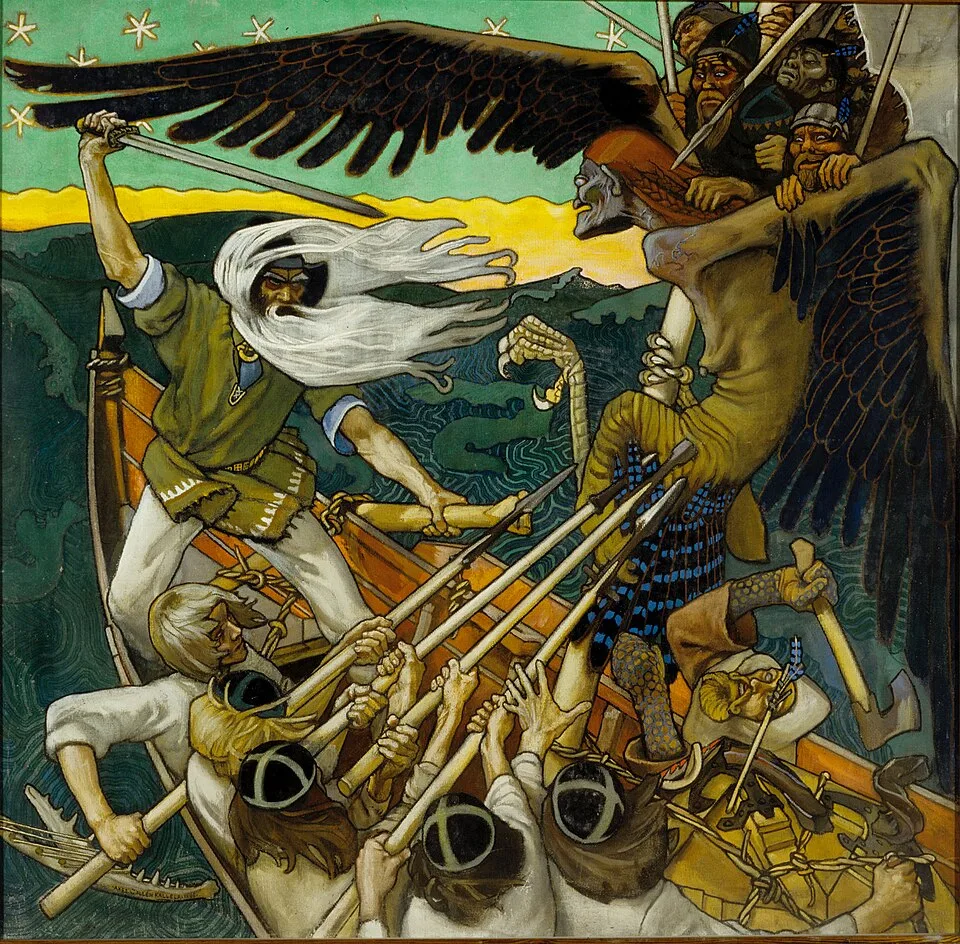
Mistress of Pohjola (the North-Land), the cosmological-counterpart-and-antagonist realm to Kalevala (the South-Land of the heroes); deity-tier sorceress with extensive shape-shifting and weather-controlling powers. Acquired the Sampo (the foundational Kalevala-magical-mill that produced grain, salt, and gold ad infinitum) by demanding it as bride-price for her daughter's hand from Ilmarinen the smith. Held the Sampo at her Pohjola fortress until Väinämöinen, Ilmarinen, and Lemminkäinen mounted the canonical Sampo-theft expedition; during the resulting battle on the open sea, the Sampo was shattered, with most of its fragments lost to the sea (per canonical-Karelian etiology, this is why the sea has salt and the land-pieces have variable agricultural-prosperity). During the Sampo-theft pursuit, Louhi shape-shifted into a giant eagle whose wings stretched across the sky — the canonical Louhi-as-eagle imagery is one of the most-iconic Kalevala visual scenes (Akseli Gallen-Kallela's 1896 painting "The Defense of the Sampo" depicts the eagle-Louhi pursuit and is one of the most-iconic Finnish national-romantic paintings). Subsequently inflicted plague and cold on Kalevala in retaliation. The Louhi-figure is structurally the most-developed female-antagonist-deity of the Kalevala, with the bride-quest, Sampo-acquisition-and-loss, and plague-retaliation arcs constituting major narrative-cycles of the epic.
Children
Powers
- Command weather and plague
- Shapeshift
Epithets
- Pohjolan emäntä Mistress/hostess of Pohjola (the North-Land)Kalevala (Lönnrot), recurring epithet for Louhi (primary)
Relations
- enemy: VäinämöinenAfter the Sampo raid the Mistress of Pohjola pursues him as a giant bird, then hides the sun and moon until forced to release them.Kalevala (Lonnrot 1849), Runos 43, 47-49 (primary)
- enemy: LemminkäinenHe storms her feast uninvited and kills Pohjola's master; she raises an army and sends the Frost against the rogue.Kalevala (Lonnrot 1849), Runos 26-30 (primary)
Sources
- existence: Elias Lönnrot, Kalevala (1849 New Kalevala) — multiple cantos (primary); Lauri Honko, Religion, Myth, and Folklore (1990) (secondary); Anna-Leena Siikala, Mythic Images and Shamanism (2002) (secondary)